
Getting VA Disability Compensation for Erectile Dysfunction


To get VA disability compensation for erectile dysfunction (ED), you must show the condition was at least as likely as not caused by service. If successful, VA will assign a rating. While ED without physical injury is typically rated 0 percent, which grants no monthly compensation, this opens the door for Special Monthly Compensation and for compensation for conditions potentially caused by ED (e.g., depression).
This article will describe:
- How to prove service connection for ED
- How ED is rated in the VA Schedule for Rating Disabilities
- Potential ways to get compensation even when ED is rated at 0 percent
Who We Are: Chisholm Chisholm & Kilpatrick (CCK Law) has argued many of the cases that have defined and clarified veterans disability law. CCK Law attorneys serve in leadership positions throughout the legal community and have posted more than 2,500 blogs and 1,100 videos about veterans benefits.
Watch CCK Law Partner Bradley Hennings break down how veterans can earn VA disability compensation for erectile dysfunction:

Service Connection: How Can I Prove Eligibility for VA Disability for Erectile Dysfunction?
To get VA disability benefits for erectile dysfunction, you must show that you developed the condition as a result of a specific event, illness, or injury that occurred during your military service. This is known as proving service connection.
Examples include (but are not limited to):
- A physical injury involving trauma to the genital region
- An event that caused psychological trauma resulting in the loss of sexual function
- Medication for service-connected anxiety that has the side effect of erectile dysfunction
There are two types of service connection: direct service connection and secondary service connection.
How Can I Prove Direct Service Connection for Erectile Dysfunction?
Direct service connection is when you can prove that your erectile dysfunction was directly caused by or worsened by your military service. To establish service connection for erectile dysfunction, you must provide proof of each of the following:
- A current diagnosis from a medical professional
- An injury, illness, or event that occurred during your military service
- A medical nexus (i.e., link) that demonstrates the cause-and-effect relationship between your ED diagnosis and the in-service event
Medical records and service records are usually the best forms of evidence to provide to ensure your VA claim is as strong as it can be. It may also help to provide lay statements, such as buddy statements from fellow veterans who witnessed your in-service injury, especially if there are gaps in your medical evidence.
When it comes to establishing the medical nexus, you should get a nexus letter describing your ED is “at least as likely as not” caused by the in-service injury or event. Here is what veterans should know about nexus letters:
- Nexus letters must be written by a qualified, licensed health care provider, including medical doctors (MD/DO), physician assistants (PA), nurse practitioners (NP), and psychologists.
- Veterans typically obtain these letters from their treating civilian physicians, local medical specialists, or independent medical evaluation companies that specialize in VA disability claims.
- While VA doctors are technically allowed to draft nexus letters, they almost never do.
How Can I Prove Secondary Service Connection for Erectile Dysfunction?
You may also be able to prove service connection for your erectile dysfunction on a secondary basis.
If you have already established a service-connected condition with VA — such as diabetes or prostate cancer — and that condition (or its treatment) goes on to cause or worsen your erectile dysfunction, you may be able to medically link your ED with that other condition and receive VA benefits for it. This is known as secondary service connection.
These are some conditions that can cause erectile dysfunction:
- Sleep apnea
- High blood pressure
- Anxiety
- Depression
- Obesity caused by a service-connected condition
- Post-traumatic stress disorder (PTSD)
- Multiple sclerosis
- Heart disease
- Parkinson’s disease
- Alcoholism
- Prostate cancer
- Diabetes
- Side effects of certain medications
If you already have a VA rating for any of the above conditions, you may be able to argue to VA that your erectile dysfunction is a result of this primary condition.
To prove secondary service connection, you typically need evidence of a primary service-connected condition and a medical opinion linking this primary condition to your ED.
What Are the Erectile Dysfunction VA Ratings?
VA rates erectile dysfunction under 38 CFR § 4.115b. Examples of erectile dysfunction-related listings include:
- Code 7520 — If doctors removed half or more than half of your penis, you receive a rating of 30 percent.
- Code 7521 — If doctors removed your glans, your rating is 20 percent.
- Code 7522 — If your penis cannot become erect, you receive a 0 percent rating.
- Code 7523 — If your ED is due to atrophied testicles, a condition often resulting in reduced testosterone and thus a lower sex drive, you receive a 20 percent rating if the condition affects both testicles, and a 0 percent rating if it affects only one testicle.
- Code 7524 — If you had both testicles removed due to a service-connected event, you receive a 30 percent rating; if you had one testicle removed due to a service-connected event, you receive a 0 percent rating.
In short, VA will generally grant a 0 percent rating for ED unless you have a physical injury. While a 0 percent rating grants no monthly compensation, there are actually multiple benefits that veterans can receive with a “noncompensable” rating.
In the video below, CCK Law Partner Christian McTarnaghan explains what veterans need to know about VA ratings for erectile dysfunction:
What Is the VA Disability Compensation for an Erectile Dysfunction VA Rating?
VA Disability Ratings of More Than Zero Percent
If your ED was caused by physical deformity/injury, then VA may assign a rating of more than zero, which entitles you to tax-free monthly compensation.
As of 2026, the VA disability rate benefit amounts are as follows:
- 0 percent disability rating: $0.00 per month
- 10 percent disability rating: $180.42 per month
- 20 percent disability rating: $356.66 per month
- 30 percent disability rating: $552.47 per month
- 40 percent disability rating: $795.84 per month
- 50 percent disability rating: $1,132.90 per month
- 60 percent disability rating: $1,435.02 per month
- 70 percent disability rating: $1,808.45 per month
- 80 percent disability rating: $2,102.15 per month
- 90 percent disability rating: $2,362.30 per month
- 100 percent disability rating: $3,938.58 per month
What Secondary Conditions Are Caused by Erectile Dysfunction?
If a veteran’s erectile dysfunction goes on to cause or worsen another condition, it may be possible to earn secondary service connection for that separate condition. This leads to another rating that is added to your existing rating (via VA math, which reduces additional ratings) and extra monthly compensation.
“For example, if your ED contributes to depression or anxiety, that condition may be its own service-connected disability,” says Bradley Hennings, partner at CCK Law. “And unlike erectile dysfunction, a mental health condition can carry a compensable rating.”
For example:
- Depression — Feelings of loss, inadequacy, or frustration stemming from ED can trigger or worsen clinical depression.
- Anxiety — Performance anxiety or general distress tied to sexual dysfunction can develop into a distinct secondary anxiety disorder
Mental health conditions receive a single mental health rating of up to 100 percent.
VA Special Monthly Compensation for Erectile Dysfunction: Can Veterans Get Compensation for 0% ED Ratings?
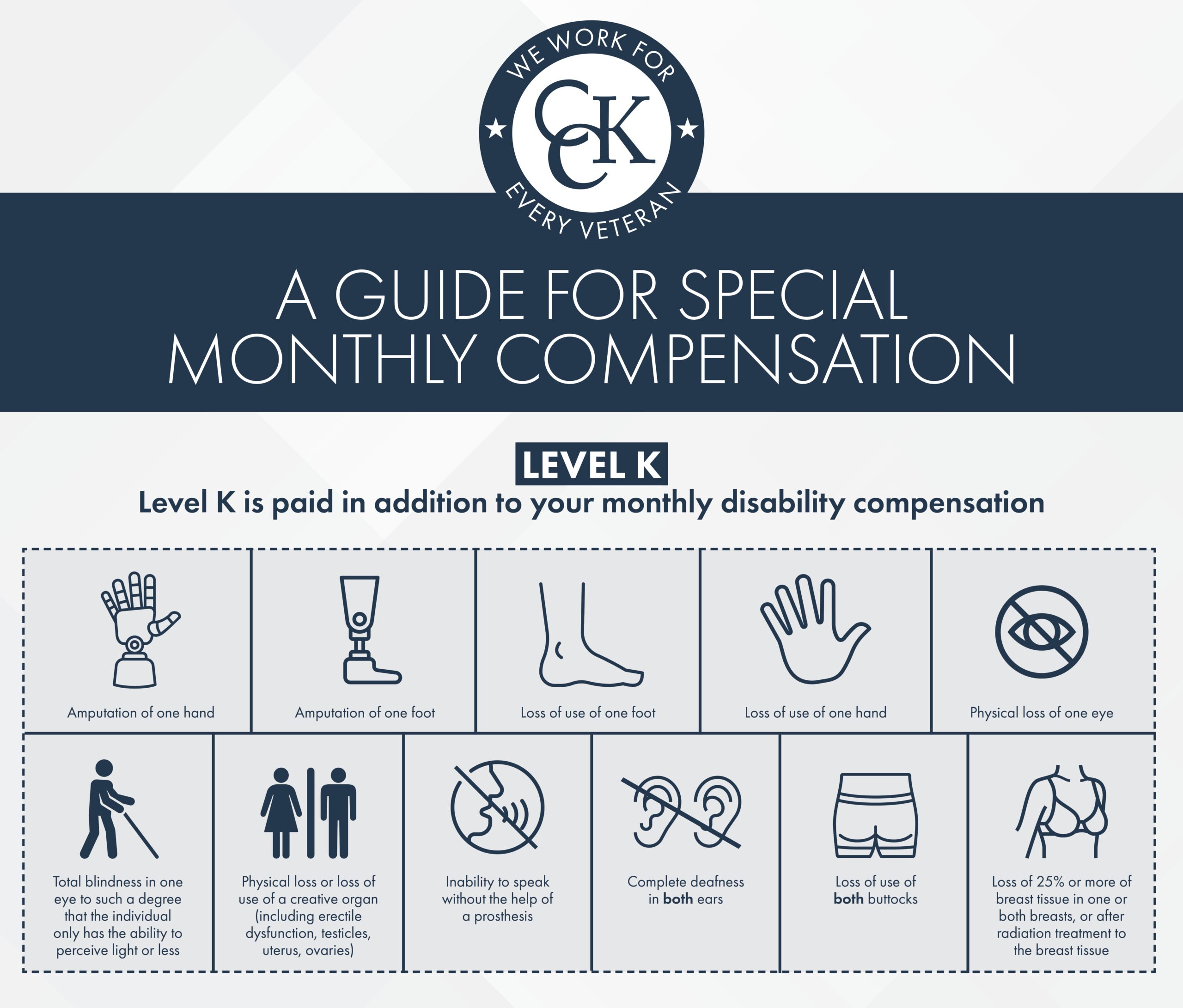
Special Monthly Compensation (SMC) is a type of financial benefit VA awards to veterans with specific or severe disabilities. Erectile dysfunction, even at 0 percent, may qualify for SMC Level K (also known as SMC(k)), for loss of use of a creative organ. Unlike most SMC levels, which replace regular VA compensation, Level K allows veterans to be compensated in addition to regular VA disability, as well as in addition to other SMC levels.
For 2026, SMC(k) compensation amounts to $139.87 per month, paid out in your monthly VA check.
“The footnote to diagnostic code 7522 directs VA to review every erectile dysfunction claim for this payment, but it still gets missed,” says Bradley Hennings. “So check your decision letter, and if it isn’t there, ask about it.”
Watch CCK Law VA-Accredited Claims Advocate Brandon Paiva explain the additional VA benefits available to veterans who qualify for SMC(k):

Did VA Deny Your ED Claim? Call CCK Law for a Free Case Evaluation
VA can apply erectile dysfunction rules inconsistently. If you disagree with a VA decision, the experienced and VA-accredited advocates at Chisholm Chisholm & Kilpatrick may be able to help. There are typically no attorney fees unless we win back pay. Call us today at (800) 544-9144 to discuss your case for free, or contact us online.
Frequently Asked Questions About VA Disability Compensation for Erectile Dysfunction
Is erectile dysfunction a compensable VA disability?
Erectile dysfunction usually receives a 0 percent, or noncompensable, rating because VA rates it by analogy to 38 CFR § 4.115b, Diagnostic Code 7522. Most veterans instead receive Special Monthly Compensation for the condition.
Can I get VA disability for erectile dysfunction caused by medication for a service-connected condition?
Yes. If medication for a service-connected condition, such as an antidepressant or a blood pressure drug, causes erectile dysfunction as a side effect, a veteran may establish secondary service connection. This claim generally requires a medical opinion linking the medication to the erectile dysfunction. The resulting benefit is often Special Monthly Compensation.
Does a 0 percent erectile dysfunction rating change my combined VA disability rating?
A 0 percent erectile dysfunction rating does not raise a combined VA disability rating, because noncompensable ratings add no value to VA combined-rating math. The practical benefit comes through Special Monthly Compensation under SMC(k), which VA pays on top of regular compensation for loss of use of a creative organ.
What should a veteran do if a VA decision does not mention SMC(k)?
A veteran whose decision omits SMC(k) may raise the issue with VA, because the rating schedule directs review of certain genitourinary codes for this benefit. Options include filing a Supplemental Claim or a Higher-Level Review. Reviewing the decision letter closely, and asking about SMC(k) directly, helps ensure the benefit is not missed.
Share this Graphic


