VA Disability Ratings for PTSD: Criteria, Compensation, and FAQs


Veterans living with post-traumatic stress disorder (PTSD) caused by military service are eligible for disability compensation from the Department of Veterans Affairs (VA). However, the amount of compensation they receive will depend on the condition’s severity and how it impacts the veteran’s ability to work.
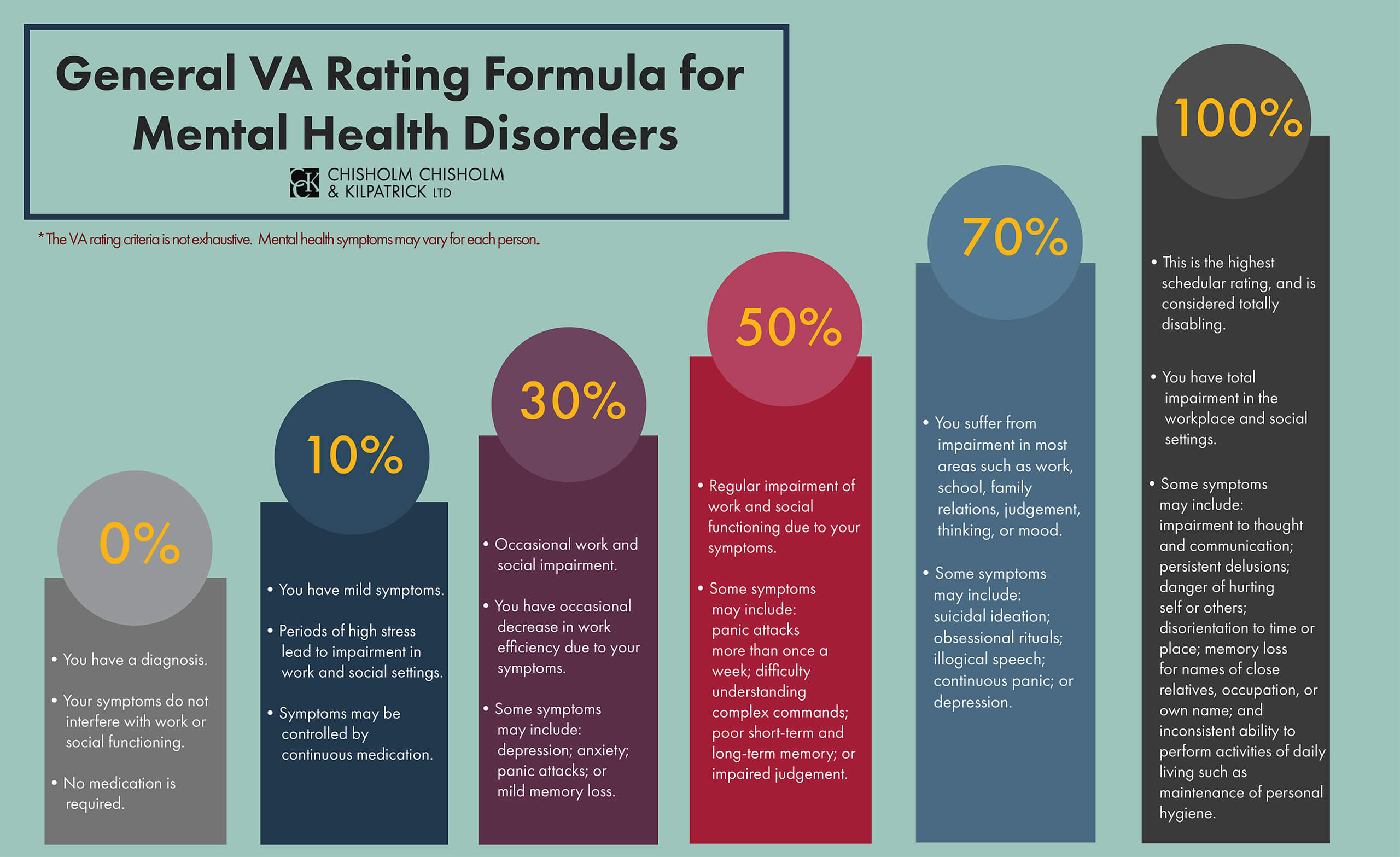
Currently, veterans can earn PTSD VA ratings of 0, 10, 30, 50, 70, or 100 percent. In this article, you will learn what each of these percentages means for compensation, how VA assigns each rating, and what to do if you get the wrong rating.
Key points of this article include:
- VA rates PTSD using its General Rating Formula for Mental Disorders, with possible percentages of 0, 10, 30, 50, 70, and 100 percent.
- To earn a PTSD VA rating, veterans must typically submit VA Form 21-526EZ and Form 21-0781. This second form provides the chance to describe the events or stressors that may have contributed to their condition.
- A 70 percent PTSD VA rating can be reached or increased in several ways, from appeals to increased-rating claims to individual unemployability.
Who We Are: Chisholm Chisholm & Kilpatrick (CCK Law) has argued many of the cases that define and clarify veterans disability law. Our attorneys serve in many leadership positions and have posted more than 2,500 blogs and 1,100 videos explaining veterans benefits. With 100+ individuals accredited by VA or admitted to practice before the U.S. Court of Appeals for Veterans Claims, CCK Law has recovered over $1 billion in compensation for 36,000+ clients since 1999. (Past results do not guarantee future outcomes.) Contact us to tell us about your case.
How Do Veterans Get PTSD VA Ratings?
The process of earning a PTSD VA rating typically includes the following steps:
- First, the veteran must file a PTSD disability claim by submitting VA Form 21-526EZ to VA through its website, the mail, or in person. They should also submit VA Form 21-0781, which allows them to include supporting evidence of their PTSD diagnosis, like potential causes or stressors.
- Next, VA usually orders a C&P exam to evaluate a veteran’s symptoms and the severity of their condition. During a C&P exam for PTSD, the examiner may determine whether the veteran’s PTSD is at least as likely as not related to their military service.
- After the C&P exam is complete, VA adjudicators will review it along with all the other evidence in the veteran’s claims file to establish possible service connection.
- If this is established, VA then rates the condition under 38 CFR § 4.130, Diagnostic Code 9411, the Schedule of Ratings for Mental Disorders. VA may also use criteria from the Diagnostic and Statistical Manual of Mental Disorders, Fifth Edition (DSM-5)to assess the claim.
- Once VA determines the severity of the veteran’s condition, they could be assigned a PTSD VA rating of 0, 10, 30, 50, 70, or 100 percent.
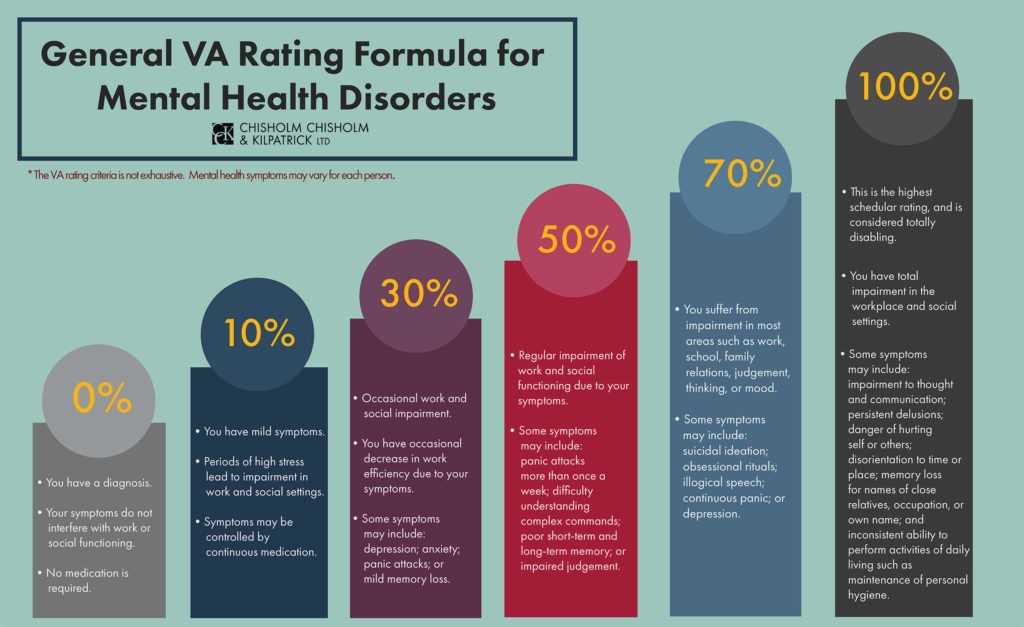
In the video below, CCK Law Partner Emma Peterson explains how veterans can determine whether their PTSD diagnosis may qualify them for a VA disability rating:
What Is the Compensation for a VA PTSD Rating?
The higher a veteran’s disability rating, the more they will receive in monthly compensation.
As of 2026, the VA disability rate benefit amounts are as follows:
- 0 percent disability rating: $0.00 per month
- 10 percent disability rating: $180.42 per month
- 20 percent disability rating: $356.66 per month
- 30 percent disability rating: $552.47 per month
- 40 percent disability rating: $795.84 per month
- 50 percent disability rating: $1,132.90 per month
- 60 percent disability rating: $1,435.02 per month
- 70 percent disability rating: $1,808.45 per month
- 80 percent disability rating: $2,102.15 per month
- 90 percent disability rating: $2,362.30 per month
- 100 percent disability rating: $3,938.58 per month
Additional Compensation for PTSD Veterans with Dependents
Veterans with conditions rated at least 30 percent disabling can qualify to receive additional benefits for dependents in their household, such as a spouse, child, or dependent parent. Even if a veteran already has a 100 percent rating and thus receives maximum compensation, they can receive additional compensation for dependents.
Additional Compensation for PTSD Veterans Who Cannot Hold Jobs
Veterans who have at least a 70 percent PTSD VA rating may find it significantly easier to prove a claim for total disability based on individual unemployability.
Additional Compensation for Veterans With Very Severe PTSD
Veterans with mental disorders that lead them to require Aid & Attendance (assistance with activities of daily living) or become housebound may also be able to earn Special Monthly Compensation, a VA benefit that can pay veterans at a rate higher than 100 percent.
What Is a 0 Percent PTSD VA Rating?
A 0 percent PTSD rating is the lowest possible rating on the PTSD rating scale. This rating will be assigned when:
- “A mental condition has been formally diagnosed, but symptoms are not severe enough either to interfere with occupational and social functioning or to require continuous medication.”
Importantly, 0 percent ratings are noncompensable, meaning the veterans will not receive VA disability compensation for a 0 percent PTSD rating. However, veterans can be eligible for other benefits from VA with a noncompensable rating.
What Is a 10 Percent PTSD VA Rating?
A 10 percent PTSD rating is the lowest compensable rating in VA’s rating criteria for mental disorders. The criteria describe very mild or well-controlled symptomology. When assigning a 10 percent PTSD rating, VA will look for:
- “Occupational and social impairment due to mild or transient symptoms which decrease work efficiency and ability to perform occupational tasks only during periods of significant stress, or symptoms controlled by continuous medication.”
In this case, a veteran may experience certain PTSD symptoms that are exacerbated during periods of stress but ultimately do not impair their ability to work in most occupations.
The increase in severity of PTSD symptoms during periods of stress implies that the symptoms tend to be episodic. This means symptoms are not always present and therefore do not significantly interfere with occupational and social functioning. Moreover, even when symptoms are present, it is likely that the veteran can control them with treatment or medication.
What Is a 30 Percent PTSD VA Rating?
The criteria for a 30 percent PTSD rating describe PTSD symptoms that are beginning to intrude on the veteran’s life despite their best efforts.
These criteria are as follows: “Occupational and social impairment with occasional decrease in work efficiency and intermittent periods of inability to perform occupational tasks (although generally functioning satisfactorily, with routine behavior, self-care, and conversation normal), due to such symptoms as:
- Depressed mood
- Anxiety
- Suspiciousness
- Panic attacks (weekly or less often)
- Chronic sleep impairment
- Mild memory loss (such as forgetting names, directions, recent events)”
“Occasional decrease in work efficiency and intermittent periods of inability to perform occupational tasks” might mean the veteran is starting to periodically miss work due to a lack of motivation associated with PTSD. However, the veteran’s PTSD does not fully prevent them from performing and succeeding in a work environment.
The veteran may experience symptoms such as depressed mood, anxiety, and panic attacks. This may cause them to occasionally isolate themselves but does not completely prohibit them from maintaining relationships with others.
Overall, a 30 percent PTSD rating is assigned when a veteran demonstrates symptoms in a discernable but intermittent manner over time.
What Is a 50 Percent PTSD VA Rating?
The 50 percent PTSD rating criteria involve an escalation in the frequency, duration, and severity of PTSD symptoms. The rating also considers several additional symptoms. If a veteran receives a 50 percent PTSD rating, they are likely beginning to display cognitive deficits such as difficulty following instructions, or they are making decisions that depart from past behavior.
The criteria for a 50 percent PTSD disability rating under 38 CFR § 4.130, Diagnostic Code 9411, are as follows: “Occupational and social impairment with reduced reliability and productivity due to such symptoms as:
- Flattened affect
- Circumstantial, circumlocutory, or stereotyped speech
- Panic attacks more than once a week
- Difficulty in understanding complex commands
- Impairment of short- and long-term memory (e.g., retention of only highly learned material, forgetting to complete tasks)
- Impaired judgment
- Impaired abstract thinking
- Disturbances of motivation and mood
- Difficulty in establishing and maintaining effective work and social relationships.”
Some of the mood-associated symptomology may also begin to manifest in physiological ways like flattened affect. For example, symptoms like depression and anxiety are causing the veteran to speak in a monotone and lack facial expressions.
The overall level of occupational and social impairment is also higher in a veteran assigned a 50 percent PTSD rating. The symptoms mentioned above are reducing the veteran’s ability to efficiently complete work-related tasks.
What Is a 70 Percent PTSD VA Rating?
A 70 percent PTSD disability rating is one step below the highest schedular rating for the condition. The key reason for most 70 percent PTSD ratings is that symptoms are causing significant levels of impairment, both occupationally and socially.
This rating is typically assigned to veterans with PTSD symptoms that are one step below totally disabling. The criteria for a 70 percent rating on the PTSD rating scale are as follows:
“Occupational and social impairment, with deficiencies in most areas, such as work, school, family relations, judgment, thinking, or mood, due to such symptoms as:
- Suicidal ideation
- Obsessional rituals which interfere with routine activities
- Speech intermittently illogical, obscure, or irrelevant
- Near-continuous panic or depression affecting the ability to function independently, appropriately, and effectively
- Impaired impulse control (such as unprovoked irritability with periods of violence)
- Spatial disorientation
- Neglect of personal appearance and hygiene
- Difficulty in adapting to stressful circumstances (including work or a work-like setting)
- Inability to establish and maintain effective relationships.”
Notably, the 70 percent disability rating criteria for PTSD include the widest array of symptoms of all rating levels. A veteran who receives a 70 percent PTSD rating may suffer from all the symptoms included in lower ratings and at a higher frequency, severity, and duration. The veteran may also be in a near-constant state of panic or depression that interferes with their ability to interact with others.
Learn more about 70 percent PTSD VA ratings at our dedicated page on the topic.
Watch CCK Law Partner Jenna Zellmer cover the basics of what a 70 percent PTSD rating entails:
What Is a 100 Percent PTSD VA Rating?
“The highest possible rating for PTSD is 100 percent,” says one VA-accredited claims advocate with CCK Law. “A 100 percent rating means that a veteran’s symptoms are so severe that they are totally impaired and unable to function in their daily life.”
While the symptoms listed in the 70 percent rating criteria also involve a high level of impairment, the jump to 100 percent is even more significant.
The criteria for a 100 percent PTSD rating are as follows: “Total occupational and social impairment, due to such symptoms as:
- Gross impairment in thought processes or communications
- Persistent delusions or hallucinations
- Grossly inappropriate behavior
- Persistent danger of hurting self or others
- Intermittent inability to perform activities of daily living (including maintenance of minimal personal hygiene)
- Disorientation to time or place
- Memory loss for names of close relatives, own occupation, or own name.”
The abovementioned symptoms represent a substantial decline in cognitive and emotional functioning compared to the rating criteria for lower percentages. Importantly, this decline results in a total impairment when it comes to a veteran’s work life and personal life.
Specifically, a veteran may experience hearing voices or perceiving things that are not actually present. Self-injurious behaviors and suicide attempts are also consistent with a 100 percent rating.
In addition to suicidality, a 100 percent on the PTSD rating scale can also include homicidal ideation, which means a veteran might have thoughts of harming others.
An “intermittent inability to perform activities of daily living” may be seen by a veteran feeling too depressed to get out of bed, take a shower, or change clothes. All these symptoms and behaviors are consistent with the highest level of impairment as reflected by the rating scale.
Due to the high level of symptom severity needed to meet this standard, 100 percent PTSD ratings are often difficult to obtain from VA, but the support and benefits may be crucial for a safe and productive life. CCK Law recommends contacting us for a free case evaluation if your claim is struggling.
Did VA Underrate or Deny Your PTSD Claim? Contact CCK Law
If you disagree with a VA decision, consider contacting Chisholm Chisholm & Kilpatrick. An experienced, VA-accredited law firm may offer significant tools and resources in support of your appeal.
While past results do not guarantee future outcomes, CCK Law has had favorable outcomes in 98.5% of its actions before VA and a 95% win rate before the U.S. Court of Appeals for Veterans Claims (federal court). We have recovered over $1 billion in compensation for 36,000+ clients to date.
Contact us online or at 800-544-9144 to tell us about your case.
More CCK Law PTSD Resources:
- Secondary Conditions to PTSD: Watch this video from three of CCK Law’s top accredited attorneys and agents about increasing your combined rating with secondary conditions caused by PTSD.
- PTSD Stressors: What VA Needs & How To Prove It: Unlike most mental health claims, PTSD requires proving a “stressor.” Learn how to overcome this hurdle.
- CCK VA Claim Builder tool: Use CCK Law’s free tool to help identify the forms, information, and additional benefits you need to be aware of when filing a claim.
- Free case evaluation: Struggling with this difficult type of claim? Contact CCK Law to tell us about your case.
Frequently Asked Questions About PTSD VA Ratings
Do veterans need to have all the symptoms listed to receive a PTSD rating?
No, they do not.
“Since mental health conditions like PTSD can manifest differently for everyone, VA’s Rating Formula for Mental Health Conditions isn’t binding,” says Dallas Aguiar, VA-accredited claims advocate at CCK Law. “The veteran doesn’t need to exhibit every single symptom listed in the rating criteria to receive that particular disability evaluation.”
In the case of Mauerhan v. Principi, the Court of Appeals for Veterans Claims (CAVC) established that the symptoms listed in Diagnostic Code 9411 (PTSD) are not intended to constitute an exhaustive list, but rather serve as examples of the type and degree of symptoms, or their effects, that would justify a particular rating.
For example, a veteran who only experiences suicidal ideation and near-continuous panic or depression might still receive a 70 percent PTSD disability rating.
What if a veteran’s symptoms are consistent with more than one PTSD rating?
Since PTSD is a complex condition and many symptoms in the rating criteria overlap, a veteran may not fall clearly into one percentage category.
Since it is not possible to split the difference between two ratings, VA must choose one to award. According to 38 CFR § 4.7, the higher evaluation should be assigned if the disability “more nearly approximates the criteria required for that rating.” Basically, having symptoms from a lower rating should not interfere with a veteran’s ability to get a higher rating.
Is PTSD an automatic 50% rating?
No. Many veterans have been led to believe that successful PTSD claims always receive an automatic 50 percent rating. This is not entirely accurate.
According to 38 CFR § 4.129, an automatic 50 percent rating will only be granted to veterans whose PTSD caused them to be discharged from military service, and this rating may only last for six months following the veteran’s separation from service.
After six months, VA will conduct a new PTSD evaluation to determine the veteran’s current condition. While it is possible the veteran will again be assigned a 50 percent rating for their PTSD, the rating could also be changed.
Can I get TDIU for PTSD?
If a veteran’s PTSD significantly impairs their ability to work, they may be eligible for a rating of Total Disability based on Individual Unemployability (TDIU) — a VA benefit that allows veterans to receive compensation at the 100 percent rate if their service-connected condition(s) prevent them from securing and maintaining substantially gainful employment.
What is the most common VA disability rating for PTSD?
Currently, the most common rating for veterans who receive VA disability for service-connected mental health conditions is 70 percent. The next-most common rating is 50 percent.
Need Immediate Help for PTSD? Contact VA’s Veterans Crisis Line
The Veterans Crisis Line is a 24/7 resource for veterans, service members, and their family members and friends. For assistance right now, use the confidential toll-free hotline, online chat, or text messaging service.
Veterans can access the Veterans Crisis Line in several ways, depending on preference:
- Dial 1-800-273-8255 and press 1.
- Send a text message to 838255.
- Start a confidential online chat session at VeteransCrisisLine.net/Chat.
- Locate a VA facility in your area.
- If you are an active duty service member, guardsman, or reservist, visit MilitaryCrisisLine.net.