
The Long-Term Disability Claim and Appeal Process

Filing a long-term disability (LTD) claim can be complicated. It starts when a person sends a “notice of claim” to their insurance company. The insurer then provides claim forms, which must be filled out and returned with supporting evidence. After reviewing everything, the insurer decides if the person meets the policy’s definition of disability and qualifies for benefits.
But the process often doesn’t end there. Many LTD claims are denied, and claimants may need to file an appeal, or even a lawsuit, to get their benefits. Knowing how the LTD claim and appeal process works can make it easier to secure the support they need.
In this article, CCK Law will discuss:
- The initial claim stage
- The administrative appeal stage
- The litigation stage, including both state and federal court lawsuits
- And more
Why Would Someone Need to File for Long-Term Disability Benefits?
Individuals typically seek long-term disability benefits when a severe illness or injury prevents them from working for an extended period.
Many conditions can qualify for such benefits, including:
- Cancer
- Osteoarthritis
- Depression and anxiety
- Parkinson’s disease
- Multiple sclerosis
- Fibromyalgia
- Orthopedic Issues
- And others
The above list is not exhaustive. Many conditions may qualify for LTD benefits, but claimants must prove to their insurers that their conditions disable them under the specific terms of their policies.
What Are the Three Stages of the LTD Claim and Appeal Process?

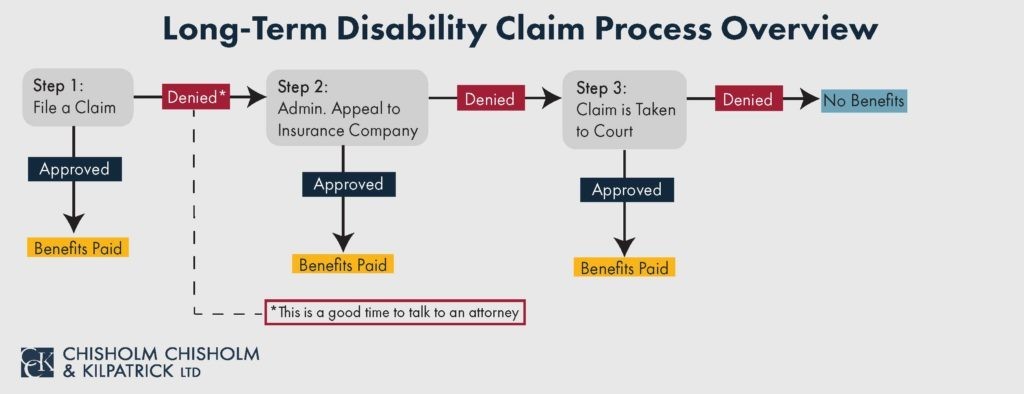
There are three stages of the LTD claim and appeal process. These stages are:
- The Initial Claim
- The Administrative Appeal
- Litigation
This article will summarize each of these stages, but be sure to check out each individual stage’s article for more information.
What is the Initial Claim?
The initial claim is the first stage of the LTD process. During this stage:
- The claimant sends their insurer a “notice of claim”
- The notice of claim initiates the process and notifies the insurer that the individual wishes to file a formal claim for benefits
- The insurance company sends claim forms to the claimant to complete
- Claimants gather evidence and submit it along with their claim forms to their insurer
- Insurers review all documentation and evidence
Common examples of evidence include:
- Detailed medical records
- Physician reports
- Witness statements
- Vocational evaluations
Additionally, when filing an LTD claim, it’s important to understand key rules and timelines:
- Know your deadlines: Missing a deadline could mean the insurance company denies your claim. Be sure to submit your notice of claim and proof of claim within the time limits in your policy.
- Understand decision timelines: For ERISA-governed claims, insurers generally have 45 days to issue a decision. They may also take up to two 30-day extensions in certain circumstances, meaning you could wait as long as 105 days.
- Be prepared to appeal: If the insurance company denies your initial claim, you have the right to file an administrative appeal.
- Stay in touch with your doctors: Keeping your doctors informed about your condition helps them provide strong medical statements to support your claim.

What is the Administrative Appeal?
If your initial LTD claim is denied, then the next step is the administrative appeal. Here’s what to know about this stage:
- Final chance to submit evidence: Under ERISA, the appeal is usually the last opportunity to add supporting evidence to your claim.
- Appeal deadlines: Claimants generally have 180 days to file an appeal.
- Key steps during this period:
- Read the denial letter carefully to understand the reasons for the denial, and
- Gather additional or updated evidence that directly addresses those reasons
- Consider legal help: The appeal stage is often the best time to contact an LTD attorney who can strengthen your appeal.
- Be prepared for another denial: Insurers can still deny appeals. If that happens, filing a lawsuit may be the next step.
What is Long-Term Disability Litigation?
Litigation differs based on the type of policy you have. Key differences include:
| State-Law-Governed LTD Claims | ERISA-Governed LTD Claims |
| May not require you to file an appeal before filing a lawsuit | Requires claimants to exhaust all appeals before filing a lawsuit. |
| Typically filed in state court | Typically filed in federal court |
| Subject to state law, not federal law | Subject to federal law, not state law |
| Deference is typically not shown to insurers | Deference often shown to insurers |
| Jury trials allowed | Typically, no jury trials; a judge alone rules on the case |
| New evidence may be presented | No new evidence may be submitted (except in rare cases) |
| Ability to sue for other damages may be allowed | May be only sue for benefits; claimants cannot seek extracontractual damages |
Note: Many lawsuits over LTD benefits do not make it to judgment. Insurers may offer a lump-sum settlement to resolve the dispute, though claimants are not required to accept such offers. Settlement offers should be carefully considered before acceptance, as insurers’ offers typically involve releasing all claims and other terms.
Other Considerations for Long-Term Disability Claimants
If you are considering an LTD claim, consider researching other aspects of the LTD claim and appeal process, like these:
- Receiving health insurance while on long-term disability
- The maximum benefit period
- The taxability of LTD benefits
- How Social Security Disability Insurance (SSDI) works with LTD
- What happens to LTD if an individual loses their job
- Offsets
- Surveillance tactics insurers use to deny claims
- Whether a person can work while receiving LTD
- And more
Frequently Asked Questions
How do I start a long-term disability claim?
To begin a claim, individuals must submit a “notice of claim” to their insurer. This notice formally notifies the insurance company of the claimant’s intent to file a claim for disability benefits. Once submitted, the insurer will send the claim forms to the claimant to complete.
What happens if the insurance company denies my LTD claim?
If the insurance company denies your initial claim, then you have the right to file an administrative appeal. The appeal process allows you to submit additional medical evidence, expert opinions, and other supporting documents to strengthen your case.
How long does the LTD appeal process take?
The timeline varies depending on the insurer and the complexity of the case. However, under ERISA, claimants typically have 180 days to submit their appeal. Moreover, insurers have 45 days to render a decision, though they can take up to two 30-day extensions.
Do I need a lawyer to handle my LTD claim or appeal?
You are not required to hire an attorney to help with your claim or appeal. However, many LTD claimants choose to do so, especially during the appeal stage. An experienced attorney can help build the strongest possible record and increase the likelihood of securing or reinstating benefits.
Need Help? Call CCK Law
The LTD claim process can be overwhelming, especially while managing a serious condition.
Chisholm Chisholm & Kilpatrick has:
- Over 25 years of experience
- Helped claimants at all stages—claims, appeals, and litigation
- Experience with all major insurers
Contact Us:
- Call (800) 544-9144 for a free case evaluation.
- Our team will review your case and determine how we can help.
Share this Graphic
