Veterans Age 75+: Important VA Benefits, Conditions & Challenges


The Department of Veterans Affairs (VA) offers many substantial disability benefits for veterans aged 75 and older. Due to a lack of information, however, many of these aging veterans often feel reluctant to pursue benefits that can be worthwhile both to them and to their families.
In this article, you will learn about the common types of conditions that impact veterans aged 75+, and what benefits they and their families can pursue to make their lives easier.
Key points of this article include:
- It is never too late to file an initial VA disability claim for benefits, and VA is generally prohibited from taking age into account when evaluating such a claim.
- Veterans 75 and older often suffer from age-worsened conditions that could qualify them for special benefits like Aid and Attendance or Housebound status.
- For the families of aging veterans, it could be worth considering Dependency and Indemnity Compensation (DIC) or accrued benefits if their veteran passes away.
Who We Are: Chisholm Chisholm & Kilpatrick (CCK Law) has argued many of the cases that define and clarify veterans disability law. Our attorneys serve in many leadership positions and have posted more than 2,500 blogs and 1,100 videos explaining veterans benefits. With 100+ individuals accredited by VA or admitted to practice before the U.S. Court of Appeals for Veterans Claims, CCK Law has recovered over $1 billion in compensation for 36,000+ clients since 1999. (Past results do not guarantee future outcomes.) Contact us to tell us about your case.
Watch CCK Law Partner Michael Lostritto and Supervising Attorney Alyse Phillips discuss why it is not too late for aging veterans to file disability claims with VA:
Is There an Age Limit To File a VA Claim?
No, under 38 CFR § 4.19, VA is typically prohibited from taking a veteran’s age into account when evaluating their disability claim.
“Age alone does not close doors on the merit of your claim,” says Maura Black, partner at CCK Law. “VA’s own rules explicitly state that age may not be used as a factor in rating service-connected disability limitations.”
There is no deadline or statute of limitations on when a veteran can file an initial disability claim. Even if several decades have passed, veterans are still entitled to pursue benefits for any disabilities they may have suffered as a result of their military service.
“It’s not too late to pursue benefits, no matter what age you are,” says Maura Black. “There’s no deadline for initial claims. You can start a claim as late in life as you want. The only downside of that is that you would miss out on the chance to enjoy an earlier effective date if your claims are granted, the longer you wait.”
What Conditions Often Affect Veterans 75 or Older?
Veterans aged 75+ often suffer from age-worsened conditions, as well as disabilities that cause separate, secondary conditions to develop. They may also be eligible for VA presumptions for conditions incurred as a result of toxic exposure to chemicals like Agent Orange.
- Age-worsened conditions — If a veteran has a service-connected disability that has become worse over time due to age (e.g., service-connected hearing loss), that veteran can pursue an increased rating claim to potentially earn greater monthly compensation for that condition.
- Secondary conditions — If a veteran’s service-connected condition has caused or worsened a new, separate condition (e.g., a veteran’s service-connected TBI now causing migraines), that veteran may be able to earn compensation for the new condition through secondary service connection.
- Presumptive conditions — Veterans who have served in particular times and regions may qualify to have their conditions automatically recognized as service connected by VA. These presumptive conditions often appear in veterans exposed to well-known toxins like Agent Orange (e.g., Parkinson’s disease or Type 2 diabetes).
In the video below, CCK Law Founding Partner Robert Chisholm explains how VA presumptive conditions affect older veterans:
What Disability Benefits and Tips Can Be More Relevant to Veterans Over 75?
| Benefit | Eligibility requirements | Evidence that can support claim | What it provides |
| Aid and Attendance | The veteran needs help with daily activities, or is bedridden | Physician statements on dressing, bathing, feeding, and safety | Higher compensation paid either through Special Monthly Compensation for a service-connected need; OR as an increased pension rate for a wartime veteran with limited income |
| Housebound | The veteran is substantially confined to the home by a disability, or meets required rating criteria | Rating history and medical statements on confinement | An added monthly amount above the base rate, available through Special Monthly Compensation; OR separately, as an increased pension rate |
| TDIU | Service-connected conditions rule out substantially gainful work | Medical records, work history, employer statements, vocational evidence | Monthly compensation at the 100 percent rate even where the combined rating is lower (more on TDIU) |
| Home and Community-Based Health Care | The veteran needs clinical or personal care at home or in a facility | VA health care enrollment and a clinical needs assessment | Health care services delivered either at home OR at an appropriate facility |
| Docket Advancement at the BVA | An appeal is pending at the Board and the veteran is 75 or older, seriously ill, or in severe financial hardship | Proof of age, a physician statement, or financial records | The appeal moves ahead of its place in line; it does not change the outcome, only the wait |
| DIC | A veteran dies from a rated condition, OR held a total rating for a qualifying period beforehand, OR meets other criteria | Death certificate, marriage or dependency records, rating history | Tax-free monthly payments to an eligible surviving spouse, child, or parent |
| Accrued Benefits | A veteran dies with benefits owed but unpaid, or with a claim still pending | Evidence already in the file at the date of death; proof of relationship | Payment of what VA owed the veteran at death. A survivor may instead request substitution to continue the pending claim, which allows new evidence |
Aid and Attendance (A&A) for Aging Veterans
Aid and Attendance (A&A) is a form of monthly compensation available to veterans who require the regular assistance of another person to perform essential daily activities like eating and bathing. Typically, A&A pays veterans at a higher rate than most schedular disability ratings would.
There are two pathways veterans can take to earn A&A:
- A&A from Special Monthly Compensation (SMC) — This pathway is for veterans whose service-connected conditions are the reason they need daily assistance. Veterans can earn several tiers of A&A through SMC, including SMC(l), SMC(r)(1), and SMC(r)(2). Of these tiers, SMC(l) provides the least A&A compensation, while SMC(r)(2) provides the most.
- A&A from VA Pension — This is a needs-based pathway to A&A, intended for veterans with lower income and qualifying wartime service. While veterans do not need a service-connected disability to qualify, it does pay less than A&A obtained through SMC.
Veterans typically cannot receive both SMC A&A and VA Pension A&A at the same time.
Housebound Status for Aging Veterans
Housebound status is a form of monthly compensation intended either for veterans whose disabilities generally confine them to their home, or those who meet certain rating criteria. Similar to A&A, it usually pays veterans at a higher rate than standard disability ratings do.
“Housebound does not necessarily mean you are bedridden or unable to physically leave your home,” says Maura Black. “You might also qualify for benefits at the rate for housebound if you have one condition rated as 100 percent disabling and another combined rating of at least 60 percent or more.” The two disabilities must be separate and distinct, meaning they involve different anatomy or body systems.
Just like A&A, veterans can pursue Housebound status either through SMC or through VA Pension:
- Housebound from SMC — Housebound status through SMC is referred to as SMC(s). It is generally reserved for veterans whose service-connected conditions leave them bound to their home (or who meet the rating criteria mentioned above).
- Housebound from VA Pension — Housebound status through VA Pension requires that the veteran be receiving VA Pension and that they spend most of their time in their house because of a permanent disability (though it does not have to be service connected).
Veterans should also note that they cannot receive Housebound compensation from SMC and VA Pension at the same time. They also cannot receive Housebound at the same time as Aid and Attendance (A&A).
Watch CCK Law Partner Maura Black break down benefits and conditions relevant to veterans 75 and older:
Total Disability Based on Individual Unemployability (TDIU)
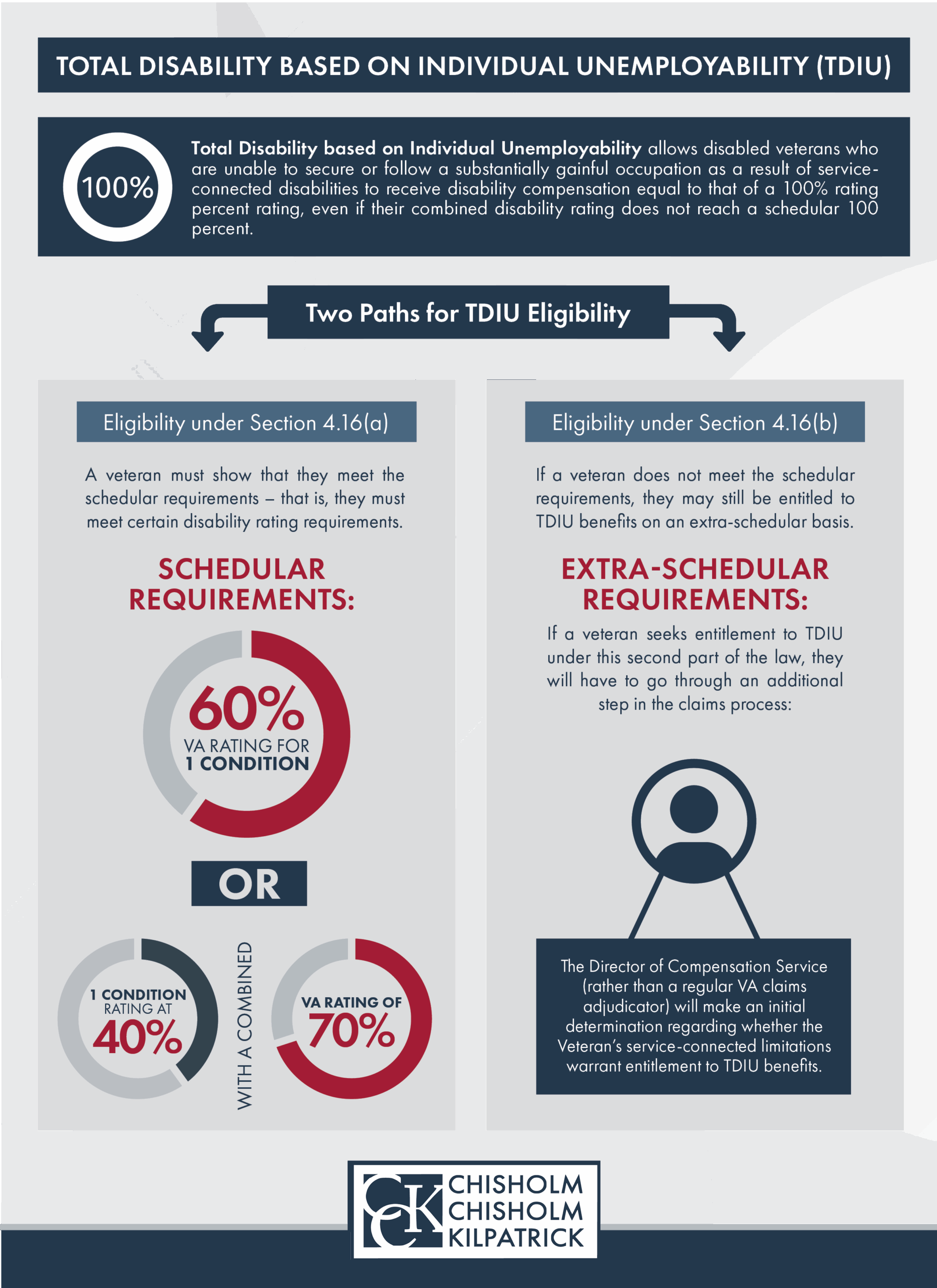
Total disability based on individual unemployability (TDIU) pays compensation at the 100 percent rate when service-connected disabilities keep a veteran from holding “substantially gainful” employment, even if the veteran’s combined rating is below 100 percent
This benefit is built for veterans whose service-connected conditions have made it severely difficult or impossible to support themselves through employment.
Just as in other types of disability claims, VA cannot count a veteran’s age against a TDIU claim, and being retired does not by itself take TDIU off the table.
This can work both for and against aging veterans: On one hand, a veteran can earn TDIU even if they actually retired years ago. On the other, if it is purely the veteran’s age that is preventing them from work (rather than their service-connected conditions), VA would be less likely to grant TDIU.
Home and Community-Based Health Care Benefits for Aging Veterans
For aging veterans, VA offers access to its Geriatrics and Extended Care Program, which provides health care options for veterans either directly within their home or in more community-based settings like assisted living facilities or adult family homes.
Some home and community-based health care benefits that veterans aged 75 and older might consider include:
- Skilled Home Health Care
- Home-Based Primary Care
- At-home telehealth appointments
- Community Living Centers
- Hospice care
Docket Advancement at the Board of Veterans’ Appeals (BVA) for Aging Veterans
Veterans aged 75 or older who are seeking to appeal their disability claim to the Board of Veterans’ Appeals (BVA) may also qualify to have their case prioritized on the BVA’s docket.
“That means that if you’re 75 or up, the Board will advance your Board appeal if you have one pending,” says Maura Black. “Given the backlogs and the delays at VA that cause extended wait times, the opportunity for advancement can be a huge plus.”
For aging veterans, this can cut down significantly on wait times and ensure their claim is heard and ruled on sooner than those of younger veterans.
Qualifying veterans can file a motion to advance their appeal on the BVA docket should the Board fail to advance them automatically.
What Benefits Should the Families of Veterans Over 75 Pursue?
Dependency and Indemnity Compensation (DIC)
Dependency and Indemnity Compensation (DIC) is a tax-free monthly payment to the surviving spouse, child, or parent of a veteran whose death is treated as service connected. This ordinarily means the veteran’s death occurred during service or resulted from a service-connected condition, though there are certain exceptions.
For a veteran weighing what a spouse or dependent will live on after the veteran passes, DIC can supply a measure of financial stability. Importantly, payment is not limited to the base rate, either.
“One thing to know about DIC in particular, is if a veteran is rated totally disabled for at least eight continuous years immediately before death and the spouse was married to the veteran throughout that period, their surviving spouse may qualify for an added amount of benefits,” says Maura Black. “The terms to research here are ‘VA DIC’ and ‘DIC enhanced rate.’ You’ll also sometimes see it referred to as the ‘kicker.’”
Further amounts may also be available for dependent children and for survivors who are Housebound or need Aid and Attendance.
Veterans and their families should be aware that eligibility for DIC is not automatic. Families planning around DIC should check the criteria that apply to their own situation rather than assume the benefit will be there.
VA Accrued Benefits and Substitution
If a veteran passes away while their claim is still pending, it does not mean the veteran’s claim simply ends there. Certain family members may be able to take up the claim and continue it as long as they do so within one year of the veteran’s passing.
“A surviving spouse or eligible dependent may be able to step into the veteran’s pending claim and continue prosecuting it,” says Maura Black. “If they win, they may be able to achieve back pay that the veteran would have earned had they continued living.”
This process is usually referred to as “substitution” and can be applied for using VA Form 21P-0847. Survivors whose substituted claims are successful can earn accrued benefits, a form of back pay that can contribute substantially to the financial stability of a family whose veteran has recently passed.
Did VA Deny Your Disability Claim? Contact CCK Law
If you disagree with a VA decision, consider contacting Chisholm Chisholm & Kilpatrick. An experienced, VA-accredited law firm may offer significant tools and resources in support of your appeal.
While past results do not guarantee future outcomes, CCK Law has had favorable outcomes in 98.5% of its actions before VA and a 95% win rate before the U.S. Court of Appeals for Veterans Claims (federal court). We have recovered over $1 billion in compensation for 36,000+ clients to date.
Contact us online or at 800-544-9144 to tell us about your case.
Frequently Asked Questions
Can I reopen a VA claim that was denied decades ago?
Yes. Under the modernized appeals system, there is no deadline for filing a Supplemental Claim, and VA will readjudicate the issue if the veteran submits new and relevant evidence. However, if a veteran files a Supplemental Claim more than one year after VA’s decision was made, their new effective date will generally be the date VA received the Supplemental Claim, which could affect back pay.
Does VA prioritize claims for veterans over 75?
That depends on where the claim is sitting. At a regional VA office, priority processing based on age alone begins at 85, requested on VA Form 20-10207. On the other hand, at the Board of Veterans’ Appeals, a veteran aged 75 or older can file a motion to advance the appeal on the Board’s docket.
Does VA disability get reduced or re-evaluated as I get older?
Age by itself is not a basis for reducing a rating, and VA regulations push in the opposite direction: Under 38 CFR § 3.327(b)(2), VA is not supposed to schedule routine future examinations for veterans over 55 except in unusual circumstances. There are other such rating protections for veterans who have held their ratings for a sufficient period of time. However, this does not always stop VA from mistakenly scheduling reevaluations for veterans whose ratings should be protected.
What if my service records are missing or were destroyed?
A missing file does not end a claim. Where federal records were lost — as happened in the 1973 fire at the National Personnel Records Center in St. Louis — VA has a heightened duty to assist, to search alternative sources, and to explain the loss to the veteran in writing. In cases like this, a veteran’s claim can sometimes be built on new or surviving records like buddy statements, unit morning reports, pay and treatment records, and a records search requested on NA Form 13055.
Can age-related conditions like hearing loss or arthritis be service-connected?
Yes, as long as the veteran can prove that the condition was somehow caused or worsened by their military service. In cases of age-related conditions, a denial usually rests on a VA examiner attributing the symptoms to normal aging, which can be countered with a medical nexus opinion explaining why service, rather than age, accounts for the condition.
Share this Graphic