VA Survivors Benefits: VA Benefits for Deceased Veterans’ Dependents


The U.S. Department of Veterans Affairs (VA) offers several survivors benefits to dependents of U.S. military veterans who have passed away. These include Dependency and Indemnity Compensation (DIC), VA Survivors Pension, educational assistance, and more.
In this article, you will learn more about these important benefits so you can determine whether you qualify for compensation or other forms of assistance.
Key points of this article include:
- VA provides several financial benefits to the survivors of deceased veterans, including a Survivors Pension, death gratuity, and more.
- There are also educational benefits available to a veteran’s survivors, including Dependents’ Educational Assistance (DEA) and the Fry Scholarship.
- Other survivor benefits offered by VA include burial benefits, health care, and home loan programs.
Who We Are: Chisholm Chisholm & Kilpatrick (CCK Law) has argued many of the cases that define and clarify veterans disability law. Our attorneys serve in many leadership positions and have posted more than 2,500 blogs and 1,100 videos explaining veterans benefits. With 100+ individuals accredited by VA or admitted to practice before the U.S. Court of Appeals for Veterans Claims, CCK Law has recovered over $1 billion in compensation for 36,000+ clients since 1999. (Past results do not guarantee future outcomes.) Contact us to tell us about your case.
Dependency and Indemnity Compensation (DIC): What Is It?
Dependency and Indemnity Compensation (DIC) is a monthly VA benefit paid to the surviving spouse, children, or sometimes dependent parents of a veteran who died of causes related to military service.
For surviving dependents to qualify for DIC, the veteran needs to meet at least one of the following criteria:
- The veteran passed away while on active duty, active duty training, or inactive duty training;
- The veteran passed away due to a service-connected condition; or
- If the veteran’s death was not service-related, but they received disability compensation for a service-connected condition considered totally disabling:
- For a period of at least 10 years prior to death; or
- Since separation from active duty, and for a period of at least five years prior to death; or
- For at least one year prior to death, if they were a former prisoner of war who died after September 30, 1999.
In addition to these criteria, for a veteran’s spouse to be eligible to collect DIC, the veteran must have had a discharge status other than Dishonorable, and their death cannot have been the result of their own willful misconduct.
Want to learn more about DIC? Watch CCK Law Partner Emma Peterson and colleagues discuss the essentials every survivor should know:
Surviving Spouse Eligibility
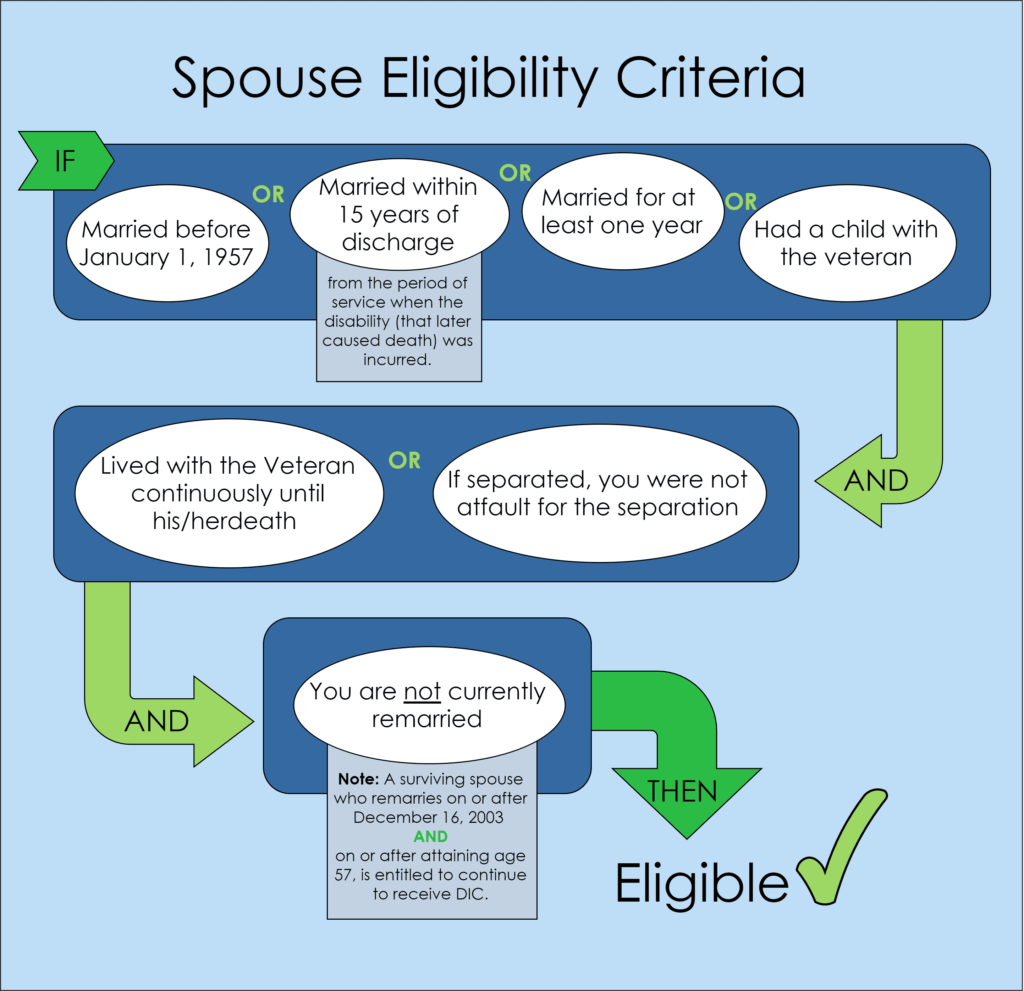
In addition to these requirements, a surviving spouse seeking DIC benefits typically should have been married to the veteran for at least one year prior to their death. Surviving partners who were not technically married to the veteran may also qualify for DIC benefits in certain circumstances:
- If the state’s laws allow for common law marriages; or
- If the veteran and surviving spouse share a child and either lived together continuously until the time of the veteran’s death or, if separated, the surviving spouse was not at fault for the separation.
A surviving spouse or partner must provide evidence that they meet these criteria.
DIC benefits may be suspended if a surviving spouse remarries after the veteran’s death. That is, unless the remarriage occurs after the spouse has reached one of the following ages:
- For remarriages occurring between December 16, 2003, and January 4, 2021, a surviving spouse must be 57 years old or older upon remarriage to continue collecting DIC benefits.
- For remarriages occurring on or after January 5, 2021, a surviving spouse must be 55 years or older upon remarriage to continue collecting DIC benefits.
Surviving Child Eligibility
A surviving child of the veteran may also receive DIC benefits, provided they meet VA’s criteria:
- The child is not married, and
- The child is not included in the surviving spouse’s compensation, and
- The child is under age 18 (or under 23 if attending school).
Surviving Parent Eligibility
A surviving parent of the veteran may be eligible for DIC benefits if the following is true:
- They are the biological, adoptive, or foster parent of the veteran; and
- Their income is within a certain income range.
VA DIC Benefit Rates
VA does not pay survivors the same monthly amount the veteran was receiving at the time of their death. Instead, DIC has its own exclusive rates, which change based on the annual cost-of-living adjustment (COLA).
For 2026, DIC pays a baseline monthly benefit of $1,699.36 to spouses or children of qualifying veterans, while eligible surviving parents are paid based on their income level and living situation.
Surviving dependents may also qualify for additional compensation provided they meet certain criteria. Some circumstances where additional compensation may be awarded include:
- Eight-year provision: If a deceased veteran had a 100 percent disability rating for at least eight years leading up to their death, and their spouse was married to them for those same eight years, the spouse may be eligible for additional compensation.
- Dependent children: Surviving spouses with dependent children may also be eligible for additional compensation for every dependent child they have.
- Transitional benefit: Surviving spouses with one or more dependent children under 18 years old may also qualify for a transitional benefit intended to provide additional, temporary support to adjust to life after their veteran’s passing. This support lasts for the first two years after the veteran’s death.
- Aid and Attendance: If a surviving spouse qualifies for aid and attendance, they may be eligible for additional compensation from VA.
- Housebound: If a surviving spouse is unable to leave their house due to a disability, they may also qualify for additional compensation.
As of 2026, the above situations can lead to the following amounts of additional compensation:
| Circumstance | Added Monthly Amount |
| Eight-year provision (see above) | +$360.85 |
| Each dependent child under age 18 | +$421.00 |
| Aid and Attendance | +$421.00 |
| Housebound | +$197.22 |
| Transitional benefit (children under 18 on award) | +$359.00 for first 2 years |
VA Survivors Pension: What Is It?
VA Survivors Pension is a monthly benefit paid to surviving spouses and unmarried dependent children of wartime veterans who meet certain income requirements set by Congress.
Surviving spouses who did not remarry after the veteran’s death may qualify for Survivors Pension, provided the deceased veteran meets the following VA requirements:
- For service on or before September 7, 1980, the veteran must have served at least 90 days of active military service, with at least one day during a wartime period (see below).
- For active duty after September 7, 1980, the veteran must have served at least 24 months or the full period for which they were called or ordered to active duty, with at least one day during a wartime period.
- The veteran was not dishonorably discharged.
To receive VA Survivors Pension as a dependent child, the surviving child must be unmarried and either under 18 years of age, under age 23 and attending a VA-approved school, or permanently incapable of self-support due to a disability incurred before age 18.
What Are Eligible Wartime Periods?
According to VA, eligible wartime periods include:
- Mexican Border Period (May 6, 1916–April 5, 1917)
- World War I (April 6, 1917–November 11, 1918)
- World War II (December 7, 1941–December 31, 1946)
- Korean conflict (June 17, 1950–January 31, 1955)
- Vietnam era (February 28, 1961–May 7, 1975, for veterans who served in the Republic of Vietnam during that period, otherwise August 5, 1964–May 7, 1975)
- Gulf War (August 2, 1990–a future date to be set by law or Presidential Proclamation)
What Is the Income Limit for VA Survivors Pension Benefits?
To qualify for VA Survivors Pension, surviving dependents must meet an income limit set by Congress, meaning the survivor’s yearly family income and assets must be less than a predetermined amount. The benefit paid to the survivor is the difference between their countable income and assets, and the annual pension limit.
Countable income includes earnings, disability and retirement, interest and dividends, and net income from a business, while assets include investments (i.e., stocks and bonds), furniture, boats, and property besides a primary residence.
As of December 1, 2025, the net worth annual pension limit is $163,699. This number is adjusted annually by VA.
VA Death Gratuity: What Is It?
“The death gratuity program provides a special tax-free payment of $100,000 to certain eligible survivors,” says Ethan Muckelbauer, attorney at CCK Law. “To qualify, the survivor’s service member must have died while either on active duty or up to 120 days after discharge, if the death was related to service.”
Provided by the Department of Defense, the goal of the death gratuity program is to provide a service member’s survivors with a lump sum of money to help them transition to life after their service member has passed away.
VA Accrued Benefits: What Are They?
If a veteran’s claim is still pending at the time of their passing, the surviving spouse may be substituted into the pending claim as the claimant. If service connection or an increased rating is later awarded, the surviving spouse will receive VA accrued benefits (i.e., the retroactive pay the veteran would have received if they were alive), up to the date of the veteran’s death.
Check out the video below to see CCK Law Senior Attorney Kaitlyn Degnan and colleagues discuss the ins and outs of accrued benefits:
Survivor Benefit Plan: What Is It?
The Survivor Benefit Plan (SBP) is a program that provides up to 55 percent of a veteran’s retirement pay to their designated beneficiaries upon the veteran’s death. Sponsored by the Department of Defense, this program automatically enrolls active duty service members, who can also purchase coverage upon retirement.
Dependents who can become beneficiaries of an SBP include:
- Surviving spouses and former spouses
- Children
- Disabled dependents
- Others of “natural insurable interest” (e.g., a veteran’s siblings) in cases where the deceased veteran has no spouse or children
How Do I Apply for VA Survivor Benefits?
To apply for VA survivor benefits (e.g., DIC, Survivors Pension, and Accrued Benefits), the surviving dependent should download and fill out VA Form 21P-534EZ. Once the form is complete, it can be submitted online, via mail, or in person at a VA regional office.
It is also important to note that VA survivors’ benefits are not taxable. VA Survivors Pension, Accrued Benefits, and DIC are all tax-free benefits that do not need to be included on a tax return. However, this does not apply to the Survivor Benefit Plan (SBP), the payments of which are considered taxable income.
Additional VA Survivor Benefits and How To Qualify
VA offers additional programs to surviving dependents of veterans. The compensation offered through these programs is intended for specific purposes, such as education, home loans, burial fees, and more.
Dependents’ Educational Assistance (DEA) Program: What Is It?
The Survivors’ and Dependents’ Educational Assistance (DEA) program, a part of the GI Bill, aims to offer education and training to eligible survivors and dependents of veterans who:
- Died while on active duty; or
- Passed away due to a service-connected disability; or
- Are currently permanently and totally disabled due to a service-connected condition(s).
The DEA program allows eligible students enrolled in the following programs to receive up to 36 months of financial assistance from VA:
- College, university, or other schooling
- Career training, licensing, and certification tests
- On-the-job training or apprenticeships
- Tutorial assistance
- Work-study
To apply for DEA benefits, VA requires eligible dependents and survivors to complete and submit VA Form 22-5490: Dependents’ Application for VA Education Benefits. Surviving spouses who qualify can collect DEA and DIC benefits at the same time.
Want to learn more about the financial benefits available to a veteran’s survivors? Watch this video of CCK Law attorneys Nick Scripter and Ethan Muckelbauer going over the most prominent survivor benefits:
Fry Scholarship: What Is It?
“Another potential education benefit is called the Fry Scholarship,” says Nick Scripter, appellate attorney at CCK Law. “This scholarship provides 100 percent tuition coverage, a housing stipend, and a book allowance for children and spouses of service members who died in the line of duty after 9/11.”
Financial benefits provided by the Fry Scholarship can last up to 36 months. Notably, if a dependent qualifies for both the DEA and the Fry Scholarship, they will have to choose only one, as they cannot receive both at the same time. They can be used one after the other, however, for a total of up to 48 months of educational benefits.
The Fry Scholarship is also available to dependents of veterans who died from a service-connected disability within 120 days of discharge from active duty, as well as to the dependents of qualifying service members of the Selected Reserve.
CHAMPVA Insurance: What Is It?
The Civilian Health and Medical Program of the Department of Veterans Affairs (CHAMPVA) is a health benefits program in which VA shares the cost of certain health care services and supplies with eligible surviving dependents.
CHAMPVA provides coverage to the spouse or widow and to the children of veterans. To qualify, the veterans must have:
- Been rated permanently and totally disabled due to a service-connected condition; or
- Been rated permanently and totally disabled due to a service-connected condition at the time of death; or
- Died of a service-connected condition; or
- Died on active duty and the dependents are not otherwise eligible for the Department of Defense’s TRICARE benefits.
To apply for CHAMPVA benefits, eligible beneficiaries should fill out VA Form 10-10d and submit it to VA. This form can be submitted either online through VA’s website or mailed to the VHA Office of Integrated Veteran Care.
Surviving spouses who remarry before age 55 no longer qualify for CHAMPVA benefits; however, if they remarry on or after their 55th birthday, they can continue their benefits. If the remarriage (prior to the age of 55) ends by death, divorce, or annulment, the surviving spouse may qualify again for CHAMPVA.
Home Loan Benefits for Surviving Spouses: What Are They?
A surviving spouse of a veteran may be eligible for VA home loan benefits, including guaranteed loans, refinancing, and loan modifications, as long as they obtain a Certificate of Eligibility (COE) to show their lender.
To qualify for a COE, the veteran must meet one of the following criteria:
- Is missing in action; or
- Is a prisoner of war (POW); or
- Died while in service or from a service-connected disability; or
- Had been totally disabled prior to death, but their disability may not have caused their death (in certain situations).
Additionally, if the veteran died while in service or from a service-connected disability, the surviving spouse could qualify for a COE if they did not remarry before age 57 or before December 16, 2003.
To secure the COE itself, the surviving spouse should complete and submit VA Form 26-1817 to their regional VA loan center.
Interested in additional survivor benefits offered by VA? Watch CCK Law attorneys Nick Scripter and Ethan Muckelbauer discuss the details of each:
Burial and Memorial Benefits: What Are They?
Eligible veterans and their spouses and dependents can be buried in one of the national cemeteries across the country that are maintained by VA. Burial benefits for veterans in these cemeteries are provided at no cost to the veteran’s family, and include:
- Opening and closing of the grave
- Perpetual care
- A government headstone or marker
- A burial flag
- A presidential memorial certificate
It is also important to remember that many states have their own veteran cemeteries and burial benefits available if they meet state residency requirements.
Veterans Burial Allowance
In addition to the above benefits, VA also offers a veterans burial allowance to help cover the costs of burial, funeral, and transportation. Surviving family members of a veteran may be eligible for a burial allowance if they are paying for the funeral and burial costs and will not be reimbursed by any other organization.
A surviving spouse, partner from a legal union, child, parent, or executor/administrator of the veteran’s estate can request the burial allowance by filling out and submitting VA Form 21P-530EZ.
To qualify, the veteran must meet at least one of the following conditions:
- The veteran’s death was the result of a service-connected disability.
- The veteran was receiving VA disability compensation or pension at the time of their death or was entitled to receive VA disability or pension but instead received their full military retirement or disability pay.
- The veteran’s death occurred while they were hospitalized by VA or while they were receiving care at a non-VA facility under VA contract.
- The veteran died while traveling under proper authorization and at VA expense to or from a specified place for the purpose of examination, treatment, or care.
- The veteran had a claim for VA compensation or pension pending at the time of death and would have been entitled to benefits prior to the date of death.
- The veteran died while a patient at a VA-approved state nursing home on or after October 9, 1996.
Watch CCK Law Partner Christian McTarnaghan discuss prominent burial benefits with VA-accredited Claims Advocates Kayla Rogers and Alexandra Gamache:
Denied VA Survivor Benefits? Contact CCK Law
If you disagree with a VA decision, consider contacting Chisholm Chisholm & Kilpatrick. An experienced, VA-accredited law firm may offer significant tools and resources in support of your appeal.
While past results do not guarantee future outcomes, CCK Law has had favorable outcomes in 98.5% of its actions before VA and a 95% win rate before the U.S. Court of Appeals for Veterans Claims (federal court). We have recovered over $1 billion in compensation for 36,000+ clients to date.
Contact us online or at 800-544-9144 to tell us about your case.
Frequently Asked Questions
What VA benefits does a surviving spouse get?
The surviving spouse of a deceased veteran may qualify for several prominent benefits, including:
- Dependency and Indemnity Compensation (DIC) if the veteran’s death was service related
- VA Survivors Pension if the veteran’s death was not service related
- Educational benefits (e.g., Dependents’ Educational Assistance or the Fry Scholarship)
- Health care benefits through programs like CHAMPVA
- Home loan benefits
- Burial and memorial benefits
How much are VA survivors benefits for 2026?
Dependency and Indemnity Compensation (DIC) is often awarded to the surviving dependents of deceased veterans, if the veteran’s death was service related.
For 2026, the DIC monthly payment rate for a surviving spouse without children is $1,699.36. This amount could increase for several reasons, however (e.g., if the surviving spouse has dependent children).
If the veteran’s death was not service related, survivors may be eligible for the VA Survivors Pension, the payment amounts of which vary significantly based on factors like income and net worth.
What form do I use for VA surviving spouse benefits?
Surviving spouses of disabled veterans should fill out and submit VA Form 21P-534EZ to potentially obtain Dependency and Indemnity Compensation (DIC), VA Survivors Pension, or accrued benefits owed to the veteran.
The fastest way to submit this form is through VA.gov, though sending it by mail can also work.