Complete 2025 Guide: VA Disability Ratings for Musculoskeletal Conditions
CCK Law: Our Vital Role in Veterans Law
Struggling to get VA disability compensation for your service-connected knee, back, shoulder, or hip condition? This comprehensive guide walks you through the VA ratings for musculoskeletal conditions, service connection requirements, and what to expect during your C&P exam.
Quick Start Guide: Get Your VA Musculoskeletal Benefits
Getting VA benefits for musculoskeletal conditions involves three key steps:
- File a Claim Establishing Service Connection — Prove your condition relates to military service
- Attend a C&P Exam — VA evaluates your condition severity
- Receive Your Rating — Get assigned percentage and monthly compensation
For the full, in-depth guide, keep reading below.
Introduction
With the physical demands of military life, musculoskeletal disorders are incredibly common among veterans. Whether you are dealing with chronic knee pain from years of rucking, back problems from heavy lifting, or shoulder issues from repetitive training, you are not alone.
If you developed a musculoskeletal condition during or after military service, you may be entitled to monthly compensation from the Department of Veterans Affairs (VA). This guide covers everything you need to know about getting the benefits you have earned.
What you will learn:
- How to prove your condition is service connected
- VA rating percentages for knee, hip, spine, and shoulder conditions
- What happens during your C&P exam
- Monthly payment amounts for 2026
- When and how to appeal a low rating
What Are Musculoskeletal Disorders?
A musculoskeletal disorder affects a veteran’s muscles, joints, bones, or connective tissues like ligaments and tendons. These conditions can develop from acute injuries (like a training accident) or from years of wear and tear on their body during military service.
Common Symptoms That Veterans Experience
Experiencing any of these symptoms as a result of service may be a sign that you are entitled to VA compensation and benefits.
- Pain that may worsen with activity or weather changes
- Swelling and stiffness, especially in the morning
- Reduced mobility that limits daily activities
- Weakness that affects a veteran’s ability to work or exercise
- Inflammation and tenderness around affected joints
- Unusual sounds during movement (popping, cracking, grinding)
- Fatigue from dealing with chronic pain
Musculoskeletal Disorders Common to Veterans
“Over the past five years, VA data shows that the musculoskeletal system has consistently been the bodily system with the most service-connected disabilities. As of 2024, more than 15.9 million veterans were receiving benefits for these conditions.” — Alyse Phillips, Supervising Attorney, CCK Law
Military service puts unique stress on your body. From basic training PT to combat operations, carrying heavy gear, and repetitive physical tasks, it is not surprising that so many veterans develop these conditions.
Joint Problems (Often causing pain and limiting motion)
- Knee conditions (one of the most common VA disability claims)
- Shoulder injuries from heavy lifting and repetitive motion
- Hip problems from long marches and awkward positions
- Ankle injuries from jumps, runs, and uneven terrain
- Elbow issues from push-ups, pull-ups, and equipment handling
Muscle Conditions (Ranging from mild to severe)
- Penetrating injuries: gunshot or shrapnel wounds
- Non-penetrating injuries: muscle tears, strains, and chronic pain
- Muscle weakness from nerve damage
Bone Conditions (From simple breaks to complex disorders)
- Fractures from training accidents or combat
- Osteoporosis from medication side effects or nutritional deficiencies
- Bone infections or nerve damage complications
Spine and Back Conditions (Among the most common veteran disabilities)
- Lower back pain from heavy lifting and poor sleeping conditions
- Neck problems from helmet wear and awkward positioning
- Disc problems from vehicle accidents or falls
- Spinal injuries from parachuting or combat operations
Amputations (Complete or partial limb loss)
- Combat-related amputations
- Medical amputations due to severe injuries or infections
- Partial amputations affecting fingers, toes, or limbs
How to Establish Service Connection for Musculoskeletal Disorders
Before VA will assign a veteran a disability rating and monthly compensation, the veteran must prove their musculoskeletal condition is connected to their military service. This is called establishing service connection, and there are two main ways to do it.
Direct Service Connection: “My Condition Started in Service”
Direct service connection means a veteran’s condition clearly links to something that happened during military service: i.e., either it started while they were serving, or their service made an existing condition worse.
The Three Requirements VA Looks For
- Current Medical Diagnosis
- The veteran needs a formal diagnosis from a qualified doctor, physician assistant, or nurse practitioner
- The diagnosis must be for a recognized musculoskeletal condition
- VA will accept diagnoses from private doctors, VA doctors, or C&P examiners
- Evidence of In-Service Event or Exposure
- This could be a specific injury (training accident, combat wound, vehicle crash)
- Or it could be gradual wear and tear from military activities (rucking, PT, heavy lifting)
- A veteran’s service treatment records are the best evidence, but buddy statements and personal testimony also help
- Medical Nexus Opinion
- A healthcare professional must provide a written statement saying the veteran’s condition is “at least as likely as not” (50 percent or more likely) related to their military service
- This is often called a “nexus letter” and is crucial for hard-to-prove conditions
- The opinion must explain the medical reasoning behind the connection
Secondary Service Connection: “My New Condition Was Caused by My Service-Connected Condition”
Secondary service connection applies when a new medical condition develops as a result of a condition VA has already recognized as service connected.
Real-World Example:
- Primary condition: The veteran has service-connected peripheral neuropathy (nerve damage) in their feet from Agent Orange exposure during Vietnam service. VA rates this at 20 percent and pays monthly compensation.
- Secondary condition develops: The neuropathy causes numbness and balance problems, so the veteran starts favoring their right leg and walking differently to avoid falls.
- New problem emerges: This altered gait gradually causes chronic lower back pain and muscle spasms.
- Secondary claim: The veteran’s doctor determines that their back problems stem directly from the way they have been walking due to their neuropathy. The veteran files a secondary service connection claim for their back condition.
- Result: VA grants service connection for the veteran’s back pain secondary to their already service-connected neuropathy, potentially increasing their overall disability rating and monthly compensation.
VA Disability Rating Charts for Musculoskeletal Conditions
Once VA establishes service connection, they’ll assign a disability rating using criteria from the Code of Federal Regulations. Ratings are typically based on:
- Pain levels and how they limit a veteran’s activities
- Loss of function in the affected body part
- Range of motion measurements
- Instability or weakness in joints
- Impact on their ability to work
Here are examples of how VA rates various musculoskeletal conditions. Musculoskeletal ratings are driven by the General Rating Formula for the spine (DCs 5235–5243) and joint‑specific ROM tables, plus functional‑loss regulations (§§ 4.40, 4.45, 4.59). To learn more details about the criteria, search for the Diagnostic Codes or DCs below in 38 CFR § 4.71a – The Musculoskeletal System.
- Knee disorders:
- Limitation of flexion of the knee (Diagnostic Code 5260): 0 percent – 30 percent
- Limitation of extension of the knee (DC 5261): 0 percent – 50 percent
- Arthritis of the knee (DC 5003): 10 percent – 20 percent
- Instability of the knee (DC 5257): 10 percent – 30 percent
- Ankylosis of the knee (DC 5256): 30 percent – 60 percent
- Hip disorders:
- Ankylosis of the hip (Diagnostic Code 5250): 60 percent – 90 percent
- Limitation of flexion of the thigh (DC 5252): 10 percent – 40 percent
- Limitation of extension of the thigh (DC 5251): 10 percent
- Impairment of thigh (DC 5253): 10 percent – 20 percent
- Hip replacement (DC 5054): 30 percent – 100 percent
- Shoulder and arm disorders:
- Ankylosis of scapulohumeral articulation (Diagnostic Code 5200): 30 percent – 50 percent for the dominant arm; 20 percent – 40 percent for the non-dominant arm
- Limitation of motion of the arm (DC 5201): 20 percent – 40 percent for the dominant arm; 20 percent – 30 percent for the non-dominant arm
- Impairment of humerus (DC 5202): 20 percent – 80 percent for the dominant arm; 20 percent – 70 percent for the non-dominant arm
- Impairment of clavicle or scapula (DC 5203): 10 percent – 20 percent for both dominant and non-dominant arms
- Limitation of flexion of the forearm (DC 5206): 0 percent – 50 percent for the dominant arm; 0 percent – 40 percent for the non-dominant arm
- Spine, neck, and back disorders:
- Vertebral fracture or dislocation (Diagnostic Code 5235): 10 percent – 100 percent
- Degenerative disc disease (DC 5242): 10 percent – 100 percent
- Intervertebral disc syndrome (DC 5243): 10 percent – 60 percent
- Spinal fusion (DC 5241): 10 percent – 100 percent
- Cervical spine stenosis (DC 5238): 10 percent – 100 percent
What If Two Paired Extremities are Affected? (“Bilateral Factor”)
Under 38 C.F.R. § 4.26, VA increases a veteran’s disability rating when they have a partial disability of compensable degree in each of two paired extremities (like both arms or both legs) or paired skeletal muscles.
To calculate it, you combine the ratings for these paired disabilities, then add 10 percent of that total value to the combined rating before applying any further combinations.
The purpose is to provide additional compensation for the impact of disabling conditions on both sides of the body, though the rule was amended in 2023 to allow veterans to exclude certain bilateral conditions if doing so results in a higher combined rating.
What to Expect During Your C&P Exam for Musculoskeletal Conditions
A Compensation and Pension (C&P) examination is a crucial medical evaluation that helps VA determine your disability rating. The exam is conducted by a VA doctor or contracted medical professional and typically takes 30-60 minutes.
Before Your Exam: How to Prepare
Bring these items:
- List of all current medications
- Medical records from private doctors
- Pain journal or symptom diary
- List of daily activities that your condition affects
- Any assistive devices you use (canes, braces, etc.)
What NOT to do:
- Don’t exaggerate symptoms (examiners are trained to spot inconsistencies)
- Don’t minimize your pain or limitations (be honest about bad days)
- Don’t skip the exam (this can result in claim denial)
During the Exam: What Will Happen
Physical Examination
- Visual inspection of the affected area
- Palpation (touching) to check for tenderness, swelling, or abnormalities
- Strength testing in affected muscles and joints
- Stability testing for joints (checking if they’re loose or unstable)
Range of Motion Testing
- The examiner will use a goniometer (angle-measuring device) to measure how far your joints can move
- You will be asked to move the joint through its full range of motion
- Measurements are taken and compared to normal ranges in VA regulations
- Testing may be done multiple times to check for pain-limited motion
Functional Assessment
- Questions about how your condition affects daily activities
- Assessment of how your condition impacts your ability to work
- Evaluation of any assistive devices you need
- Discussion of flare-ups or worsening symptoms
Common Questions Your Examiner May Ask
- “When did your symptoms first appear?”
- “What activities make your condition worse?”
- “What activities make your condition better?”
- “How does your condition affect your sleep?”
- “Have you missed work due to this condition?”
- “What treatments have you tried?”
- “How would you rate your pain on a scale of 1-10 on your worst days?”
After Your Exam: What Happens Next
Timing may vary widely.
- Report completion: The examiner writes a detailed report within 2-3 weeks
- VA review: A rating specialist reviews the report and assigns your disability percentage
- Decision letter: You receive your rating decision within 30-90 days
- Payment begins: If approved, your first payment arrives within 1-2 months
VA Compensation for Musculoskeletal Conditions (2026)
A veteran’s disability rating determines their monthly compensation amount.
As of 2026, the VA disability rate benefit amounts are as follows:
- 0 percent disability rating: $0.00 per month
- 10 percent disability rating: $180.42 per month
- 20 percent disability rating: $356.66 per month
- 30 percent disability rating: $552.47 per month
- 40 percent disability rating: $795.84 per month
- 50 percent disability rating: $1,132.90 per month
- 60 percent disability rating: $1,435.02 per month
- 70 percent disability rating: $1,808.45 per month
- 80 percent disability rating: $2,102.15 per month
- 90 percent disability rating: $2,362.30 per month
- 100 percent disability rating: $3,938.58 per month
Important Notes:
- Rates are higher if a veteran’s rating is 30 percent or higher and they have dependents (spouse, children, dependent parents)
- A veteran may qualify for additional benefits (beyond compensation) like healthcare, vocational rehabilitation, and education benefits
- Some conditions may qualify for Special Monthly Compensation (SMC) for additional payments
Total Disability Based on Individual Unemployability (TDIU) for Musculoskeletal Conditions
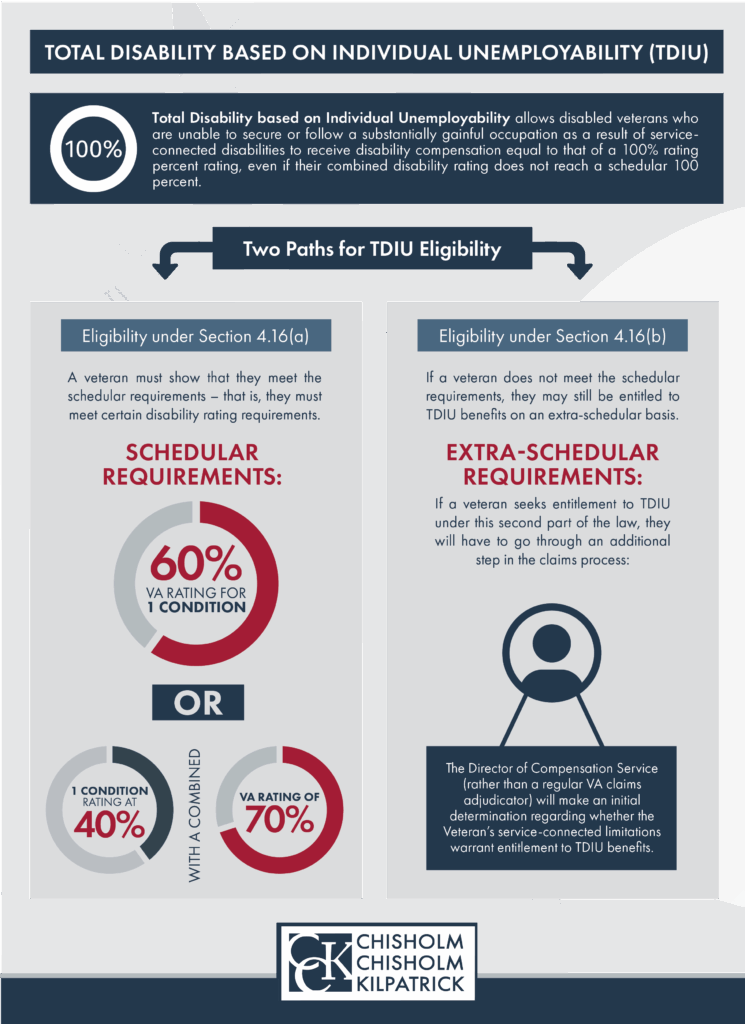
Can’t work because of your service-connected musculoskeletal conditions? You may qualify for Total Disability based on Individual Unemployability (TDIU), which pays you at the 100 percent rate even if your combined rating is less than 100 percent.
Who Qualifies for TDIU for VA Musculoskeletal Conditions?
There are two ways to qualify for TDIU.
Schedular TDIU (meets specific rating requirements):
- One condition rated 60 percent or higher, OR
- Combined rating of 70 percent or more with at least one condition rated 40 percent or higher
Extraschedular TDIU (special circumstances):
- A veteran’s disability rating is lower than the schedular requirements, but their conditions still prevent them from working
- Requires individual review by VA’s Director of Compensation Service
Real Examples of TDIU for VA Musculoskeletal Conditions
Example 1: A veteran has a 50 percent rating for degenerative disc disease and a 30 percent rating for knee arthritis (resulting in a 70 percent combined rating, using VA math). The chronic back and knee pain prevents them from standing, lifting, or walking for extended periods, making most jobs impossible. The veteran meets the rating requirements for schedular TDIU, with a 70 percent combined rating AND at least one rating at 40 percent or above.
Example 2: A veteran with a service-connected knee injury might receive a 40 percent rating for a limited range of motion. However, if the pain and swelling are so severe that they can’t stand for more than 15 minutes, making it impossible to hold a job, they may be eligible for extraschedular consideration.
TDIU Benefits Include:
- Monthly compensation at the 100 percent rate ($3,938.58 for 2026)
- Full VA healthcare benefits
- Eligibility for additional programs like vocational rehabilitation
- Dependent benefits if applicable
When to Appeal Your Musculoskeletal VA Rating
Not every VA rating decision is correct the first time. Here are red flags that suggest you should consider appealing your musculoskeletal disability rating:
Signs Your Musculoskeletal VA Rating May Be Too Low
Your symptoms are worse than your rating suggests:
- You received 0 percent but have constant pain that affects daily activities
- You received 10-20 percent but can’t perform your job duties
- Your condition has worsened since your original rating
The examiner didn’t measure everything:
- Limited range of motion wasn’t properly documented
- Functional loss (weakness, instability) wasn’t considered
- Pain-limited motion wasn’t acknowledged
- Secondary conditions weren’t addressed
Missing conditions:
- You have multiple joint problems, but only one was rated
- Secondary conditions (like back pain from limping) weren’t claimed
- Mental health conditions from chronic pain weren’t considered
Common Mistakes That Lead to Low Ratings
- Incomplete C&P exams that don’t test all affected areas
- Failure to consider functional loss beyond just the range of motion
- Not rating bilateral conditions (problems on both sides)
- Missing secondary conditions caused by compensation behaviors
- Outdated medical evidence that doesn’t reflect current severity
Your Appeal Options
Supplemental Claim (most common):
- Submit new medical evidence
- Get an Independent Medical Opinion (IMO)
- May be resolved within 4-6 months
Higher-Level Review:
- Senior VA employee reviews your case
- No new evidence allowed
- May be a faster process (2-4 months)
Board Appeal:
- Veterans Law Judge reviews your case
- Can include hearing if requested
- Timelines vary by docket, but often can range over a year
FAQ: Other Questions Veterans Ask About VA Musculoskeletal Ratings
What Is the Highest VA Rating for Knee Problems?
The highest standard VA disability rating for knee conditions is typically 60 percent for complete ankylosis (joint fusion). However, you may qualify for higher ratings if you have multiple knee conditions or if your knee problems prevent you from working (TDIU at 100 percent rate).
How Does VA Rate Chronic Back Pain?
VA rates back pain based on range of motion measurements, functional limitations, and pain severity. Ratings range from 10 percent to 100 percent depending on how limited your spine movement is and how the condition affects your daily life and work capacity.
Can I Get VA Disability for Arthritis?
Yes, arthritis can receive VA disability ratings from 0 percent to 50 percent if it is service connected. The rating depends on pain levels, joint stiffness, swelling, and functional limitations. Arthritis in multiple joints may result in separate ratings for each affected joint.
Arthritis is rated under the specific joint’s range-of-movement criteria. For example, limitation of knee extension to 45 degrees is 50 percent under DC 5261. If giving a zero rating based on range of movement, degenerative arthritis (DC 5003) is 10 or 20 percent.
How Long Does It Take to Get a Musculoskeletal Disability Rating?
The initial claim process typically takes 3-6 months from filing to decision. This includes scheduling your C&P exam (may occur within 30 days of request), completing the exam, and VA processing your claim. Appeals can take 4-18 months, depending on the type chosen.
Can My Musculoskeletal Rating Increase Over Time?
Yes, if your condition worsens, you can file for a rating increase. You will need current medical evidence showing deterioration and may need to attend another C&P exam. Many musculoskeletal conditions do worsen with age, making rating increases common.
What If I Have the Same Condition in Multiple Joints?
VA will typically rate each affected joint separately. For example, if you have arthritis in both knees, you may receive separate ratings for each knee. These ratings are then combined using VA’s combined ratings table, not simple addition.
Do I Need a Lawyer for My Musculoskeletal Claim?
While not required, veterans law attorneys can be extremely helpful, especially for complex cases or appeals. They can help gather proper medical evidence, obtain Independent Medical Opinions, identify related claims and benefits, and navigate the appeals process. Many work on contingency, meaning no upfront costs.
Can I Work While Receiving VA Disability for Musculoskeletal Conditions?
Yes, VA disability is compensation for your injury, not unemployment benefits. However, if you are receiving TDIU (unemployability benefits), then there are restrictions on employment. You generally cannot engage in “substantially gainful employment” while receiving TDIU.
Need Help with Your Musculoskeletal VA Claim? Call CCK Law
Navigating the VA disability system can be overwhelming, especially when you are dealing with chronic pain and mobility issues. You don’t have to go through this process alone.
When to consider legal help:
- Your initial claim was denied
- You received a rating that seems too low
- Your condition has worsened since your original rating
- VA missed secondary conditions or bilateral problems
- You are unable to work due to your conditions
What CCK Law Can Do:
A highly experienced, VA-accredited law firm can:
- Review your claim for missed opportunities
- Gather strong medical evidence and expert opinions
- Handle all paperwork and deadlines
- Represent you in appeals and hearings
- Fight for the full benefits you have earned
If your musculoskeletal condition stems from your military service and you believe your VA disability rating doesn’t accurately reflect its impact on your life, reach out to CCK Law by calling (800) 544-9144 or by contacting us online.
Our experienced team has helped thousands of veterans get the musculoskeletal disability ratings they deserve. Don’t let VA’s complex system prevent you from getting the benefits you have earned through your service to our country.