Dependency & Indemnity Compensation (DIC) for a Deceased Veteran’s Dependents
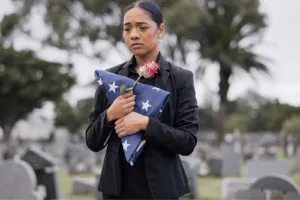

When a spouse dies, it can feel as though your world has been upended. This is especially true if your veteran had service-connected disabilities, and your household relied on monthly disability compensation from the Department of Veterans Affairs (VA).
While disability compensation payments are not continued for a surviving spouse after death, survivors may be entitled to a different type of benefit called Dependency and Indemnity Compensation (DIC).
Key points of this article include:
- Dependency and Indemnity Compensation (DIC) is a financial benefit paid to the eligible survivors of certain service members and veterans.
- For survivors to qualify for VA DIC, their service member or veteran must have died in the line of duty or as a result of a service-connected condition.
- Surviving spouses, dependent children, and dependent parents may all be eligible for VA DIC, as long as they meet specific requirements.
Who We Are: Chisholm Chisholm & Kilpatrick (CCK Law) has argued many of the cases that define and clarify veterans disability law. Our attorneys serve in many leadership positions and have posted more than 2,500 blogs and 1,100 videos explaining veterans benefits. With 100+ individuals accredited by VA or admitted to practice before the U.S. Court of Appeals for Veterans Claims, CCK Law has recovered over $1 billion in compensation for 36,000+ clients since 1999. (Past results do not guarantee future outcomes.) Contact us to tell us about your case.
What Is VA Dependency and Indemnity Compensation?
Dependency and Indemnity Compensation (DIC) is a tax-free monetary benefit from VA paid to eligible survivors of qualifying military service members.
“The qualifications for the veteran: they need to have either died in action, or died from a service-connected condition,” says Emma Peterson, partner at CCK Law. “For example, if a veteran is service connected for cancer and ultimately passes away from that cancer, their dependent — if eligible — would be entitled to DIC benefits.”
It is important to note that DIC is separate from the disability benefits the veteran may have been receiving during their lifetime. This means that their monthly benefits will be discontinued at the time of their passing.
Watch CCK Law Partner Emma Peterson break down the details of DIC with colleagues:
Who Qualifies for VA Dependency and Indemnity Compensation?
Surviving spouses, children, and parents of eligible veterans or service members may all qualify for DIC. However, as with the deceased veteran, there are certain criteria that survivors must meet.
Can Surviving Spouses Earn VA DIC Benefits?
In short, yes, if the veteran and spouse were married for a certain amount of time or if they had a child and lived together (no marriage required, in this case).
Specifically, according to VA’s DIC page, the surviving spouse of a veteran is eligible to receive DIC if they:
- Were married to a service member who died while on active duty, active duty for training, or inactive duty training; or
- Were legally married to the veteran before January 1, 1957; or
- Married the veteran within 15 years of military discharge when the service-connected condition that caused the veteran’s death began or was aggravated; or
- Were married to the veteran for at least one year immediately preceding the veteran’s death; or
- Had a child or children with the veteran, and continuously cohabited (lived with) the veteran until their time of passing and were not separated from the veteran or, if separated, were not responsible for the separation and are not currently remarried.
Depending on the state, common law marriages may also apply, which usually count as legal marriages for the purpose of DIC.
Legally married military couples of any orientation can apply for DIC benefits.
Will a Surviving Spouse Lose VA DIC After Remarriage?
“In general, if a surviving spouse remarries, VA will discontinue DIC benefits,” says Kayla Rogers, VA-accredited claims advocate at CCK Law. “However, there are some exceptions to that rule. In the event they remarry and that marriage ends in death, divorce, or annulment, then DIC benefits can be restored from the date of termination of that marriage.”
Also, if the surviving spouse remarries after a certain age, they may also be able to continue receiving DIC benefits. These ages are:
- For remarriages occurring between December 16, 2003, and January 4, 2021, a surviving spouse must be 57 or older upon remarriage to continue collecting DIC benefits.
- For remarriages occurring on or after January 5, 2021, a surviving spouse who is 55 or older upon remarriage can continue collecting DIC benefits.
To summarize, DIC benefits can continue or be restored with remarriage in the following instances:
- DIC can be restored if the remarriage ended in death, divorce, or annulment; or
- A surviving spouse can continue to receive DIC if they remarried on or after reaching age 55 or age 57, depending on the date of remarriage.
Note: Unfortunately, if you are the surviving spouse of a veteran who died on or after reaching age 57, but before December 16, 2003, VA requires that you must have re-applied for DIC between December 16, 2003, and December 15, 2004, to have DIC benefits restored.
Can Dependent Children Earn VA DIC Benefits?
Yes, but dependent children must meet certain requirements to receive DIC benefits. These qualifications are very similar to those for a veteran claiming a dependent child.
Here is a breakdown of when a dependent child may be eligible for DIC benefits:
- The dependent child is unmarried; and
- The dependent child is not included on the surviving spouse’s compensation; and
- The dependent child is:
- Under the age of 18; or
- Between the ages of 18 and 23 and attending a VA-approved school; or
- Permanently incapable of self-support due to a disability that began before age 18.
Can Surviving Parents Earn VA DIC Benefits?
Yes, as long as they meet certain criteria, surviving parents of veterans may also be eligible for DIC benefits. To qualify, they must meet these requirements:
- They are the biological, adoptive, or foster parent of the veteran or service member; and
- Their income is below a certain amount.
For the purposes of DIC, VA defines a foster parent as one who served in the role of a parent to the veteran or service member before their last entry into active service.
In the video below, CCK Law Partner Michael Lostritto discusses who qualifies as a dependent for the purposes of VA compensation:
How Do a Veteran’s Survivors Prove Service Connection for Cause of Death in DIC Claims?
To qualify for DIC benefits, survivors must show VA that the veteran’s death was connected to their service. If they died in the line of duty or as a result of an already service-connected disability, this process should be relatively straightforward.
However, there are a few VA regulations meant to speed up the process that it may be helpful to know:
- If the death certificate lists one of the veteran’s service-connected conditions as a cause of death, VA may grant service connection without further investigation.
- If the veteran’s service-connected condition was a contributory cause of death, VA should presume that it contributed “substantially and materially” to the veteran’s death, and thus grant service connection without further investigation.
What if My Spouse Did Not Die From a Service-Connected Condition?
If the condition that caused the veteran’s death was not already service-connected when they died, survivors can still apply for DIC. Claims like these may take longer to process, though, because VA adjudicators will follow the typical disability claims review process to decide whether the cause of death is service connected.
Under 38 USC § 1318, the spouses of veterans who did not die due to a service-connected disability but meet the following criteria may also be eligible for DIC if their veteran:
- Had a service-connected disability that VA rated totally disabling (i.e., a 100 percent rating); or
- Had disabilities that combined to be 100 percent to include on the basis of total disability based on individual unemployability (TDIU); and
- The disability was rated totally disabling for at least 10 years before death, or since the veteran’s discharge and at least five years before death, or for at least one year before death if the veteran was a former prisoner of war.
For example, say a Vietnam veteran did not apply for post-traumatic stress disorder (PTSD) disability benefits during their lifetime, but the condition later became a contributory cause of death. The surviving spouse or dependent can apply for service connection after the fact and, if VA grants service connection, they will then be entitled to DIC.
It is important to note that in this case, the surviving spouse or dependent child will not receive retroactive disability benefits for the veteran’s PTSD, but they can use it for the purposes of establishing DIC.
Survivors who receive benefits under 38 USC § 1318 are entitled to the same DIC benefits as survivors whose spouses died from service-connected disabilities.
How Does Presumptive Service Connection Apply to a Veteran’s Cause of Death?
If the veteran’s cause of death was a presumptive condition and evidence shows the veteran meets the particular presumptive criteria, VA should grant service connection without further investigation.
Presumptive conditions are another way that a spouse or dependent may establish entitlement to DIC benefits for conditions that were not service connected at the time of death. An example of this is Agent Orange exposure in Vietnam.
Agent Orange exposure can lead to multiple presumptive conditions. VA updates its presumptive list periodically, meaning a condition that caused the veteran’s death has the potential to become a presumptive condition in the future. If this is the case, the surviving spouse or dependent child can file for DIC benefits after the fact.
What Are the 2026 VA Dependency and Indemnity Compensation Rates?
As of 2026, the fixed monthly benefit amount for DIC is $1,699.36. However, there are situations where VA may award additional compensation, including:
| Circumstance | Added Monthly Amount |
| Eight-year provision | +$360.85 |
| Each dependent child under age 18 | +$421.00 |
| Aid and Attendance | +$421.00 |
| Housebound | +$197.22 |
| Transitional benefit (if at least one child under 18) | +$359.00 for first 2 years |
Additional DIC Compensation for Dependent Children
If your children are under age 18 and live in your household, you are eligible for additional compensation for each child.
- Each qualifying child is an additional $421 per month. This lasts until the child turns 18. If one or more of your children is disabled, you can continue to receive benefits on their behalf even beyond age 18. You must report when your children are no longer eligible to avoid overpayments.
- For the first two years, an additional $359 (only awarded once per family, not per child)
8 Years Totally Disabled: Additional DIC Compensation
If your veteran spouse was rated totally disabled for eight continuous years immediately before death and you were married to the veteran during those eight years, you may be eligible for additional compensation per month.
The veteran may have been totally disabled due to one disability rated 100 percent, multiple disabilities that combined to 100 percent, or TDIU.
Additional DIC Compensation for Surviving Spouses Who Are Housebound or Require Aid & Attendance
If the surviving spouse of a veteran qualifies for either Aid and Attendance (A&A) or Housebound benefits, they may be awarded additional compensation each month.
Are VA DIC Benefits Adjusted for Inflation?
Yes, Dependency and Indemnity Compensation rates generally rise when a cost-of-living adjustment (COLA) is approved. These annual increases help benefits keep pace with inflation and are implemented under the Veterans’ Compensation Cost-of-Living Adjustment Act. DIC rates rose 2.5 percent in 2025 and 2.8 percent in 2026.
Are VA DIC Benefits Subject to Income Tax?
No, DIC payments are not considered taxable income for federal tax purposes. Under federal law, survivors who receive DIC do not need to include these benefits when reporting income on their federal tax returns.
In the video below, CCK Law Partner Michael Lostritto covers the VA DIC rates for 2026:
How Do I Apply for VA Dependency and Indemnity Compensation?
Surviving dependents can apply for VA DIC benefits via these methods:
- Online using VA’s website or through QuickSubmit (found on AccessVA)
- In person at a VA regional office
- Mailing their application to: Department of Veterans Affairs Pension Intake Center PO Box 5365 Janesville, WI 53547-5365
- With assistance from a VA-accredited attorney, claims advocate, or Veterans Service Organization (VSO)
What Forms Do I Use To Apply for VA DIC Benefits?
The exact form a survivor submits will depend on the circumstances of their situation. Some of these forms include:
- Surviving spouse or child of a veteran – VA Form 21P-534EZ
- Surviving spouse or child of a service member who died on active duty – VA Form 21P-534a (generally completed with help from a Casualty Assistance Officer)
- Surviving parent – VA Form 21P-535
When filing Form 21P-534, survivors will find that there is a specific question regarding whether they are seeking service connection for the cause of death. If the veteran did not pass away from a service-connected condition, they will want to make sure they answer this question appropriately.
If a survivor’s spouse was killed on active duty or while conducting a training exercise, VA will assign a Casualty Assistance Officer to file for surviving spouse benefits on their behalf.
What Evidence Should I Submit With My VA DIC Application?
Alongside the proper forms, we recommend that survivors include supporting documentation proving they and their veteran meet the criteria for DIC, such as:
- The veteran’s death certificate indicating cause of death
- A marriage certificate
- Any prior divorce decrees
- Service records of the veteran
- Medical records of the veteran’s condition
- Birth certificates
- School transcripts
- Medical records documenting an adult child’s permanent incapacity
Submitting this evidence with the initial application for DIC can help speed up the adjudication process.
Should I Submit an Intent to File (ITF) Before Applying for VA DIC?
Generally, yes. An Intent to File can protect an earlier effective date for benefits while survivors prepare their Dependency and Indemnity Compensation (DIC) claim.
If VA ultimately grants the claim, any retroactive compensation may be calculated from the ITF date instead of the date the full application was submitted. This allows survivors to potentially secure greater back pay while also giving them more time to gather supporting documentation.
Can I Apply for DIC if My Veteran Never Filed a VA Claim?
Yes, a surviving family member may still qualify for DIC even if their veteran never obtained VA disability benefits during their lifetime. In these situations, VA will review the evidence to determine whether the condition that caused or contributed to the veteran’s death should be service connected. Because VA must make that determination as part of the DIC claim, the process can take additional time.
Survivors should note that this situation has become increasingly common among Vietnam and post-9/11 veterans, since many of these veterans may have had conditions that are now covered under PACT Act presumptions.
When Should I Apply for VA Dependency and Indemnity Compensation?
Survivors should apply for DIC VA benefits as soon as possible after the veteran’s death. If they apply within one year of the veteran’s death and are granted benefits, they will likely be paid retroactively from one month after the date of the veteran’s death.
Typically, the family receives one final payment of the veteran’s disability benefits and then will begin receiving DIC benefits the following month.
If they do not apply for DIC within one year of the veteran’s death and VA later grants them benefits, their effective date (i.e., the date from which they begin receiving benefits) will be the date VA receives their DIC claim.
There are exceptions for surviving spouses and dependent children of Vietnam veterans who meet the Nehmer Class definition and those of Blue Water Navy veterans. In these cases, a Veterans Service Officer (VSO) or an accredited representative or attorney may be able to help and provide useful insight regarding the effective date for DIC benefits.
What Can I Do if VA Denies My DIC Claim?
A DIC denial does not necessarily mean the end of the process. Under the Appeals Modernization Act (AMA), survivors have multiple options for seeking further review of an unfavorable decision. These include:
- Supplemental Claim — Submit new and relevant evidence for VA to consider.
- Higher-Level Review — Ask a more experienced VA adjudicator to review the decision based on the existing record.
- Board Appeal — Appeal the decision to the Board of Veterans’ Appeals, with options that may include a hearing.
In most cases, survivors should file an appeal within one year of the initial decision date to preserve their effective dates.
Why Would VA Deny a DIC Claim?
Common reasons for VA to deny DIC claims include:
- A lack of strong evidence supporting the application for DIC.
- A finding that the veteran’s death was unrelated to service.
- The survivor not meeting certain eligibility criteria.
How Long Do Dependency and Indemnity Compensation Benefits Last?
Once granted, DIC is permanent for surviving spouses, unless the surviving spouse remarries prior to turning 57 years old. For surviving children, DIC usually lasts until the age of 18 (or 23 if the child is still in school). Adult children who are permanently incapable of self-support due to a condition may also be entitled to DIC.
Are Surviving Spouses Eligible for Any Other Benefits?
Possibly. Survivors who are eligible for DIC may also be eligible for these benefits:
- Civilian Health and Medical Program of the Department of Veterans Affairs (CHAMPVA)
- Dependents Educational Assistance (DEA)
- Burial benefits
Overwhelmed or Denied? CCK May Be Able To Help
If you disagree with a VA decision, consider contacting Chisholm Chisholm & Kilpatrick. An experienced, VA-accredited law firm may offer significant tools and resources in support of your appeal.
While past results do not guarantee future outcomes, CCK Law has had favorable outcomes in 98.5% of its actions before VA and a 95% win rate before the U.S. Court of Appeals for Veterans Claims (federal court). We have recovered over $1 billion in compensation for 36,000+ clients to date.
Contact us online or at 800-544-9144 to tell us about your case.
Frequently Asked Questions
What is the SBP/DIC offset (“widow’s tax”)?
A substantial number of surviving spouses historically received reduced DIC because of the Survivor Benefit Plan (SBP)/DIC offset. Congress fully repealed this offset effective January 1, 2023.
Can multiple family members receive VA DIC benefits?
Often, yes. A surviving spouse may be entitled to DIC and may receive additional monthly benefits for qualifying children. That said, a child who receives DIC directly as an eligible beneficiary is generally not counted for purposes of increasing the spouse’s monthly payment.
Can I collect VA DIC and VA Survivors Pension benefits together?
No, VA does not allow beneficiaries to receive both DIC and Survivors Pension payments at the same time. If a survivor is eligible for both programs, VA generally pays the benefit that results in the higher monthly amount.
Can the PACT Act help survivors qualify for VA DIC?
Yes, the PACT Act expanded the list of presumptive service-connected conditions associated with toxic exposures, making it easier for some surviving family members to establish DIC eligibility.
The law covers a range of exposures, including burn pits, airborne hazards, Agent Orange, and other toxic substances. If a veteran’s death is now presumed to be service connected under the PACT Act, surviving dependents may be eligible for DIC even if VA denied a previous claim.
Survivors do not need to wait for VA outreach before filing a new claim or seeking review of a prior denial. In certain circumstances, federal law even allows VA to assign an earlier effective date tied to the original claim.