Type 1 Diabetes and VA Disability Compensation


The Department of Veterans Affairs (VA) rates type 1 diabetes under 38 CFR 4.119, Diagnostic Code 7913 (the same as type 2 diabetes), awarding veterans a disability rating of 10, 20, 40, 60, or 100 percent.
Rather than rating based on which type a veteran has, VA rates diabetes mellitus based on insulin use, dietary restrictions, and required activity limits.
This guide can help veterans with type 1 diabetes better understand their path to VA benefits.
Key points in this guide include:
- VA rates type 1 and type 2 diabetes using the same diagnostic code and criteria.
- Complications and secondary conditions resulting from type 1 diabetes can be rated separately from a veteran’s diabetes rating.
- Veterans can use certain types of evidence to support their type 1 diabetes VA claim.
- Veterans have several options if they choose to appeal an unfavorable VA decision.
Who We Are: Chisholm Chisholm & Kilpatrick (CCK Law) has argued many of the cases that define and clarify veterans disability law. Our attorneys serve in many leadership positions and have posted more than 2,500 blogs and 1,100 videos explaining veterans benefits. With 100+ individuals accredited by VA or admitted to practice before the U.S. Court of Appeals for Veterans Claims, CCK Law has recovered over $1 billion in compensation for 36,000+ clients since 1999. (Past results do not guarantee future outcomes.) Contact us to tell us about your case.
What Is Type 1 Diabetes According to VA’s Rating Schedule?
Type 1 diabetes is an autoimmune condition in which the pancreas produces little or no insulin, meaning that veterans require lifelong insulin therapy to survive.
VA uses the same diagnostic code for type 2 and type 1 diabetes: 38 CFR 4.119, Diagnostic Code 7913. This means that rather than rating based on which type of diabetes a veteran has, VA assigns veterans a disability rating based on the severity of the condition.
What Are the VA Disability Rating Criteria for Diabetes Mellitus?
VA assigns ratings for diabetes mellitus at 10, 20, 40, 60, or 100 percent disabling. Each rating level reflects how much treatment and how much lifestyle restriction the condition requires.
- 10 percent — Diabetes managed by a restricted diet alone.
- 20 percent — Diabetes requiring one or more daily injections of insulin and a restricted diet, or an oral hypoglycemic agent and a restricted diet.
- 40 percent — Diabetes requiring one or more daily injections of insulin, a restricted diet, and regulation of activities (see definition box below).
- 60 percent —All of the 40 percent elements, with episodes of ketoacidosis or hypoglycemic reactions requiring either one or two hospitalizations per year or twice-monthly visits to a diabetic care provider, plus complications that would not be compensable if rated separately.
- 100 percent — Diabetes requiring more than one daily injection of insulin, a restricted diet, and regulation of activities, with episodes of ketoacidosis or hypoglycemic reactions requiring either at least three hospitalizations per year or weekly visits to a diabetic care provider, plus either progressive loss of weight and strength or complications that would be compensable if rated separately.
Veterans should keep in mind that VA rates diabetes complications, such as peripheral neuropathy and diabetic retinopathy, separately from the diabetes rating unless the complications are already part of the rating criteria used to support a rating of 100 percent.
This means that if a veteran files a claim for their complication(s), they may be able to substantially increase the amount of VA compensation they receive through a combined rating.
How Can Veterans Get Service Connection for Type 1 Diabetes?
Service connection is when a veteran can prove to VA that a link exists between their current diagnosis and their military service. Veterans with type 1 diabetes generally rely on one of these paths to pursue VA service connection:
- Direct service connection — VA grants direct service connection when a veteran provides medical evidence showing that their type 1 diabetes began, or was first diagnosed, during active duty.
- Presumptive chronic disease service connection — Diabetes mellitus appears on VA’s list of chronic diseases at 38 CFR § 3.309(a). A veteran who served 90 days or more of continuous active service during a period of war, or during peacetime on or after January 1, 1947, and whose diabetes became at least 10 percent disabling within one year of separation, may be granted service connection on a presumptive basis. VA can rebut the presumption with affirmative evidence, so the presumption just reduces what a veteran must prove rather than removing VA’s review.
- Secondary service connection or aggravation — VA will grant one of these forms of service connection when a veteran’s type 1 diabetes developed, or became permanently worse, due to an already service-connected condition or its treatment.
An important distinction: Unlike veterans with type 2 diabetes, those with type 1 diabetes do not qualify for presumptive service connection through Agent Orange exposure or other herbicide exposure. Veterans whose type 1 diabetes was noted when they entered service may still pursue benefits on an aggravation theory under 38 USC § 1153 and 38 CFR § 3.306. For wartime service, if the condition increased in severity during service, VA presumes that service aggravated it. VA can overcome that presumption only with clear and unmistakable evidence that the increase reflected the natural progress of the disease. Medical records showing the severity of the diabetes at entry, during service, and at separation are central to these claims.
Can Secondary Conditions Develop From Type 1 Diabetes?
Yes. A person with long-term high blood sugar can experience damage to their blood vessels, nerves, and organs, which can result in some common secondary conditions, including:
If a veteran is already service connected for type 1 diabetes, they can file a claim for secondary service connection for these or any other condition they can show was caused by their type 1 diabetes. VA rates each secondary condition separately from the diabetes rating.
How Is a Type 1 Diabetes VA Claim Different From One for Type 2?
Although type 1 diabetes and type 2 fall under the same VA rating criteria, the two conditions differ in the ways veterans prove service connection.
Type 2 diabetes is a presumptive condition for Agent Orange or other herbicide exposures, making it potentially easier for veterans to pursue service connection for type 2. Type 1 diabetes does not have an equivalent path to service connection for exposure-related presumption.
What Evidence Helps Prove a Type 1 Diabetes VA Claim?
When a veteran has strong evidence of service connection for their condition, VA examiners and raters will have a clearer understanding of how the veteran’s type 1 diabetes affects their daily life.
Helpful records for veterans to submit to VA include:
- Diagnosis records — These include endocrinologist or primary care notes that confirm the veteran’s type 1 diabetes and insulin dependence.
- Treatment history — This includes any documentation of the insulin regimen, restricted diet instructions, and any activity restrictions a physician has ordered.
- Hospitalization or emergency records —This can include evidence of any ketoacidosis or hypoglycemic episodes that required treatment.
- Nexus opinion — A nexus is a medical opinion, typically written by a treating physician, linking the veteran’s type 1 diabetes directly to service or as secondary to another service-connected condition.
- Buddy statements — These are lay statements written by a veteran’s friends, family, fellow service members, or the veteran themselves, describing symptoms that began during service or within one year of discharge.
If a veteran does not have or is struggling to obtain these kinds of records — namely medical or service records — they should know that VA legally has a duty to assist veterans in obtaining records that support their claim.
What Happens After Filing a VA Claim for Type 1 Diabetes?
The process begins when veterans file VA Form 21-526EZ and any supporting medical evidence. Next, VA will schedule a Compensation & Pension (C&P) exam to evaluate the current severity of the condition before making a rating decision.
VA may deny the claim for type 1 diabetes, or the veteran may feel that the rating does not match the medical evidence provided. In either of these cases, veterans have several options to appeal:
- File a Supplemental Claim
- Request a Higher-Level Review
- Appeal to the Board of Veterans’ Appeals
Veterans with type 1 diabetes may also qualify for other VA benefits that could potentially increase the amount of monthly compensation they receive.
For example, if a veteran requires assistance with activities of daily living (including administration of insulin or blood sugar monitoring), they may also qualify for Special Monthly Compensation for Aid & Attendance.
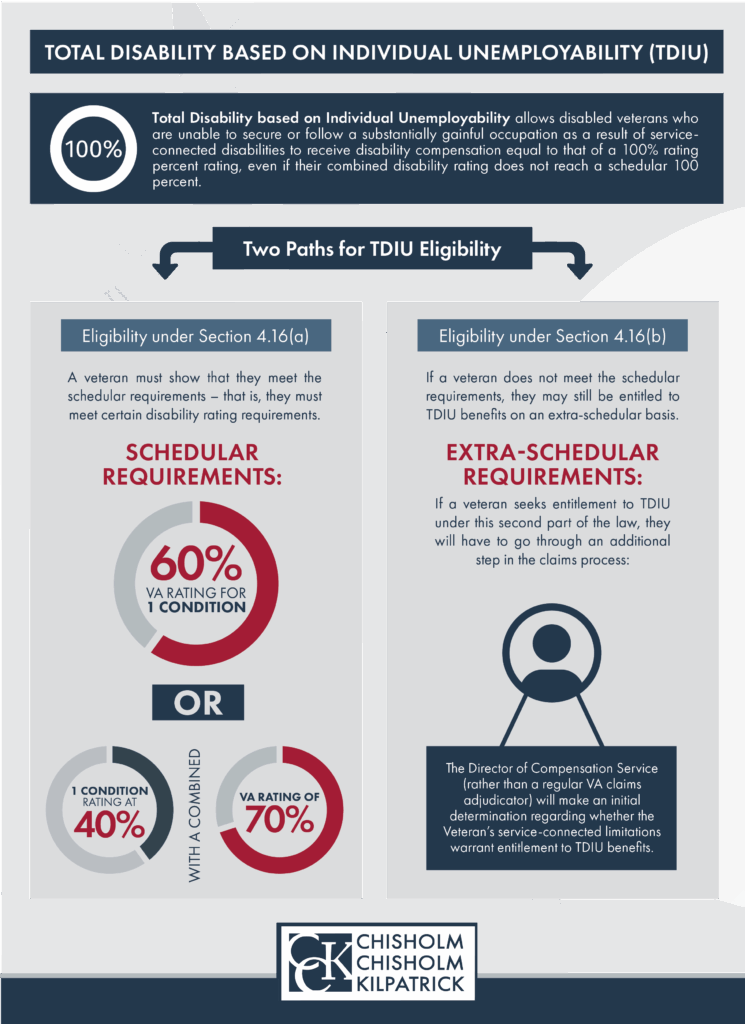
Veterans with diabetes or complications that prevent them from getting or maintaining substantially gainful employment may also want to pursue a claim for total disability based on individual unemployability (TDIU). This VA benefit compensates veterans at the 100 percent level even if their schedular rating is less than that.
Disagree With VA? How Veterans Can Get Help With a Type 1 Diabetes Claim
If you disagree with a VA decision, consider contacting Chisholm Chisholm & Kilpatrick. An experienced, VA-accredited law firm may offer significant tools and resources in support of your appeal.
While past results do not guarantee future outcomes, CCK Law has had favorable outcomes in 98.5% of its actions before VA and a 95% win rate before the U.S. Court of Appeals for Veterans Claims (federal court). We have recovered over $1 billion in compensation for 36,000+ clients to date.
Contact us online or at 800-544-9144 to tell us about your case.
Frequently Asked Questions
Can veterans receive separate VA ratings for diabetes and its complications?
Yes. Note (1) within DC 7913 states that VA rates compensable complications (rated 10 percent or higher) separately from a veteran’s diabetes rating. The only exception is when the complications are already part of the criteria VA used to support a 100 percent diabetes rating.
Common diabetes complications include diabetic retinopathy, kidney disease, and peripheral neuropathy.
Can episodes of ketoacidosis or hypoglycemia increase a type 1 diabetes VA rating?
Yes. Note that documented episodes are one element of the 60 and 100 percent criteria, not a shortcut to them. A veteran must also meet the insulin, restricted diet, and regulation-of-activities requirements, along with the complications element described in the rating table above. Keeping records of every hospitalization, emergency room visit, and diabetic care visit tied to hypoglycemia or ketoacidosis preserves the evidence for the element those visits do address.
Is the VA disability rating different for type 1 diabetes than type 2?
No. VA rates both type 1 and type 2 diabetes under the same schedule (38 CFR 4.119, Diagnostic Code 7913), using the same criteria for diet, insulin use, regulation of activities (activity restrictions), and hospitalization history. VA assigns diabetes ratings of 10, 20, 40, 60, or 100 percent regardless of which type a veteran has.
Does type 1 diabetes qualify for Agent Orange presumptive service connection?
No. Only type 2 diabetes qualifies for presumptive service connection through Agent Orange exposure. Veterans with type 1 diabetes can still pursue VA service connection directly, through secondary service connection, or through VA’s one-year chronic disease presumption under 38 CFR 3.309(a).