Back Range of Motion: Understanding How VA Rates Spine Disabilities


If you are a veteran with a back condition related to your military service, you may be wondering how your impaired range of motion factors into VA’s rating process. This article will guide you through the importance of range of motion testing so you can better understand how your condition can be rated.
Key points of this article include:
- Impaired range of motion is one of the primary ways by which VA measures the severity of a back disability. Typically, the lower a veteran’s range of motion with their back, the higher their rating will be.
- VA usually requires that veterans undergo Compensation and Pension (C&P) exams to receive a VA rating for back range of motion. During this exam, the examiner will likely use a goniometer to measure the veteran’s range of motion.
- If a veteran’s impaired range of motion prevents them from working, it is possible for them to secure Total Disability based on Individual Unemployability (TDIU). This benefit allows veterans to be compensated at the 100 percent disability level, even if their VA disability rating for back range of motion is less than 100 percent.
Why Are Veterans Prone to Back Conditions?
Life in the military can be very physically demanding, which is why veterans frequently experience back pain following their time in service. Some common aspects of military service that can contribute to the development of back conditions include:
- Excessive marching, jogging, and other physical training
- Carrying around heavy gear for extended periods
- Manual labor like digging or lifting
- Injuries from falls or accidents
- General wear and tear
- Lack of proper footwear
If veterans can establish that their back pain is a result of their military service, they may be eligible to receive VA disability benefits in the form of monthly compensation and VA health care.
According to VA’s Annual Benefits Report for Fiscal Year 2025, back conditions are the fourth most common condition among veterans, with almost 1.8 million veterans being compensated for back-related disabilities.
Depending on their severity, these conditions can greatly impact a veteran’s ability to perform activities of daily living or carry out work-related responsibilities.
What Is Range of Motion and How Does It Impact VA Claims?
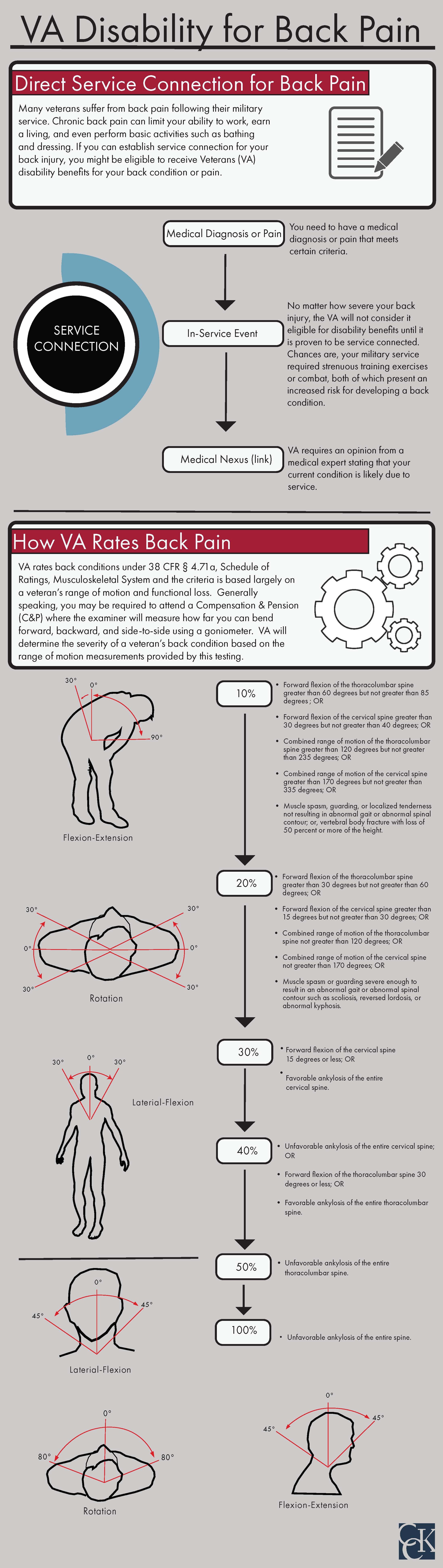
Range of motion is defined as a joint’s ability to go through its full spectrum of movement. When it comes to the back, this refers to a veteran’s ability to:
- Bend forward (flexion)
- Bend sideways (lateral flexion)
- Arch backward (extension)
- Twist back and forth (rotation)
Veterans should note that range of motion is arguably the most important factor VA considers when evaluating a veteran’s back pain or condition, as it effectively measures the limitations brought on by the condition. In other words, the more severe the condition, the more limited a veteran’s range of motion is.
“Range of motion is usually measured in degrees,” says Alyse Phillips, supervising attorney at CCK Law. “So during a C&P exam, the VA examiner uses an instrument to precisely measure both active range of motion and passive range of motion. Active range of motion is when you move your joint, whereas passive range of motion is when the examiner moves your joint for you.”
To ensure accuracy when measuring the veteran’s range of motion, 38 CFR § 4.46 requires VA to use a specific instrument known as a goniometer (i.e. an instrument used for the precise measurement of angles).
What Should I Expect on a C&P Exam for Back Range of Motion?
A Compensation and Pension (C&P) exam is a medical evaluation conducted by a VA medical professional or one contracted through VA. The purpose of this examination is to measure the severity of a veteran’s disability, which helps VA determine the appropriate disability rating. C&P exams are also commonly used to assess whether a veteran’s condition is linked to their military service.
If a veteran’s primary symptom is impaired range of motion in the back, then the most important part of this C&P exam will likely be when the examiner uses a goniometer to measure the veteran’s range of motion:
“The examiner will likely measure and record the degrees of flexion, extension, lateral flexion, and rotation depending on the affected joints,” says Alyse Phillips. “The measured range is then compared to the normal ranges provided in the regulations to determine the appropriate rating. The more limited the measured range of motion, the higher the disability rating.”
Besides this, there could be several other relevant parts to the exam, including:
- A physical section where the examiner inspects the veteran’s back for pain levels and any outward-facing symptoms.
- A questionnaire section where the examiner asks the veteran about how their back condition affects their everyday life, what activities it may prevent them from performing, and how they think the condition originally developed.
- Finally, the examiner may order additional medical tests like MRIs or X-rays to confirm the veteran’s diagnosis.

How Does VA Rate Back Pain and Back Conditions?
In most cases, VA uses the General Rating Formula for Diseases and Injuries of the Spine under 38 CFR § 4.71a to evaluate back conditions, including back pain.
VA generally rates back conditions/pain as follows:
- 100 percent–Unfavorable ankylosis (i.e., stiffness of a joint due to abnormal adhesion and rigidity of the bones of the joint) of the entire spine
- 50 percent–Unfavorable ankylosis of the entire thoracolumbar spine
- 40 percent–Unfavorable ankylosis of the entire cervical spine; or, forward flexion of the thoracolumbar spine 30 degrees or less; or, favorable ankylosis of the entire thoracolumbar spine
- 30 percent–Forward flexion of the cervical spine 15 degrees or less; or, favorable ankylosis of the entire cervical spine
- 20 percent–Forward flexion of the thoracolumbar spine greater than 30 degrees but not greater than 60 degrees; or, forward flexion of the cervical spine greater than 15 degrees but not greater than 30 degrees; or, the combined range of motion of the thoracolumbar spine not greater than 120 degrees; or, the combined range of motion of the cervical spine not greater than 170 degrees; or, muscle spasm or guarding severe enough to result in abnormal gait or abnormal spinal contour such as scoliosis, reversed lordosis, or abnormal kyphosis
- 10 percent–Forward flexion of the thoracolumbar spine greater than 60 degrees but not greater than 85 degrees; or, forward flexion of the cervical spine greater than 30 degrees but not greater than 40 degrees; or, combined range of motion of the thoracolumbar spine greater than 120 degrees but not greater than 235 degrees; or, combined range of motion of the cervical spine greater than 170 degrees but not greater than 335 degrees; or, muscle spasm, guarding, or localized tenderness not resulting in abnormal gait or abnormal spinal contour; or, vertebral body facture with loss of 50 percent or more of height
What Is VA’s Painful Motion Rule?
VA’s Painful Motion Rule is a regulation that allows veterans to earn a disability rating as long as their condition results in painful movement of the spine or a separate joint. This is the case even if that veteran’s condition does not lead to limited range of motion.
VA’s Painful Motion Rule is outlined under 38 CFR § 4.59. Specifically, the regulation states, “it is the intention to recognize actually painful, unstable, or mal-aligned joints, due to healed injury, as entitled to at least the minimum compensable rating for the joint.”
That is, veterans who experience pain on motion may be assigned a 10 percent disability rating, even if their range of motion is not necessarily impeded. This regulation also stipulates that the joints involved should be tested for pain on both active and passive motion, in weight-bearing and non-weight-bearing and, if possible, with the range of the opposite undamaged joint.
How Does VA Handle Back Pain Flare-Ups?
Another relevant factor that should be considered during VA ratings for back range of motion is the possibility of flare-ups.
Generally speaking, flare-ups are defined as a sudden and temporary increase in symptoms. These flare-ups often recur periodically, but are unpredictable and arise without warning. The abrupt escalation in symptoms can often result in extreme pain and loss of mobility.
If a veteran is service connected for a back condition, VA examiners must account for the possibility of flare-ups worsening the veteran’s symptoms. Specifically, a higher rating may be awarded when there is additional loss or limitation of motion due to pain during flare-ups. This is the case even if the veteran is not experiencing a flare-up during their exam.
For example:
- Say a veteran suffers from a back condition. On most days, they are unable to bend forward more than 60 degrees, and generally experience pain while doing so.
- Eventually, the veteran is granted service connection for this back condition and receives a 10 percent disability rating.
- However, the veteran also experiences flare-ups in their condition where they are unable to bend more than 30 degrees. Therefore, during the flare-up, the veteran’s back condition becomes much more disabling than 10 percent.
- In this case, the veteran may be able to argue to VA that they should undergo a new C&P exam that takes this possibility for flare-ups into account. If their argument is successful, VA may order a new exam and potentially even assign a higher disability rating in accordance with this additional loss.
How Does Functional Loss Affect Back Pain VA Ratings?
VA should also consider the functional loss caused by the veteran’s back condition. In short, beyond range of motion limitations, a veteran might suffer from additional symptoms like weakness, incoordination, or pain that leads them to lose substantial function in their back.
For example:
- Say a veteran suffers from a back condition. VA recognizes that the condition is service connected and begins the process of assigning the veteran a VA rating for back range of motion.
- During the veteran’s C&P exam, the VA examiner notes that, while the veteran is able to bend forward 85 degrees, they start to experience pain when bending at 55 degrees or more.
- In this case, the VA examiner should take into account the pain the veteran experiences when bending at 55 degrees, since this pain will likely functionally prevent the veteran from bending forward that far in their day-to-day life.
- With this in mind, the veteran should receive a disability rating that is consistent with both the range of motion measurements and the functional limitations caused by their back pain.
Back Disability Claim Denied? Call CCK Law
If you were denied a VA rating for back range of motion, then the representatives at Chisholm Chisholm & Kilpatrick may be able to assist.
Our accredited attorneys have represented over 36,000 veterans and dependents and have secured favorable ratings for nearly 99 percent of our past clients before VA and 95 percent before the Court of Appeals for Veterans Claims. Note that past results do not guarantee future outcomes.
Call CCK Law today at (800) 544-9144 or contact us online to request a free evaluation of your case.
Share this Graphic