What Does “Permanent” Mean for VA Disability Ratings?

CCK Law: Our Vital Role in Veterans Law
A VA disability rating is “permanent” when medical evidence makes it reasonably certain that the condition will not improve for the rest of a veteran’s life. A permanent rating protects veterans from future reexaminations and makes it much harder for VA to reduce benefits. Importantly, “permanent” is not the same as “permanent and total” (P&T); a rating can be permanent at any percentage, not just 100 percent.
Key points:
- VA designates a rating permanent when improvement is considered medically unlikely.
- A permanent rating generally means no future Compensation & Pension (C&P) exams for that condition.
- “Permanent” and “permanent and total” are related but distinct terms. Many veterans have permanent ratings below 100 percent.
- Certain time-based protections, like VA’s 5-year and 20-year rules, offer additional shields against rating reductions even before a formal “permanent” designation.
How Does VA Define “Permanent” Disability?
Under 38 C.F.R. § 3.340, a disability is permanent when the impairment is “reasonably certain to continue throughout the life of the disabled person.” VA does not require absolute certainty, only that improvement is not realistically expected based on the available medical evidence.
VA looks at factors such as:
- The nature and history of the condition
- Medical prognosis and any available treatment options
- How long the disability has been stable
Examples of conditions VA commonly rates as permanent:
- Amputation or loss of use of a limb
- Blindness or significant vision loss
- Deafness or significant hearing loss
- Chronic degenerative diseases (e.g., emphysema, Parkinson’s disease)
- Severe PTSD that has been consistently documented over many years
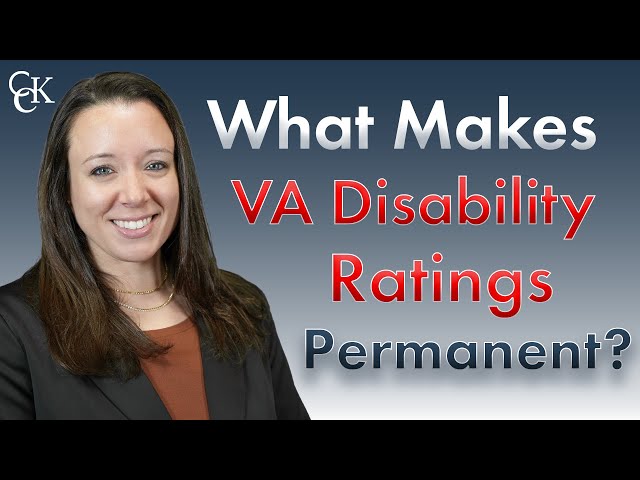
Watch CCK Law Partner Maura Black answer “What Makes Your VA Disability Rating Permanent?”:
What Is the Difference Between “Permanent” and “Permanent and Total”?
These two terms are often used together when people discuss veterans disability, but they mean different things. The “permanent” designation simply means that individual rating is shielded from future reexamination.
For example, a veteran can have a permanent 30 percent rating for a knee condition without being “permanent and total.”
| Term | What It Means |
| Permanent | The condition is not expected to improve; VA will not schedule future C&P exams for it. Can apply at any rating percentage. |
| Total | The veteran is rated at 100 percent disabled (or receives Total Disability based on Individual Unemployability, or TDIU). |
| Permanent and Total (P&T) | The veteran is both rated at 100 percent (or TDIU) and the disability is considered permanent. |
For additional explanation of permanent and total ratings, visit What Does It Mean to Be 100 Percent Disabled by VA? and Can VA Take Away 100 Percent Permanent and Total Disability?
How Do I Know If My VA Disability Is Permanent?
VA does not always announce clearly that a rating has been designated permanent. Here is how to find out:
- Check Your Rating Decision Letter: Look for language stating that the disability is “permanent” or that no future examinations are required.
- Review Your Code Sheet: Your VA claims file (also called your C-File) contains a Code Sheet that lists each disability and its status. If the “Future Exam” field is blank or marked “None,” the disability is likely considered static or permanent.
- Look for “Static” Designations: VA uses the term “static” for conditions with little or no expectation of improvement. Under 38 C.F.R. § 3.327(b)(2)(i), no periodic reexamination will be scheduled when a disability is established as static.
- Check for “No Future Examinations” Language: Under 38 C.F.R. § 3.327, VA generally will not schedule future C&P exams when:
- The disability is static
- Symptoms have persisted without material improvement for 5 or more years
- The disease is permanent and degenerative in nature
- The veteran is over age 55 (except under unusual circumstances)
- The current rating is already the minimum schedular rating
Can VA Disability Become Permanent Over Time?
A disability does not automatically become permanent over time. However, several protections kick in at certain periods of time that make it increasingly difficult for VA to reduce the rating.
The 5-Year Rule (Stabilized Ratings)
Under 38 C.F.R. § 3.344, if a rating has been in place for 5 or more years, VA must show “sustained improvement,” not just a single better exam, before reducing it. One C&P exam showing improvement is not enough. VA must demonstrate that improvement has persisted consistently under ordinary conditions of life.
The 20-Year Rule (Protected Ratings)
Under 38 C.F.R. § 3.951(b), if a disability has been continuously rated at or above a certain level for 20 or more years, VA generally cannot reduce the rating below that level even with medical evidence of improvement unless the original rating was based on fraud.
Age 55 and Older
Under 38 C.F.R. § 3.327(c), veterans over age 55 are generally not scheduled for reexaminations except under unusual circumstances.
What Are the Practical Benefits of a Permanent Rating?
When VA designates a rating as permanent, several important protections apply:
- No future C&P exams for that condition under 38 C.F.R. § 3.327
- Higher bar for reductions: VA must meet strict legal standards before reducing a permanent rating
- Additional benefits: If a rating is permanent and total (P&T), additional benefits become available, including Chapter 35 Dependents’ Educational Assistance, CaregiversPrograms, and other VA programs. Some states may have veteran benefits that are contingent on permanent status, as well.
Is PTSD a Permanent VA Disability?
Veterans often ask us about PTSD specifically. PTSD can be permanent, but it is not automatic. Whether PTSD receives a permanent designation depends on:
- Severity and duration of documented symptoms
- Prognosis stated in medical records and C&P exams
- Rating history: a long-standing high rating with consistent documentation strengthens the case for permanency
Veterans with PTSD rated at 70 or 100 percent, with a lengthy medical history of persistent symptoms, are more likely to receive a permanent designation. However, early in the claims process, VA may schedule routine future exams for PTSD, particularly within the first few years.
If a veteran’s PTSD qualifies as both permanent and total, VA will not schedule any further C&P exams.
How Can I Request a “Permanent” Designation from VA?
VA may not automatically flag a rating as permanent even when the medical evidence supports it. Veterans can take proactive steps:
- Obtain a private medical opinion: A nexus or prognosis letter from a treating physician stating that the condition is unlikely to improve can support a permanency designation.
- Document your treatment history: Ongoing records showing consistent, unimproved symptoms build the case for permanency.
- Contact a VA-accredited attorney or claims agent: An accredited representative can review your file and request appropriate designations.
Is Individual Unemployability (TDIU) Permanent?
TDIU, which pays veterans at the 100 percent rate even if their combined rating is below 100 percent, is not always permanent. VA can only revoke TDIU if “actual employability is established by clear and convincing evidence” under 38 C.F.R. § 3.343(c). This means VA must show that the veteran is capable of substantially gainful employment, generally meaning at least 12 consecutive months of work above the federal poverty threshold.
Frequently Asked Questions
Does a VA disability automatically become permanent after 5 years?
No. After 5 years, a rating becomes “stabilized.” This means VA faces a higher legal burden to reduce the rating, but it is not automatically designated permanent. A formal permanent designation still depends on the medical prognosis for the specific condition.
Can VA reduce a permanent rating?
In very limited circumstances, yes, such as fraud or clear and unmistakable error (CUE). Note that VA must follow strict procedural requirements, including a written proposed reduction notice, a 60-day period to submit evidence, and the opportunity to request a hearing. Rating reduction proposals are often easy to fight if the veteran’s disabilities have not materially improved.
What is the difference between “static” and “permanent”?
Both terms mean VA does not expect the condition to improve, but they are used in different regulatory contexts. “Static” typically appears on a veteran’s code sheet to indicate no future exams will be scheduled. “Permanent” is a broader legal designation used in rating decisions and P&T determinations. In practice, the two terms often overlap.
If I have a permanent rating, can I still file for an increase?
Yes. A permanent designation reflects VA’s current assessment that the condition will not improve. It does not prevent a veteran from filing for an increased rating if symptoms have worsened.
How do I know if my PTSD rating is permanent?
Review your rating decision letter for permanency language and request your C-File to check your Code Sheet. If the “Future Exam” field is blank, your PTSD rating may already be considered static. An accredited representative can help interpret this information.
For more information about VA disability ratings, visit the CCK Law blog or explore CCK Law’s YouTube channel for hundreds of free videos on veterans law topics. You may also contact CCK Law online or at 800-544-9144 if you would like us to consider your case.