TERA VA Medical Opinions for PACT Act Claims


TERA VA medical opinions are medical evaluations ordered by VA to determine whether a veteran’s current disability is connected to any toxic exposure risk activities (TERAs) that they participated in during their military service.
These toxic exposure risk activities could include situations like exposure to burn pits, radiation, herbicides (e.g., Agent Orange) or other hazardous substances.
The guidelines by which VA claims processors review TERA claims and appeals has been updated within the past few years due in part to the passage of the PACT Act. This article will dive into these changes in order to better educate veterans on this aspect of the VA disability claims process.
Below, watch CCK Law Partners Maura Black and Emma Peterson and VA-Accredited Claims Advocate Nicholas Briggs explain toxic exposure and the PACT Act:
What Is the Updated Procedure?
According to the VBA, this updated guidance is effective as of January 1, 2023. Updates will be incorporated into the M21-1 Adjudication Procedures Manual, and 38 CFR Parts 3 and 4.
Definitions of Toxic Exposure
Included in the VBA updates for clarity are three definitions relating to toxic exposure: toxic exposure, toxic-exposed veteran, and toxic exposure risk activity (TERA).
- Toxic exposure pertains to Vietnam-era herbicide-exposed veterans, radiation-exposed veterans, TERA, and an ongoing list that “identifies substances, chemicals, and airborne hazards that are appropriate for presumptions of specific toxic exposure for members who served in certain locations.”
- Toxic-exposed veteran includes Persian Gulf veterans, Camp Lejeune veterans, veterans who participated in a toxic exposure risk activity, and chemical and biological warfare testing.
- Toxic exposure risk activity, or TERA, is defined as “any activity that requires a corresponding entry in an exposure tracking record system, or that VA determines qualifies for purposes of this subsection when taking into account what is reasonably prudent to protect the health of veterans.” This exposure tracking record system refers to government programs that will track how service members or veterans have been exposed to various occupational or environmental hazards.
Revisions to Claims Processing
The PACT Act claims processing guidelines include the following revisions:
- August 10, 2022 is the earliest effective date for establishing entitlement to PACT Act benefits. *Note: There are some exceptions for survivors’ benefits.
- VA Form 21-526EZ, Application for Disability Compensation and Related Compensation Benefits, now includes a toxic exposure section. This is intended to help VA identify claims related to toxic exposure.
- VA Forms 21P-534EZ (Application for DIC, Survivors Pension, and/or Accrued Benefits) and 21P-535 (Application for Dependency and Indemnity Compensation by Parent(s)) now include a question about choosing reevaluation of a previously denied DIC claim.
Supplemental Claims and VA Outreach for Previously Denied Claimants
When VA receives a supplemental claim for a new or modified presumption, VA has a duty to review the claim based on the new law and the claimant is not required to submit new and relevant evidence. However, veterans must submit a Decision Review Request: Supplemental Claim form to initiate the process.
In addition, VA must “identify all previously denied disability compensation claims that might be evaluated differently when there is an establishment of or modification to a presumption of service connection” (38 USC § 1167). It must then conduct outreach and inform identified claimants that a supplemental claim may be submitted. This will apply to veterans affected by the PACT Act.
VA is also required to conduct similar outreach to previously denied survivors under 38 USC § 1305. For previously denied DIC claims, VA must award effective dates “as if the establishment or modification of the presumption of service connection had been in effect on the date of the submission of the original claim.”
When Are VA C&P Examinations and Medical Opinions Needed?
In the past, VA was required to provide a compensation and pension (C&P) exam or medical opinion for certain claims involving TERA in which the record did not contain sufficient evidence to decide the claim (38 USC § 5103A(d)).
Now, under USC § 1168, a C&P exam and medical opinion must be provided in TERA cases when evidence is not sufficient to establish service connection for the condition, rather than when a decision cannot be made. In other words, VA must conduct C&P exams related to a veteran’s possible participation in a TERA for PACT Act related claims.
As a result of this modified C&P examination threshold for TERA-related conditions, VA claims processors will likely need to order C&P exams in cases where they would not have done so previously. This means VA claims processors must now obtain a C&P exam with a medical nexus opinion, unless an exception applies, before denying service connection for a TERA-related claim.
There is a prominent exception to regulation USC § 1168 denoting when VA must order a C&P exam and TERA medical opinion. Under USC § 1168(b), if there is “no reasonable indication” of a connection between a veteran’s disability and the TERA for which they submitted evidence, VA may determine that an exam and opinion are not required, and the claim is unlikely to be approved.
This exception has led to many TERA claims being denied early in the process, and is a common source of disputes between VA and veterans or their advocates. For veterans whose claims were denied under this exception, it may be worth consulting a VA-accredited attorney.
What Evidence Do VA Examiners Consider When Composing TERA Medical Opinions?
Per USC § 1168(a)(2), when composing a TERA medical opinion, VA examiners must consider a veteran’s total potential exposure across deployments, as well as the synergistic, combined effect of all toxic exposure risk activities.
To fulfill this obligation, the examiner must take into account all available evidence, such as:
- Full ILER record
- Service treatment and personnel records
- VA and private treatment records
- Lay statements
- Expert reports or testimony
- Military occupational specialty
- Locations of known non-presumptive and presumptive exposures
Veterans should note that it is not uncommon for VA examiners to fail to meet the standards set under USC § 1168(a)(2). For instance, some examiners may treat each of a veteran’s TERAs as isolated and not consider the combined effect they might all have had on the veteran’s health.
If a veteran’s claim is denied based on an inadequate TERA opinion like this, it may be grounds for them to appeal the examination and have a new one ordered.
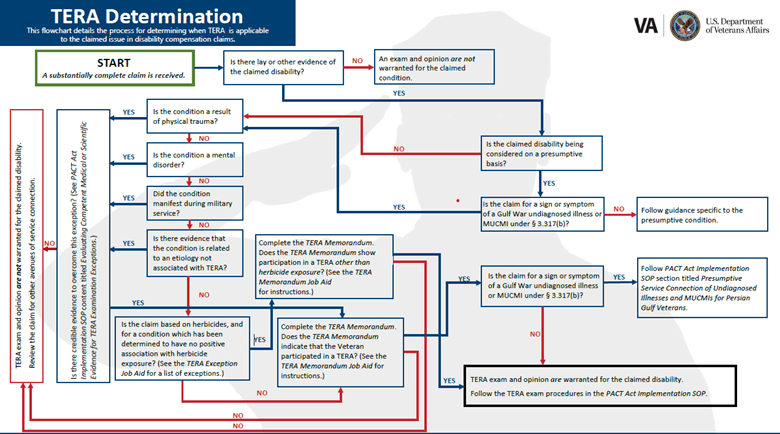
Flowchart of the TERA Medical Opinion Process
Below is a flowchart detailing the process VA claims processors must follow to determine if TERA is applicable to the condition in a disability compensation claim.
What Do These Changes Mean for Veterans and Their Families?
In issuing this memo, VBA aims to provide clarification and guidance for claims processors handling PACT Act-related claims for service connection and service-connected death. The step-by-step process outlined in the TERA memo should enable VA claims processors to review these claims in an efficient and accurate manner the first time around.
CCK Can Help With Your PACT Act Claim
To find out if you qualify for benefits under the PACT Act, check out our blog post detailing PACT eligibility requirements.
If you need assistance filing a PACT Act-related claim or appealing a decision, the team at CCK may be able to assist you. Please contact us for a complimentary case review to see if we can help.