Inclusion Body Myositis VA Ratings and Claims Guide


Veterans can earn disability compensation for service-connected inclusion body myositis (IBM). However, their potential disability rating percentages will vary because IBM has no specified rating criteria in the Department of Veterans Affairs’ (VA) Schedule for Rating Disabilities.
As of November 2026, VA does not recognize IBM as a presumptive condition resulting from toxic exposure under the PACT Act. This means veterans will have to submit medical evidence to VA to prove service connection for IBM on a direct basis.
This article covers where federal recognition of IBM stands as of November 2026, how VA rates the condition, what evidence supports service connection, and what options remain if your IBM claim is denied.
Key points include:
- VA presumes service connection for amyotrophic lateral sclerosis (ALS) under 38 CFR § 3.318. In October 2026, over 50 members of Congress sent a letter to the VA Secretary requesting IBM also be made presumptive under this same regulation.
- Myositis is rated under Diagnostic Code 5021, which evaluates the condition on limitation of motion of the affected body parts.
- Difficulty swallowing and reduced lung function from IBM are generally evaluated under their own diagnostic codes and then combined with a veteran’s IBM musculoskeletal rating.
Who We Are: Chisholm Chisholm & Kilpatrick (CCK Law) has argued many of the cases that define and clarify veterans disability law. Our attorneys serve in many leadership positions and have posted more than 2,500 blogs and 1,100 videos explaining veterans benefits. With 100+ individuals accredited by VA or admitted to practice before the U.S. Court of Appeals for Veterans Claims, CCK Law has recovered over $1 billion in compensation for 36,000+ clients since 1999. (Past results do not guarantee future outcomes.) Contact us to tell us about your case.
What Is Inclusion Body Myositis (IBM)?
Inclusion body myositis (IBM) is a progressive disease that causes chronic muscle inflammation, often leading to deterioration of muscle tissue and loss of function over time. It is part of a group of muscle-wasting conditions called idiopathic inflammatory myopathies, which also includes polymyositis and dermatomyositis.
This disorder primarily affects older men and has the tendency to progress asymmetrically throughout the body, meaning one side of the body is affected more than the other. Symptoms of IBM include:
- Weakness in the arms, legs, and fingers — Difficulty gripping objects, opening containers, or handling tools.
- Trouble standing and climbing stairs — Thigh weakness makes rising from a seated position difficult.
- Falls and loss of balance — Knees may buckle without warning.
- Visible muscle wasting — Loss of bulk in the forearms and thighs.
- Difficulty swallowing — Called dysphagia, this can cause choking and aspiration.
Sporadic inclusion body myositis (sIBM) is the form most veterans are diagnosed with. There is no cure for IBM, and unlike some other forms of myositis, IBM generally does not respond to treatments like corticosteroids or immunosuppressants.
Is Inclusion Body Myositis More Common Among Veterans?
Possibly. The Myositis Association (TMA) claims that IBM occurs at a rate of about 189 per million among veterans, compared to about 15 per million for civilians. These figures also appear in the congressional letter sent to VA Secretary Collins concerning IBM, where they are attributed to an analysis conducted by Dr. Thomas Lloyd, former director of the Neuromuscular Pathology Laboratory at Johns Hopkins, and Dr. Julie Tomaska, a former member of the VA National Research Advisory Council.
According to the congressional letter, researchers have highlighted overlaps between neuromuscular conditions like IBM and the environmental exposure risks that often occur during military service. Dr. Thomas Lloyd claimed in a separate 2022 letter that “since environmental exposures during military service have been shown to increase the risk of developing ALS, it is likely that the same holds true for IBM.”
The rate at which veterans are developing IBM may be increasing, too. According to the congressional letter, in July 2025, 6,771 veterans were receiving VHA care for IBM nationwide, which is an increase of about 221 percent in diagnosed cases since 2010.
In response, VA Press Secretary Quinn Slaven released a statement acknowledging that, while veterans are about 1.5 times more likely to develop ALS than civilians, “no similar association has been identified for inclusion body myositis.”
However, Slaven went on to say that VA is still conducting further investigations into the condition, with VA requesting a new study on IBM from the National Academies of Sciences, Engineering, and Medicine. This study is expected to be released in the summer of 2027.
What Is the VA Rating for Inclusion Body Myositis?
VA rates myositis under 38 CFR § 4.71a, Diagnostic Code 5021. Diagnostic Code 5021 carries no percentage criteria of its own. Instead, it directs VA to evaluate myositis based on limitation of motion of the veteran’s affected parts, as degenerative arthritis.
Essentially, this means percentage ratings for IBM could range from 0 to 100 percent depending on which muscle groups are affected and how severely the disorder limits function and motion. In cases where IBM affects multiple limbs, joints, and other body parts, VA may assign a separate evaluation for each and combine them with VA Math to calculate a veteran’s overall rating.
For example, say there are two veterans suffering from IBM:
- The first veteran’s IBM limits motion only in one knee and one elbow, with no other affected areas. In this case, the veteran’s knee and elbow may be evaluated separately based on limitation of motion under DCs 5261 and 5207, respectively. If the veteran’s limitation of motion is fairly mild, they might receive a rating of 10 percent for their elbow and 10 percent for their knee, which combine through VA Math to an overall rating of 20 percent.
- The second veteran’s IBM also causes limitation of motion in the elbow and knee. However, this veteran’s joint impairments are more severe, and they also suffer from dysphagia as a result of weakened throat muscles. In this case, the veteran’s dysphagia might be evaluated under DC 7203 and its rating combined with those of the veteran’s joint and knee. If the veteran received a rating of 30 percent for their elbow, 40 percent for their knee, and 50 percent for dysphagia, their overall combined rating would come out to 80 percent.
Even though these veterans both have IBM, the difference in symptom severity and affected body parts can lead to drastically different percentage ratings.
How Does VA Rate IBM With Swallowing or Breathing Problems?
If a veteran suffers swallowing or breathing issues due to IBM, these issues will generally be evaluated under their own diagnostic codes (e.g., trouble swallowing could be evaluated under DC 7203 for stricture of the esophagus). These ratings would then be combined with the veteran’s musculoskeletal ratings through VA Math to calculate an overall disability rating.
Since breathing and swallowing issues are both recognized features of advanced IBM, a veteran who has either should make sure it is documented and claimed. A swallow study or pulmonary function testing may help create the objective evidence a rating specialist needs.
Can a Veteran Get 100% or TDIU for Inclusion Body Myositis?
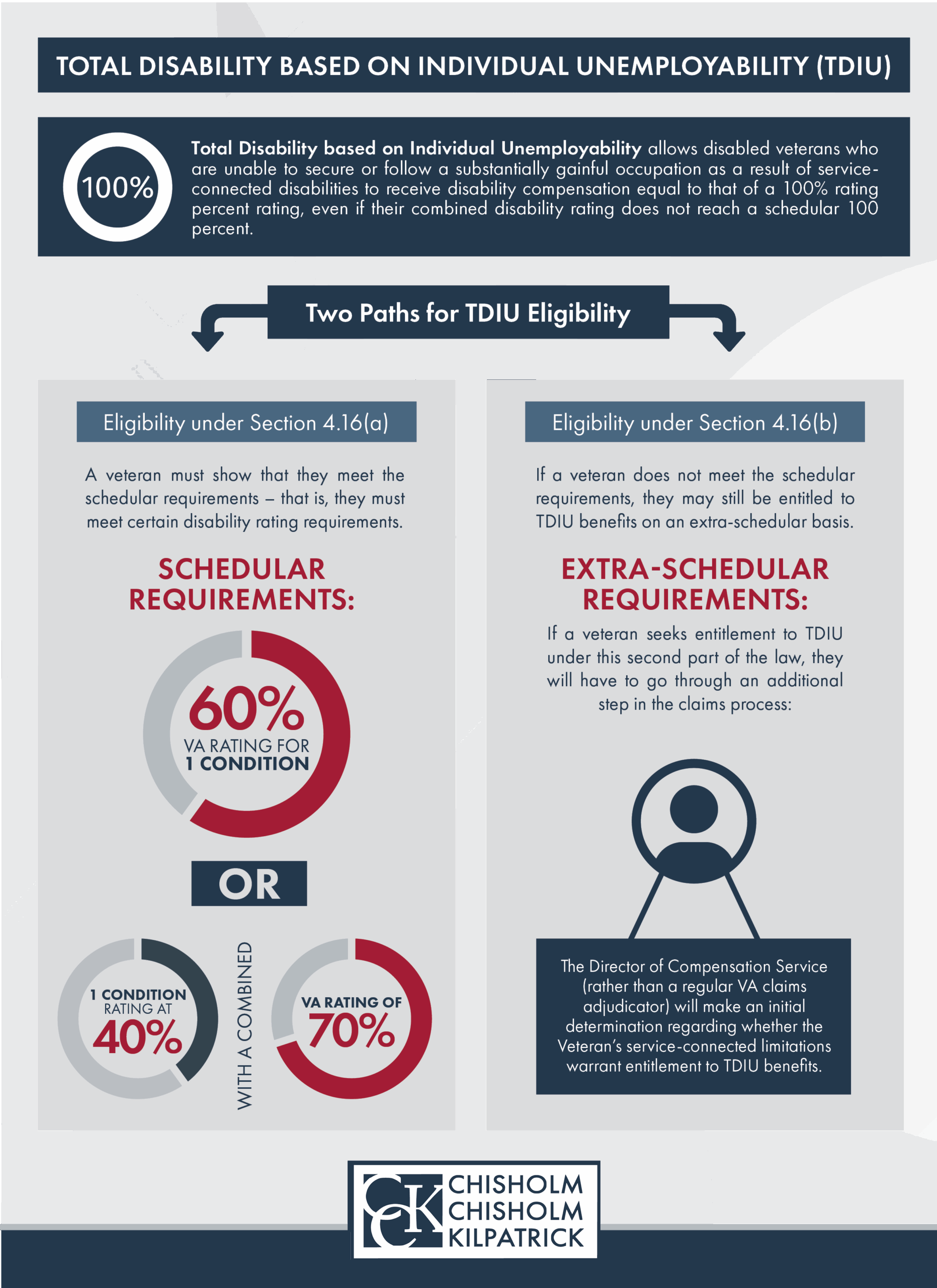
Yes, veterans can earn 100 percent ratings for IBM either through VA’s schedular rating process, or through a benefit called total disability based on individual unemployability (TDIU).
- 100 Percent Schedular Rating – It is technically possible to earn a 100 percent rating through one of the conditions by which body myositis is rated. A veteran could also combine multiple individual percentage ratings for each of their joints or other affected body parts until their overall rating reached 100 percent. A veteran with a single systemic complication, such as respiratory muscle involvement, can potentially reach a 100 percent rating with that alone.
- TDIU – TDIU can be earned if the veteran’s service-connected IBM inhibits their ability to work to support themselves. This benefit pays at the 100 percent rate, even if the veteran’s actual disability rating is lower than 100 percent.
Of these two, TDIU is probably the more realistic route to 100 percent in IBM claims, since grip and mobility loss can prevent a person from working well before the limitation-of-motion measurements reach 100 percent.
It is also important to keep in mind that, since IBM is a condition that progresses over time, veterans should consider filing increased rating claims if their IBM has significantly worsened.
How Do Veterans Establish Service Connection for Inclusion Body Myositis?
Direct service connection is the most viable pathway to earning a disability rating for IBM. Generally, to establish direct service connection, veterans will need to submit three key pieces of evidence to VA:
- A current diagnosis of IBM;
- An in-service event, injury, or exposure that could have led to IBM developing; and
- A medical nexus opinion that draws a link between the two.
Is Inclusion Body Myositis a Presumptive Condition for VA?
No, as of November 2026, VA does not recognize IBM as a presumptive condition.
Presumptive conditions are those VA will automatically assume are service connected, as long as the veteran meets the proper eligibility requirements. IBM does not have any presumptions attached to it, though there have been recent pushes to change that.
In October 2026, 54 lawmakers from both parties, led by Senator Tammy Baldwin, wrote to the VA Secretary asking that IBM be made a presumptive condition under 38 CFR § 3.318. This federal code establishes the presumption for amyotrophic lateral sclerosis (ALS), which bears many similarities to IBM, including progressive weakness and loss of motor function. Because of this, many lawmakers and veterans believe IBM deserves to be made presumptive alongside ALS.
So far, no changes in IBM’s status have occurred as a result of the letter. However, it is possible IBM may be added to § 3.318 at some point in the future and thereby made presumptive. If this happens, IBM that develops at any time after discharge may be sufficient to establish service connection, provided the veteran had 90 days or more of continuous active service.
Watch CCK Law Founding Partner Robert Chisholm break down presumptive conditions for older veterans:

What Evidence Does an Inclusion Body Myositis Claim Need?
Because no presumption applies to IBM, it is the evidence a veteran submits that will determine whether their condition is recognized as service connected. Some forms of evidence that could support a direct claim for IBM include:
- Medical records specifically indicating that the veteran suffers from IBM, with biopsy or specialist findings where available.
- Service personnel records establishing the veteran may have suffered an exposure or event that contributed to their developing IBM.
- A medical nexus opinion stating that IBM is “at least as likely as not” related to the veteran’s service, with thorough medical reasoning supporting its assertion.
- Service treatment records and later medical records showing when symptoms first appeared.
- Lay statements from the veteran, family members, and fellow service members describing the onset and progression of IBM.
Of these forms of evidence, it is often the nexus opinion that can end up deciding the success or failure of an IBM claim. An effective nexus opinion for IBM would identify the exposure, address the medical literature, and explain why the physician reached the conclusion that the veteran’s IBM is likely related to their service.
On the other hand, a weak nexus opinion may be too brief or provide little reasoning for the physician’s assertion, and thus may bear less weight to the VA rater deciding the claim.
What Happens if VA Denies an Inclusion Body Myositis Claim?
Veterans have options if their IBM claim is denied. Generally, a veteran has one year from the date of VA’s decision to appeal a denied claim. Meeting this deadline helps protect the veteran’s original effective date, which determines how much back pay they will receive if their appeal is successful.
The three appeal options open to veterans are:
- Higher-Level Review — A more senior reviewer takes a fresh look at the same evidence. Useful where the denial appears to rest on an error rather than a gap in the record.
- Supplemental Claim — Allows new and relevant evidence, which makes it the usual choice where the denial turned on a weak or missing nexus opinion.
- Board appeal — Sends the case to the Board of Veterans’ Appeals, with options for a direct review, additional evidence, or a hearing before a Veterans Law Judge.
Because IBM claims commonly fail on the nexus element rather than on the diagnosis, the Supplemental Claim option may be the most reliable appeal pathway for veterans. This option allows veterans to submit new, stronger nexus opinions if the initial one was insufficient.
What Other VA Benefits May Be Available for Inclusion Body Myositis?
In addition to standard monthly compensation, a disability rating for IBM can grant veterans access to other benefits as the disease advances:
- Special Monthly Compensation (SMC) — SMC offers additional compensation for losses such as loss of use of a hand or foot, or for needing the regular aid and attendance of another person.
- Caregiver support — This program offers support for the eligible caregivers of disabled veterans. It is administered separately from the disability claim, with its own eligibility criteria and its own application.
- VA health care and adaptive benefits — Veterans suffering from IBM may also qualify for VA benefits including assistive devices, home modification grants, and automobile adaptive equipment where criteria are met.
Did VA Deny Your IBM Claim?
If you disagree with a VA decision, consider contacting Chisholm Chisholm & Kilpatrick. An experienced, VA-accredited law firm may offer significant tools and resources in support of your appeal.
While past results do not guarantee future outcomes, CCK Law has had favorable outcomes in 98.5% of its actions before VA and a 95% win rate before the U.S. Court of Appeals for Veterans Claims (federal court). We have recovered over $1 billion in compensation for 36,000+ clients to date.
Contact us online or at 800-544-9144 to tell us about your case.
Frequently Asked Questions About Inclusion Body Myositis and VA Benefits
Do I need a muscle biopsy for VA to accept my IBM diagnosis?
A biopsy is the definitive diagnostic test, and a biopsy-confirmed diagnosis is difficult for VA to dispute. Other testing could include clinical examinations of muscle strength, blood work, electromyography, or MRI. For claims purposes, the wording of the diagnosis matters as much as the testing behind it. A record describing “myopathy” or “muscle weakness of unclear origin” leaves VA an easy basis to deny. A record naming inclusion body myositis does not.
Will VA order a C&P exam for inclusion body myositis?
It is possible, since VA often schedules C&P exams when it needs more information to decide a veteran’s claim. Because IBM is uncommon, however, the veteran’s examiner may not always be a neuromuscular specialist, which could negatively impact the C&P exam and overall claims. Veterans who believe their C&P exams were inadequate can challenge those exams or obtain a nexus opinion from their treating physician.
Is IBM treated the same as ALS for VA purposes?
No. ALS carries a presumption of service connection under 38 CFR § 3.318. IBM does not, so a veteran with IBM must prove the link to service by submitting evidence like medical records and nexus opinions.
I am a Gulf War veteran with IBM. How do I file?
Veterans can file a direct service connection claim for IBM by filling out and submitting VA Form 21-526EZ. On the form, they should be sure to identify specific in-service exposures that may have caused their IBM. They should also submit evidence like medical records, service records, or a medical nexus opinion supporting their claim.
Share this Graphic