'/%3E%3Cpath%20fill='%23b2b2b2'%20d='M241%20382q0%2016%2017%2026%2017%2011%2042%2011t42-11q16-11%2017-26V269H241'/%3E%3Cpath%20fill='%239f7e00'%20d='M241%20379q0%2014%208%2023%209%209%2021%209%2014%200%2021-9%209-9%209-23V269h-59'/%3E%3Cpath%20d='M241%20339v-70h59v110q0%2014-9%2023l-6%205v-68h-15v72q-8%200-14-4v-68zm59%2040c0%2022%2015%2032%2029%2032%2021%200%2030-18%2030-32v-40h-59'/%3E%3Cpath%20fill='%239f7e00'%20d='M266%20277v5h2v12h-3v-5h2v-5h-9v5h2v5h-4v9h3v18h-5v10h34v-10h-5v-18h3v-9h-4v-5h2v-5h-9v5h2v5h-3v-12h2v-5zm42%20101q0%2010%206%2017%206%206%2015%207%2010-1%2016-7%206-7%206-17v-29h-43'/%3E%3Ccircle%20fill='%230044ad'%20cx='329.5'%20cy='372'%20r='6'/%3E%3Cellipse%20fill='%230044ad'%20cx='300'%20cy='340'%20rx='16'%20ry='21'/%3E%3C/svg%3E)

How To Increase Your VA Disability Rating: 4 Proven Methods That Work


If VA gave you a disability rating that seems too low for your condition, you are not alone. Thousands of veterans receive initial ratings that they feel do not reflect the true impact of their service-connected disabilities. The good news? You have options to increase your VA disability rating and get any compensation you may be entitled to.
This comprehensive guide covers everything you need to know about increasing your VA disability rating, including:
- Four proven methods to boost your rating from 30 percent to 70 percent, 70 percent to 100 percent, or anywhere in between
- Step-by-step instructions for each approach
- Important deadlines you cannot afford to miss
- Insider tips from veteran disability attorneys
- Real risks to consider before filing
Who We Are: Chisholm Chisholm & Kilpatrick (CCK Law) has argued many of the cases that have defined and clarified veterans disability law. CCK Law attorneys serve in leadership positions throughout the legal community and have posted more than 2,500 blogs and 1,100 videos about veterans benefits.
Watch CCK Law Partners Jenna Zellmer, Emma Peterson, and Lindy Nash explain what veterans can do to pursue an increased VA disability rating:
What Do VA Disability Ratings Mean (And Why Is Higher Better)?
VA disability ratings range from 0 percent to 100 percent in 10 percent increments. Your rating determines:
- Monthly compensation amount (10–100 percent ratings qualify for payments; 0 percent ratings do not give compensation but enable other benefits)
- Health care benefits through VA medical centers
- Additional benefits like vocational training and housing assistance
- Special Monthly Compensation (SMC) for severe disabilities
As of 2026, the VA disability rate benefit amounts are as follows:
- 0 percent disability rating: $0.00 per month
- 10 percent disability rating: $180.42 per month
- 20 percent disability rating: $356.66 per month
- 30 percent disability rating: $552.47 per month
- 40 percent disability rating: $795.84 per month
- 50 percent disability rating: $1,132.90 per month
- 60 percent disability rating: $1,435.02 per month
- 70 percent disability rating: $1,808.45 per month
- 80 percent disability rating: $2,102.15 per month
- 90 percent disability rating: $2,362.30 per month
- 100 percent disability rating: $3,938.58 per month
Note: Rates include Cost of Living Adjustment and may vary based on dependents.
The bottom line: A higher rating means significantly more monthly compensation and better benefits.
How Does VA Assign Disability Ratings?
After receiving a veteran’s claim and acknowledging service connection for the condition, VA uses 38 CFR Part 4 — Schedule for Rating Disabilities to assign ratings based on your symptoms. If your current symptoms match a higher rating level than what you received, you may have grounds for an increase.
Evidence that can support your claim and improve your rating include:
- Medical records from VA or private doctors
- Test results showing a worsened condition
- Service records documenting your military service
- Lay statements from family, friends, or coworkers
- Employment records showing work limitations
4 Ways To Increase Your VA Disability Rating
Method #1: File an Appeal (Within One Year of Decision)
Best for: Veterans who received their rating decision within the past year and believe it was wrong from the start.
Deadline: One year from your decision letter date
Your Three Appeal Options:
Higher-Level Review (Fastest)
- Same evidence reviewed by a senior VA employee
- No new evidence allowed
- Goal timeline: 365 days
- Best if you think VA made an error with existing evidence
Supplemental Claim (Most Common)
- Submit new and relevant evidence
- VA helps gather additional evidence
- Keeps your original effective date if filed within one year
- Best if you have new medical records or test results
Board of Veterans’ Appeals
- Direct review by a Veterans Law Judge
- Three sub-options:
- Direct Docket: No new evidence, no hearing (365-day goal)
- Evidence Docket: Submit new evidence (up to 550 days)
- Hearing Docket: Appear before a judge (up to 730 days, sometimes longer)
Below, watch CCK Law Partners Jenna Zellmer and Michael Lostritto explain whether veterans should consider appealing their VA claim themselves or hire a VA-accredited representative:

Method #2: File a New Claim for Increased Rating
Best for: Veterans whose condition has worsened since their original rating, or those outside the one-year appeal window.
No deadline — can file anytime
What You Will Need:
- VA Form 21-526EZ (Application for Disability Compensation)
- New medical evidence showing your condition has worsened
- Attendance at C&P exam (mandatory — missing it can result in denial)
Method #3: Apply for TDIU (Total Disability Based on Individual Unemployability)
Best for: Veterans who cannot work due to service-connected disabilities but do not have a 100 percent schedular rating.
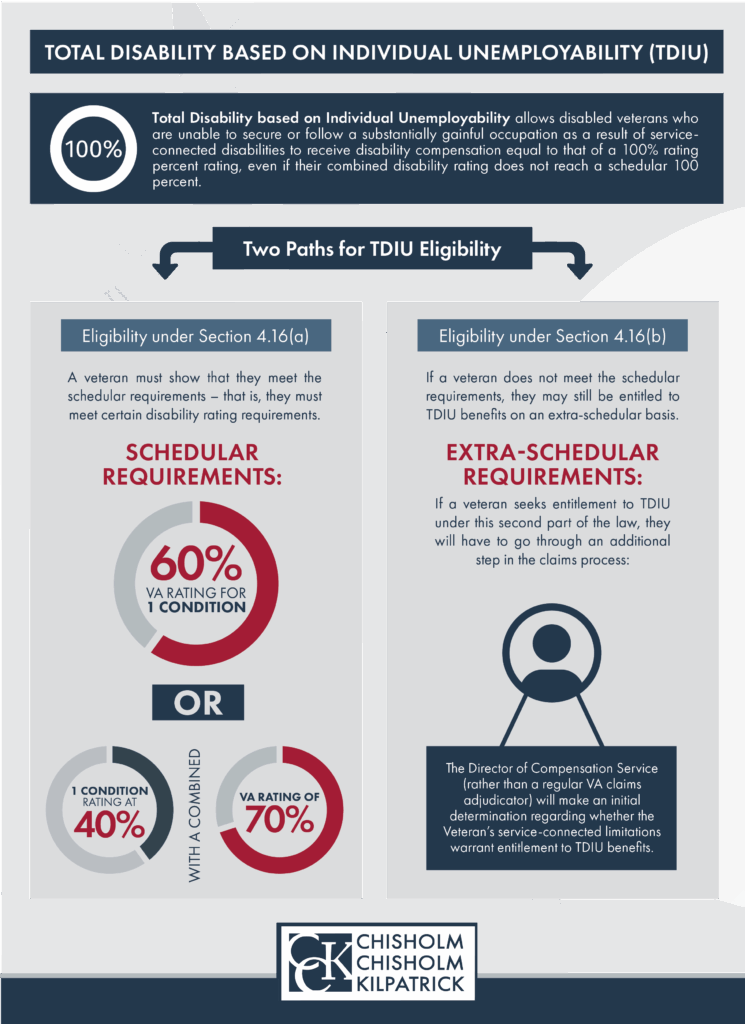
TDIU pays you at the 100 percent rate even if your combined rating is lower.
Eligibility Requirements:
Schedule Requirements (easier to qualify):
- One disability rated at least 60 percent; OR
- Multiple disabilities with one at 40 percent minimum and a combined rating of 70 percent.
Extraschedular (harder but possible):
- Prove your disabilities prevent substantially gainful employment.
- Show the rating schedule does not capture your functional limitations.
- Your claim will need to be approved by VA’s Director of Compensation.
How To Apply:
- VA Form 21-8940 (Veteran’s Application for Unemployability)
- Submit online, by mail, fax, or in person
- Include employment history and medical evidence
TDIU is a challenging claim. Consider contacting CCK Law or another experienced VA-accredited advocate for assistance.
In the video below, CCK Law Founding Partner Robert Chisholm and Partners Michael Lostritto and Maura Black discuss how veterans can pursue TDIU:
Method #4: File for Secondary Service Connection
Best for: Veterans whose service-connected disability caused or worsened other conditions. This is referred to as “secondary service connection.”
This is not technically an increase. It is a new disability rating that gets combined with your existing rating using “VA Math.”
Common secondary conditions include:
- Back injury → knee/hip problems (altered gait)
- PTSD → sleep apnea (medication side effects)
- Service-connected injury → depression/anxiety
- Medication side effects → gastrointestinal issues
What You Need To Prove:
- You have a current disability.
- Your service-connected condition caused or aggravated it.
- You’ve obtained a medical nexus connecting the two conditions.
Watch CCK Law’s Brandon Paiva, a VA-Accredited Claims Advocate, explain how veterans can use secondary claims to get a 100 percent rating:
Which Method for Increasing a VA Disability Rating Is Right for You?
If you are having trouble determining which method is best for your needs, use this decision tree:
Did you receive your rating decision within the past year?
- Yes: Consider filing an appeal (Method #1)
- No: Continue to next question
Has your condition gotten worse since your original rating?
- Yes: File a new claim for increased rating (Method #2)
- No: Continue to next question
Are you unable to work due to your disabilities?
- Yes: Consider TDIU (Method #3)
- No: Continue to next question
Has your service-connected disability caused other health problems?
- Yes: File for secondary service connection (Method #4)
What Are Important Risks To Consider When Trying To Increase a VA Rating?
Rating Reductions Are Possible
When you ask VA to review your rating, they examine your entire claim file. If they determine your condition has improved or you were initially rated too high, they can reduce your rating. If VA is in error, this can result in extensive delays while you appeal and reclaim your benefits.
When Rating Reductions Are More Likely:
- Your condition is expected to improve over time.
- You have a temporary 100 percent rating.
- Your medical records show improvement.
How To Minimize Risk of VA Errors:
- Consult with a VA-accredited attorney before filing
- Gather strong supporting evidence
- Continue regular medical treatment
- Document ongoing symptoms and limitations
What Common Mistakes Can Hurt Your Chances?
- Filing without new evidence — VA needs proof that your condition has worsened.
- Missing C&P exams — This results in an automatic denial in most cases.
- Not preparing for C&P exams — Be honest but thorough about your worst days.
- Doing it alone — Consider hiring a VA-accredited attorney for appeals.
- Missing deadlines — Your appeal rights expire after one year.
- Understating symptoms — Do not downplay your limitations during exams.
Timeline: What Should Veterans Expect?
These timelines can vary significantly based on the facts of your case and VA’s backlog.
Initial Claims Processing:
- New claims: 100–200+ days on average
- Appeals: Varies significantly by type (see detailed timelines above)
After You File:
- VA acknowledges receipt (one to two weeks).
- VA schedules C&P exam if needed (four to eight weeks).
- VA makes a decision (varies).
- You receive a decision letter with a new rating.
In the video below, CCK Law Founding Partner Robert Chisholm and Partner Brad Hennings discuss how long veterans can expect the VA claims and appeals process to take:
Pro Tips From Experienced VA Disability Attorneys
Before You File:
- Research the rating criteria for your condition in the VA Schedule for Rating Disabilities.
- Talk to your doctor about whether an increase request is realistic.
- Gather strong medical evidence showing symptom progression.
- Consider consulting a VSO or an attorney for complex cases.
During the Process:
- Keep copies of everything you submit.
- Track all deadlines carefully.
- Attend all scheduled exams — even if you feel terrible.
- Be completely honest during C&P exams about your limitations.
After Your Decision:
- Review the decision letter carefully — You may have additional appeal rights.
- Do not give up if denied — Many veterans succeed on appeal.
- Consider legal representation for Board appeals.
When Should Veterans Hire a VA-Accredited Attorney To Help Increase Their Rating?
You are always welcome to contact CCK Law for a free case evaluation. You may particularly want to consider professional help if:
- Your case involves multiple disabilities.
- You are filing a Board appeal.
- VA has proposed reducing your rating.
- You have been denied multiple times.
- Your disabilities are complex or rare.
- You are seeking TDIU benefits.
Need Help Appealing Your VA Claim or Increasing Your Rating? Contact CCK
We hope this blog helped answer your questions.
Need personalized assistance? If VA has made any kind of decision related to your claim, then CCK Law may be able to help. Contact us online or at 800-544-9144 for a free case evaluation.
(As of 2026, federal law prohibits agents and attorneys from charging veterans a fee to file an initial VA claim. In these cases, you will need to find a VA-accredited representative or VSO to assist you.)
Looking for more information? CCK Law hosts over 2,500 pages and 1,100 videos of free veterans law content. Search our blog or browse our YouTube channel for guides, explainers, and updates on VA benefits topics.
Stay current. Veterans disability law and VA policy change frequently. Follow CCK Law on social media using the links at the bottom of this page, or subscribe to one of our newsletters for updates tailored to your situation.


