
How Much Compensation Do Veterans Get for Service-Connected Disabilities?


U.S. military veterans with service-connected disabilities may be eligible for monthly, tax-free compensation. How much veterans get as disability compensation depends on the rating that the U.S. Department of Veterans Affairs (VA) assigns to their service-connected disability.
If veterans have more than one service-connected condition, the amount of monthly compensation will be based on their combined disability rating. Compensation can also be affected by dependents and by special situations like loss of use of limbs or needing daily assistance.
Veterans who know their ratings can easily calculate their compensation using the CCK Disability Calculator.
Who We Are: Chisholm Chisholm & Kilpatrick (CCK Law) has argued many of the cases that have defined and clarified veterans disability law. CCK Law attorneys serve in leadership positions throughout the legal community and have posted more than 2,500 blogs and 1,100 videos about veterans benefits.
Who Is Eligible for VA Disability Compensation?
First and foremost, you must have served in the U.S. military, whether on active duty, active duty training, or inactive duty training. You also need to establish a service connection for a condition related to your military service and have had VA assign a disability rating for that condition.
Only ratings of 10 percent or higher qualify for compensation, although noncompensable (0 percent) ratings can qualify veterans for other benefits like health care.
How VA Assigns a Disability Rating
VA assigns a disability rating based on the Schedule for Rating Disabilities. What veterans should know about the rating schedule:
- This rating schedule is mainly a guide for evaluating disability caused by diseases and injuries that happen during or because of military service.
- The percentage ratings show, as accurately as possible, how much these conditions affect a veteran’s ability to earn a living in civilian jobs. In general, the listed disability levels are meant to make up for the amount of work time a veteran may lose because of flare-ups or illnesses that match each level of severity.
- To apply this schedule correctly, medical exams must be accurate and clearly describe the condition, especially how it limits the veteran’s activities. Over many years, a veteran’s disability claim may need to be rated again if laws change, medical knowledge improves, or the veteran’s physical or mental condition changes. For this reason, it is important that each disability be examined and evaluated with its full history in mind.
- The authority for the VA Schedule for Rating Disabilities is 38 U.S.C. § 1155. The complete regulations are located in Title 38, Part 4 of the Code of Federal Regulations (CFR).
How Much VA Disability Compensation Do Disabled Veterans Receive?
A veteran’s service-connected condition(s) must have a combined disability rating of at least 10 percent for the veteran to qualify for VA monthly compensation. The highest possible “schedular” disability rating VA can assign to a veteran’s condition is 100 percent. Alternatively, veterans with unique medical situations may receive Special Monthly Compensation, which is higher than schedular compensation.
As of 2026, the VA disability rate benefit amounts are as follows:
- 0 percent disability rating: $0.00 per month
- 10 percent disability rating: $180.42 per month
- 20 percent disability rating: $356.66 per month
- 30 percent disability rating: $552.47 per month
- 40 percent disability rating: $795.84 per month
- 50 percent disability rating: $1,132.90 per month
- 60 percent disability rating: $1,435.02 per month
- 70 percent disability rating: $1,808.45 per month
- 80 percent disability rating: $2,102.15 per month
- 90 percent disability rating: $2,362.30 per month
- 100 percent disability rating: $3,938.58 per month
Does VA Change Compensation Amounts Over Time?
VA does apply the federal Cost of Living Adjustment (COLA) each year:
- Periodic adjustments: The VA makes cost-of-living adjustments (COLAs) periodically to the compensation and pension benefits for veterans. These adjustments are designed to offset the effects of inflation on the purchasing power of the benefits provided to veterans.
- Matching inflation rate: The COLA is a percentage that reflects the rate of inflation, and it’s applied to VA compensation and pension benefits to match the inflation rate.
- Determination by Social Security Administration (SSA): The rate of COLA is based on the change in the cost of living as determined by the Social Security Administration (SSA). The same percentage of COLA applied to Social Security benefits is applied to VA compensation, ensuring that veterans’ benefits increase at a rate that’s aligned with the general cost of living.
Through these mechanisms, VA ensures that the compensation rates provided to veterans are adjusted in a manner that reflects changes in the cost of living, helping to maintain the real value of the benefits over time.
How Do Dependents Increase VA Disability Compensation?
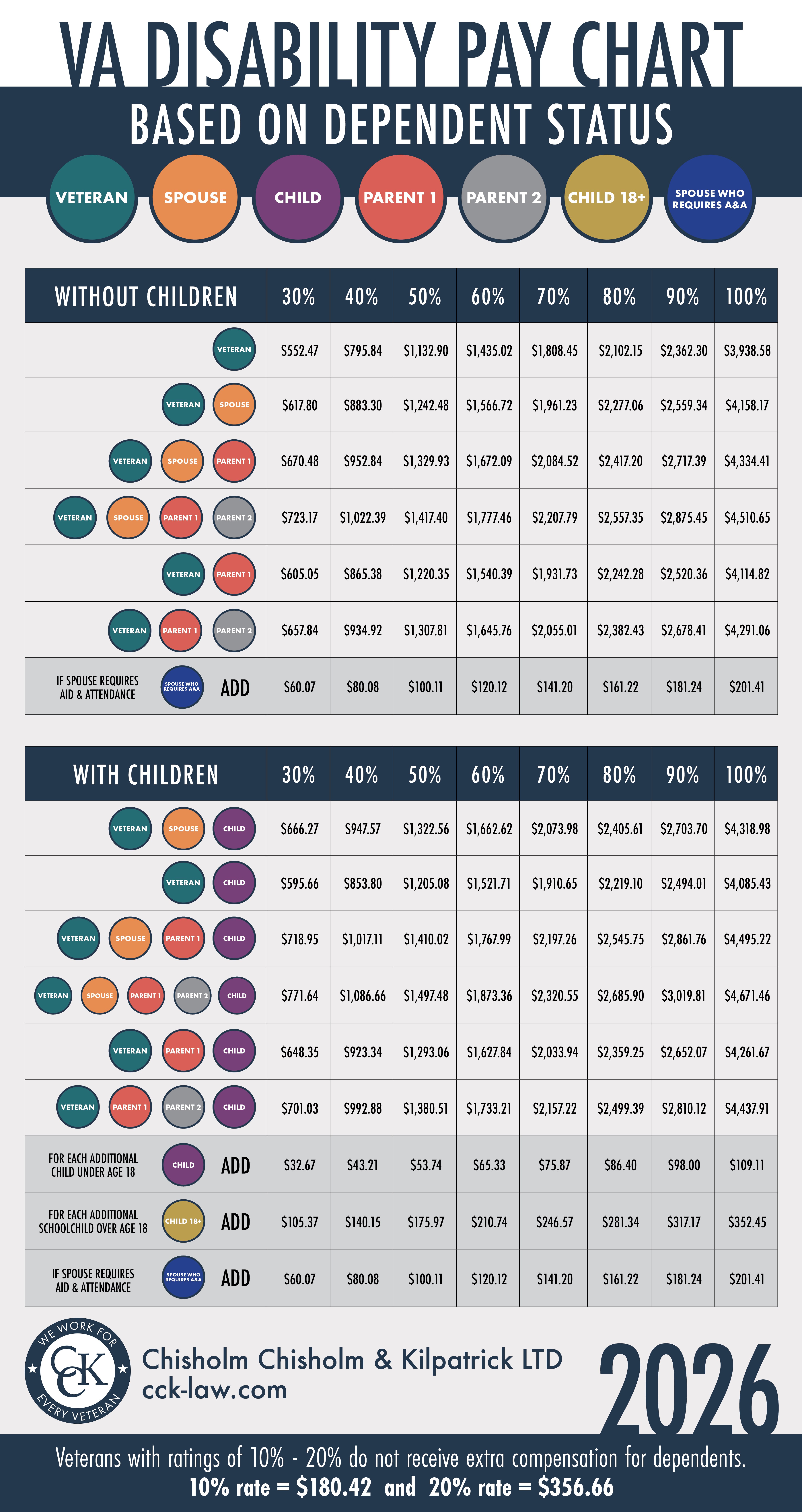
If you have a combined disability rating of 30 percent or higher, then you may be eligible for additional monthly compensation for qualifying dependents, including:
- Children under 18 years old
- Children ages 18 to 23 years old and still in school
- Spouses
- Dependent parents
Use the chart below to calculate compensation with dependents.
Special Monthly Compensation for Disabilities Causing Severe Impairment
Veterans who have service-connected conditions that result in severe impairment may be eligible for additional monthly compensation. This type of compensation is known as Special Monthly Compensation. Some examples include:
- the loss of use of extremities
- blindness
- the regular need for aid and attendance
Special Monthly Compensation pays at higher rates than regular monthly compensation.
Dependency and Indemnity Compensation (DIC)
VA also offers Dependency and Indemnity Compensation (DIC) to the spouses or dependent children of veterans who were killed in the line of duty or passed away from a service-connected condition. Though DIC is distinct from disability compensation, it can still provide substantial monthly income for the survivors of a veteran whose death was connected to their military service.
What To Do if You Disagree With VA’s Rating of Your Disability
We hope this blog helped answer your questions.
Need personalized assistance? If VA has made any kind of decision related to your claim, then CCK Law may be able to help. Contact us online or at 800-544-9144 for a free case evaluation.
(As of 2026, federal law prohibits agents and attorneys from charging veterans a fee to file an initial VA claim. In these cases, you will need to find a VA-accredited representative or VSO to assist you.)
Looking for more information? CCK Law hosts over 2,500 pages and 1,100 videos of free veterans law content. Search our blog or browse our YouTube channel for guides, explainers, and updates on VA benefits topics.
Stay current. Veterans disability law and VA policy change frequently. Follow CCK Law on social media using the links at the bottom of this page, or subscribe to one of our newsletters for updates tailored to your situation.


