Bipolar Disorder: VA Ratings, Claims, and Compensation


Bipolar disorder is a mental disorder that causes unusual shifts in mood, energy, activity levels, concentration, and the ability to carry out daily life tasks. For many veterans, this condition is a direct result of their military service and can stand in the way of living a fulfilling life.
If you are a veteran suffering from bipolar disorder as a result of your military service, then you may be entitled to monthly compensation from VA, depending on the cause and severity of your symptoms. This article will help you claim these benefits, starting with how to earn a bipolar disorder VA rating.
Highlights of this article include:
- An exploration of the symptoms of bipolar disorder
- Strategies to claim VA disability for bipolar disorder
- Methods to gain a bipolar disorder VA rating
- And more
Who We Are: Chisholm Chisholm & Kilpatrick (CCK Law) has argued many of the cases that define and clarify veterans disability law. Our attorneys serve in many leadership positions and have posted more than 2,500 blogs and 1,100 videos explaining veterans benefits. With 100+ individuals accredited by VA or admitted to practice before the U.S. Court of Appeals for Veterans Claims, CCK Law has recovered over $1 billion in compensation for 36,000+ clients since 1999. (Past results do not guarantee future outcomes.) Contact us to tell us about your case.
What Is Bipolar Disorder?
Bipolar disorder (formerly known as manic-depressive disorder or manic depression) is a mental disorder commonly characterized by extreme mood swings that include emotional highs (mania or hypomania) and lows (major depressive episodes). This condition can make it difficult to maintain relationships.
Nonetheless, the hazards involved in military service can substantially increase one’s risk for developing bipolar disorder, leading this condition to be of particular concern amongst veterans. Some of these hazards include:
- High-stress conditions
- Exposure to mental trauma
- Potential for traumatic brain injury (TBI)
- Lack of a social support system
Treatment for bipolar disorder (I and II) often involves medication for mood stabilization. From there, individuals may become involved in psychotherapy (i.e., talk therapy) with a licensed clinician. Although bipolar disorder is a lifelong condition, the symptoms can be managed effectively.
Major Depressive Episode
A major depressive episode includes symptoms that are severe enough to cause noticeable difficulty in day-to-day activities, such as work, school, social activities, or relationships. An episode includes five or more of these symptoms:
- Depressed mood, including feelings of sadness, emptiness, and hopelessness
- Marked loss of interest or feeling no pleasure in majority of activities
- Significant weight loss, weight gain, or decrease or increase in appetite
- Insomnia or sleeping too much
- Fatigue or loss of energy
- Feelings of worthlessness or excessive or inappropriate guilt
- Decreased ability to concentrate
- Suicidal ideation
Mania or Hypomania
Although mania and hypomania are two distinct types of episodes, they have the same symptoms (see below). The main difference between mania and hypomania involves the level of severity. In this case, mania is more severe than hypomania and causes more noticeable problems at work, school, and social activities. Both a manic and a hypomanic episode include three or more of these symptoms:
- Abnormally upbeat, jumpy, or wired
- Increased activity, energy, or agitation
- Exaggerated sense of well-being and self-confidence (euphoria)
- Decreased need for sleep
- Unusual talkativeness
- Racing thoughts
- Distractibility
- Poor decision-making (e.g., buying/spending sprees, taking sexual risks, starting grandiose projects)
Episodes of mood swings between mania or hypomania and depression may occur rarely or multiple times a year (referred to as “rapid cycling”).
Importantly, there are a few types of bipolar disorder.
Bipolar I Disorder
With bipolar I disorder, you must experience at least one manic episode that may be preceded or followed by either a hypomanic or major depressive episode. In some cases, mania may become so extreme that individuals experience a state of psychosis (i.e., a break from reality).
Bipolar II Disorder
Bipolar II disorder is characterized by at least one major depressive episode and at least one hypomanic episode. However, it does not include a manic episode.
Cyclothymic Disorder
Cyclothymic disorder or cyclothymia is a milder form of bipolar disorder that often occurs in adolescence or early adulthood. Typically, those suffering from cyclothymia have more moderate—but still significant—mood swings, not reaching the extreme highs and lows that characterize other forms of bipolar disorder.
A Bipolar Disorder VA Rating Requires Service Connection
If you are a veteran suffering from bipolar disorder, you may be eligible for VA disability benefits. In order to receive monthly disability compensation, you must first establish service connection—proof that your condition is related to your military service.
Direct Service Connection for Bipolar Disorder
When it comes to VA disability for bipolar disorder, direct service connection is when you can prove that your bipolar condition either directly resulted from or was aggravated by your military service.
The following three elements are required by VA to prove direct service connection:
- A current diagnosis of bipolar disorder—typically provided by a medical professional
- An in-service event, injury, or illness—in-service records documenting this event are often quite helpful
- A medical nexus linking the current diagnosis of bipolar disorder to the in-service incurrence—this, too, is provided by a medical professional, and serves as an official opinion that your disorder is “at least as likely as not” to have resulted from the in-service event or injury
Secondary Service Connection for Bipolar Disorder
Secondary service connection applies when a veteran can demonstrate that their bipolar disorder stems from another condition that is already recognized as service connected.
For example, say a veteran has a traumatic brain injury (TBI) from a car crash that they suffered during their service, and that VA recognizes the service connection of this TBI and provides the veteran disability compensation for it.
If this veteran later goes on to develop symptoms of bipolar disorder, they may be able to connect these symptoms to their service by claiming they are a result of the TBI. If their claim is successful, then they will have established secondary service connection for bipolar disorder by way of traumatic brain injury.
Evidence for Establishing Service Connection for Bipolar Disorder
One of the first pieces of evidence VA looks for when determining a veteran’s eligibility for service connection are in-service treatment records. If symptoms of bipolar disorder emerged while a veteran was in the military and they sought treatment with a mental health counselor, it should be documented in service records.
In some cases, veterans do not have in-service medical records detailing the onset of their bipolar disorder. Here, veterans can provide lay statements from themselves, family, friends, or fellow service members describing how bipolar disorder has affected them.
Bipolar Disorder VA Ratings
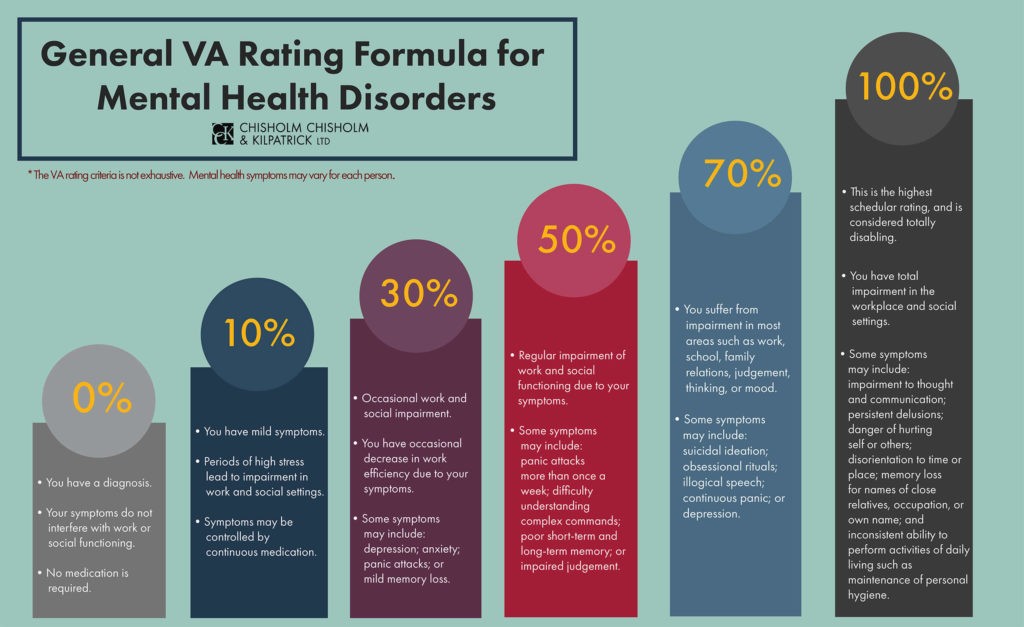
VA rates all mental health conditions using the same diagnostic criteria. Therefore, a VA rating for bipolar disorder ranges from 0 to 100 percent. Mental health conditions are rated under 38 CFR § 4.130 using VA’s General Rating Formula for Mental Disorders.
The VA bipolar rating criteria are as follows:
- 100 percent—Presents total occupational and social impairment
- 70 percent—Occupational and social impairment, with deficiencies in most areas
- 50 percent—Presents occupational/social impairment with reduced reliability
- 30 percent—Occupational and social impairment with occasional decrease in work efficiency and intermittent periods of inability to perform occupational tasks
- 10 percent—Occupational or social impairment due to mild or transient symptoms
- 0 percent—If diagnosed but symptoms are not severe enough to interfere in occupational or social settings
These bipolar disorder VA ratings are based on the level of social and occupational impairment the condition presents.
For example, if a veteran is experiencing mild bipolar disorder symptoms, they may receive a disability rating of only 10 percent. Veterans with more severe bipolar disorder symptoms—such as an intermittent inability to perform the activities of daily living or suicidal ideation—may receive a higher rating disability rating.
Does VA Consider Veterans’ GAF Scores?
Previously, VA rated veterans’ mental health conditions using a Global Assessment of Functioning (GAF) score. As of August 2014, VA officially adopted the Diagnostic and Statistical Manual (DSM-5). The DSM-5 does not feature GAF scores, and therefore, they are not used by VA when adjudicating claims for mental health conditions, such as bipolar disorder.
VA Disability for Bipolar Disorder
If a veteran successfully acquires a bipolar disorder VA rating, then they qualify to begin receiving monthly compensation from VA.
As of 2026, the VA disability rate benefit amounts are as follows:
- 0 percent disability rating: $0.00 per month
- 10 percent disability rating: $180.42 per month
- 20 percent disability rating: $356.66 per month
- 30 percent disability rating: $552.47 per month
- 40 percent disability rating: $795.84 per month
- 50 percent disability rating: $1,132.90 per month
- 60 percent disability rating: $1,435.02 per month
- 70 percent disability rating: $1,808.45 per month
- 80 percent disability rating: $2,102.15 per month
- 90 percent disability rating: $2,362.30 per month
- 100 percent disability rating: $3,938.58 per month
Depending on certain factors, like the number of dependents a veteran has, it is possible to receive more compensation than the amounts listed in the table above.
Total Disability Based on Individual Unemployability (TDIU) for Bipolar Disorder
If a veteran is unable to secure and maintain substantially gainful employment as a result of their service-connected bipolar disorder, they may be entitled to total disability based on individual unemployability (TDIU). TDIU allows veterans who are not rated as 100 percent disabled to still be compensated as if they were.
There are two primary paths to qualify for TDIU:
- Schedular TDIU — This option is available if a veteran meets one of the following criteria:
- They have a single service-connected condition rated at 60 percent or higher, or
- They hold a combined disability rating of 70 percent or more, with at least one individual condition rated at 40 percent or more.
- Extraschedular TDIU — Veterans who don’t meet the schedular requirements may still be eligible for TDIU through the “extraschedular” pathway. VA’s Director of Compensation Service must determine that the veteran’s service-connected condition makes it impossible for them to maintain substantially gainful employment.
VA should automatically consider entitlement to TDIU benefits when evaluating a veteran’s claim for bipolar disorder if the veteran is unable to work. However, it may be necessary veterans to specifically file for TDIU, especially if their inability to work develops after their initial claim.
TDIU claims are complex and challenging. Veterans with potential TDIU cases are highly encouraged to contact CCK Law for a free case evaluation.
Call CCK Law Today
If you are looking to increase your bipolar disorder VA rating or otherwise file an appeal with VA, then it is valuable to have a veterans law attorney at your side. A professional, VA-accredited attorney can guide you past the common mistakes and pitfalls that affect many veterans over the course of the appeals process, as well as potentially identify benefits that you are not even aware you may be eligible for.
Call CCK Law today at 800-544-9144 or contact us online for a free case evaluation.