VA Dependent Compensation Explained: What Veterans Overlook
CCK Law: Our Vital Role in Veterans Law
Eligible veterans with service-connected disabilities and certain types of dependents can get added compensation and dependent benefits. The process is straightforward but depends on a veteran’s action and certain restrictions.
This article will guide you through the process of claiming VA dependent compensation, including which dependents are eligible, how to add them to a claim, and how much compensation you can receive for each.
Key takeaways:
- VA only pays extra for dependents if your combined disability rating is thirty percent or higher and you have Other than Dishonorable discharge status.
- The effective date (back pay) for adding a dependent depends on timing and evidence under 38 C.F.R. § 3.401(b).
- The correct form to use depends on whether your dependent(s) is a child under 18 or a spouse, a child between 18 and 23 attending an eligible school, or an eligible parent.
Who Qualifies as a Dependent for VA Purposes?
For VA purposes, a dependent is a family member who relies on the veteran financially and meets certain criteria. Examples of these dependents include:
- A spouse generally qualifies if the marriage is valid and you can provide proof (such as a marriage record). VA has specific evidence rules for establishing marriage.
- Unmarried children (this includes stepchildren, adopted children, and biological children) who:
- Are under the age of 18; or
- Are between age 18 and 23 and attending school full-time; or
- Are permanently incapable of self-support due to a disability that began before age 18.
- Parents in the veteran’s direct care whose net worth and income are below the limit put in place by law:
- Parents (biological, step, adopted, foster, etc.) are defined as those who, for at least one year, “stood in the relationship of a parent to a veteran at any time before his or her entry into active service.”
Additionally, common law spouses can also count as dependents for VA purposes, though this often depends on regulations within the state the veteran is living in.
How Much Do Dependents Increase VA Disability Compensation?
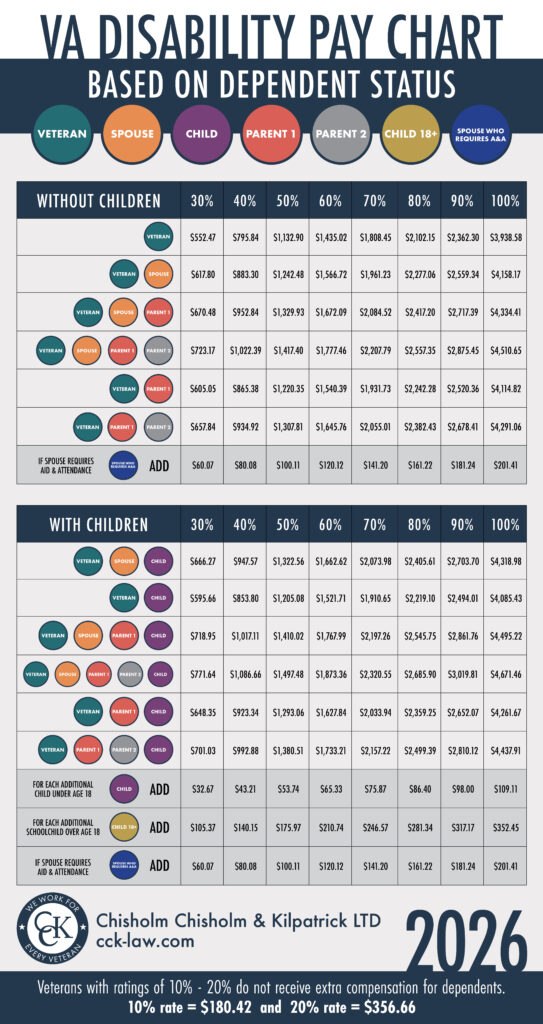
“VA adds specific dollar amounts for each dependent that’s added on to a disability claim,” says Michael Lostritto, Partner at CCK Law. “For example, say a veteran has a forty percent combined rating and a spouse listed as a dependent. That veteran will receive additional compensation stacked onto their monthly payment for that spouse. If they have a spouse and a child, they would receive additional compensation for both the spouse and the child.”
Veterans who have eligible dependents should consult the infographic below to gain an estimate of how much additional compensation they could earn by adding their dependents to their disability claim:
How Much Back Pay Will I Receive for Adding Dependents to My VA Disability Claim?
VA back pay is calculated from the effective dates for each dependent added to a veteran’s disability claim. These dates can be either:
- The date of the event when the veteran first gained the dependent – This includes events like the birth or adoption of a child, or marriage to a current spouse. However, for the date of this event to serve as an effective date, the veteran must have added the dependent to their disability claim within one year of this event taking place.
- The date the veteran first adds the dependent to their disability claim – If a veteran waits longer than a year after gaining a dependent to add them to the veteran’s disability claim, the effective date will instead be when the veteran first adds that dependent to their claim.
TIP: Ensure Each Eligible Dependent is Added to the Claim
Sometimes, veterans make the mistake of assuming that VA knows how many eligible dependents the veteran has and is compensating them accordingly. However, this is not always the case.
“It’s always important when you receive an award letter to check to see what dependents you’re being compensated for,” says Dallas Aguiar, VA-accredited claims agent with CCK Law. “Some veterans simply assume their dependents are on there. But that might not be officially documented in the record. So, it’s important to pay close attention and ensure your dependents are on the award.”
Veterans can also review their monthly disability check to see if they are being paid the proper amount for the number of dependents the veteran has.
TIP: Update VA on Changes in Dependent Status
It is also crucial for veterans to regularly check or update VA on the status of their dependents. This can help prevent situations where a veteran ends up being paid by VA for a dependent who no longer qualifies (e.g., a child who ages out or a spouse who gets divorced), which can lead to overpayment and VA debt.
“Everyone’s life changes. People get married, get divorced, have kids, and VA is often not up to date with all of this,” says Michael Lostritto. “Has the veteran had a new child since the last time VA issued an award? Did their marital status change? These things really factor into veterans making sure that benefits are going forward and VA is accurately compensating them.”
TIP: Preemptively Submit Dependent Info to VA
It can also be beneficial for veterans to submit dependent info to VA even if the veteran has a combined disability rating of less than 30 percent and therefore will not receive any compensation for their dependents.
The reason for this is simple: if the veteran’s rating ever increases to 30 percent or higher (and therefore triggers dependent benefits) VA will already have the veteran’s dependents on file and can add them to the claim with little action necessary from the veteran. Altogether, this may lead to a smoother, more efficient payment process.
Looking to maximize VA dependent compensation? Watch CCK Law Partner Michael Lostritto cover the best tips on ensuring dependent pay:
How Do I Add Dependents to My Disability Claim?
VA allows you to add/remove dependents online or by mail.
Option 1: File online (fastest)
VA’s “manage dependents” site allows you to file a dependency claim online and upload supporting documents.
Option 2: Mail the forms
VA directs veterans to mail dependency forms to the Evidence Intake Center in Janesville, Wisconsin.
Which VA form do I need?
VA commonly uses:
- VA Form 21-686c (spouse and/or child under 18; also used with school-age dependents)
- VA Form 21-674 (child age 18 to 23 in school full time)
- VA Form 21P-509 (dependent parent)
Can Dependents Help Me Earn VA Aid and Attendance (A&A) Benefits?
Yes, there are certain situations where eligible dependents can help a household earn additional compensation through Aid and Attendance (A&A) benefits. For example:
- The dependent must help a disabled veteran perform activities of daily living
- The veteran’s eligible spouse needs aid and attendance
Dependent Is the Veteran’s Caregiver (Special Monthly Compensation)
Some disabled veterans need regular assistance with the activities of daily living like dressing, bathing, or taking medication safely. This assistance does not have to be professional or paid for the veteran to earn A&A benefits. The veteran must establish to VA their need for assistance, which can be done with supporting testimony from a dependent caregiver.
For instance, if the veteran’s spouse, child, or other dependent is the one providing the veteran care, then that dependent could submit lay statements to VA to help the veteran potentially earn A&A compensation through Special Monthly Compensation (SMC). This compensation can amount to hundreds or even thousands of dollars more than a regular rating without this benefit.
To qualify for this A&A compensation, veterans should have a medical professional complete VA Form 21-2680 (Aid and Attendance) and then submit it themselves. They should also be sure to submit lay statements from their caregiving dependent, whether it is their spouse or child.
Watch the video below to unravel some of the more confusing VA benefits that involve dependents:
Spousal Aid and Attendance
Eligible disabled veterans whose spouses need daily aid and attendance can also qualify for a benefit called “spousal aid and attendance.” This benefit provides additional monthly compensation to help the veteran provide necessary aid for their spouse. This compensation amounts to:
- $60.07 if the veteran is rated at 30 percent disabled
- $80.08 if the veteran is rated at 40 percent disabled
- $100.11 if the veteran is rated at 50 percent disabled
- $120.12 if the veteran is rated at 60 percent disabled
- $141.20 if the veteran is rated at 70 percent disabled
- $161.22 if the veteran is rated at 80 percent disabled
- $181.24 if the veteran is rated at 90 percent disabled
- $204.41 if the veteran is rated at 100 percent disabled
To qualify for spousal A&A, the veteran will need to have a combined disability rating of 30 percent or higher. They must also meet a high standard of evidence for VA to approve the benefit.
“It’s important though to note that medical evidence is often required,” says Michael Lostritto. “VA won’t often grant this benefit on their own, at least in my experience, without an argument or some additional evidence because they usually don’t know the condition that the veteran’s spouse is in.”
VA Deny Your Disability Claim? Contact CCK Law
If VA denied your disability claim, the dedicated attorneys at Chisholm Chisholm & Kilpatrick may be able to help. Our VA-accredited team has represented over 36,000 veterans and dependents, helping secure favorable outcomes before VA for 99 percent of our past clients.
Call CCK Law at 800-544-9144 or contact us online for a free case evaluation.

Frequently Asked Questions
How much does VA pay per dependent child?
As of 2026, the figures below detail how much additional compensation VA pays out to veterans with a single dependent child vs veterans with no children or other dependents:
- $43.19 if the veteran is rated at 30 percent disabled (with an additional $32.67 for every subsequent child).
- $57.96 if the veteran is rated at 40 percent disabled (with an additional $43.21 for every subsequent child).
- $72.18 if the veteran is rated at 50 percent disabled (with an additional $53.74 for every subsequent child).
- $86.69 if the veteran is rated at 60 percent disabled (with an additional $65.33 for every subsequent child).
- $102.20 if the veteran is rated at 70 percent disabled (with an additional $75.87 for every subsequent child).
- $116.95 if the veteran is rated at 80 percent disabled (with an additional $86.40 for every subsequent child).
- $131.71 if the veteran is rated at 90 percent disabled (with an additional $98.00 for every subsequent child).
- $146.85 if the veteran is rated at 100 percent disabled (with an additional $109.11 for every subsequent child).
Veterans should note that how much VA pays per dependent child varies based on the veteran’s VA rating percentage and annual cost-of-living adjustments (COLA) implemented by VA.
Additionally, the first child added to a VA claim will net the veteran more compensation than every subsequent child added.
How long can I claim my child as a dependent for VA disability?
Typically, a child can only be claimed as a dependent for VA disability until they turn 18 years old. However, there are a few exceptions to this rule, including:
- If the child is between 18 and 23 years old, unmarried, and attending school full-time, then they may continue to qualify as a dependent for VA disability.
- If the child was severely disabled prior to reaching age 18 and therefore requires continuous aid and support, they may also qualify as a dependent for VA disability.
What other benefits are available to dependents of veterans?
In addition to increasing a veteran’s monthly compensation, eligible dependents on a VA claim may also gain access to some or all of the following benefits:
- Health coverage through TRICARE or CHAMPVA (if certain requirements are met)
- Educational benefits through Dependents’ Educational Assistance (DEA)
- Family Servicemembers’ Group Life Insurance (FSGLI)
- Burial benefits through the National Cemetery Administration (NCA) or Veterans Benefits Administration (VBA)
- VA Survivors Pension
- And more
What if both spouses are veterans?
VA notes that if both spouses are veterans with qualifying ratings, each may be eligible for additional compensation for dependents, but VA may take longer to process. However, the veterans should receive back pay for any delay.