Scars and VA Disability Compensation
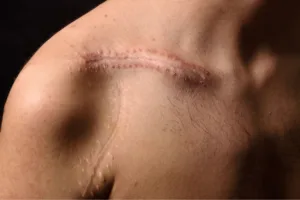

Scars are the eighth most common disability among veterans, affecting more than 1.3 million veterans according to VA’s Annual Benefits Report for Fiscal Year 2025.
VA rates scar disabilities under 38 CFR §4.118, Diagnostic Codes 7800–7805. Scars are rated based on:
- The number of scars or disfigurements a veteran has
- The area of the body affected
- The permanence of the scars
- The presence of pain or instability
The VA Schedule for Rating Disabilities (VASRD) notes eight characteristics of disfigurement that VA incorporates into how it rates scars for disability compensation purposes.
Who We Are: Chisholm Chisholm & Kilpatrick (CCK Law) has argued many of the cases that have defined and clarified veterans disability law. CCK Law attorneys serve in leadership positions throughout the legal community and have posted more than 2,500 blogs and 1,100 videos about veterans benefits.
What Are the Eight Characteristics of Disfigurement?
- Scar is 5 or more inches in length.
- Width of the scar is one-quarter inch at the widest part.
- Surface of the scar elevates or depresses when pressed upon.
- The scar is adherent to the soft tissue underneath it.
- Hypopigmentation (loss of skin color) or hyperpigmentation (darkening of skin color) in an area larger than 6 square inches.
- Abnormal skin texture (e.g., tight, shiny, scaly, etc.) in an area larger than six square inches.
- Underlying soft tissue beneath the scar is missing in an area larger than 6 square inches.
- Skin is inflexible (does not move) and indurated (hard) in an area exceeding 6 square inches.
7800: Scars or Disfigurement of the Head, Face, or Neck
There are three main categories VA takes into account when assigning a rating for scars under Diagnostic Code 7800: tissue loss; distortion or asymmetry of features; and characteristics of disfigurement.
- 80 percent — Tissue loss and “gross distortion or asymmetry of three or more features,” such as the nose, chin, forehead, eyes (including eyelids) ears, cheeks, or lips; OR display six or more characteristics of disfigurement.
- 50 percent — Tissue loss and gross distortion or asymmetry of two of the features listed above; OR have four or five characteristics of disfigurement.
- 30 percent — Tissue loss and gross distortion or asymmetry of one of the aforementioned features; OR two or three characteristics of disfigurement.
- 10 percent — One characteristic of disfigurement.
7801: Scars Elsewhere on the Body That Are Deep and Nonlinear
Nonlinear scars located in different areas of the body (e.g., one extremity, two separate extremities, front or back of the torso, etc.) are rated separately.
Each rating is based on the area of qualifying scars that affect a portion of the body. This means that if a veteran has one qualifying scar on their right arm and a qualifying scar on their left leg, they will receive separate ratings for each scar, which will then yield a combined disability rating.
Nonlinear, deep scars that occupy an:
- Area(s) of 144 square inches or more may receive a 40 percent disability rating;
- Area(s) of at least 72 but less than 144 square inches warrant a 30 percent rating;
- Area or areas of 12 square inches minimum, but under 72 square inches may be assigned a 20 percent disability rating;
- Area or areas of at least 6, but less than 12 square inches should receive a 10 percent VA rating.
7802: Superficial Nonlinear Scars Not of the Head, Neck, or Face
Superficial scars are not permanent in nature and do not affect underlying soft tissue, only the skin. Similar to Diagnostic Code 7801, these scars are rated separately for each area of the body affected. Veterans are only able to receive a 10 percent disability rating for superficial nonlinear scars affecting one area of the body other than the head, face, or neck:
- 10 percent — If the area or areas of the scar(s) are 144 square inches or more.
7804: Painful or Unstable Scars
According to the VASRD, an unstable scar is one where “there is frequent loss of covering of skin over the scar.”
If more than one scar is considered unstable, an additional 10 percent may be added to the rating. Scars rated under Diagnostic Codes 7800, 7801, 7802, or 7805 can also receive an evaluation under 7804 when applicable.
- 30 percent — Five or more unstable or painful scars
- 20 percent — Three or four painful or unstable scars
- 10 percent — One or two painful or unstable scars
7805 Other Scars Including Linear Scars
Disability ratings for these conditions are based on the disabling effects the scar presents. For example, if a veteran has a linear scar running along the elbow that prevents flexion, they will be rated on limitation of motion of the elbow.
All other scar conditions not listed in the VASRD are rated analogous to diagnostic codes 7800 to 7805.
Does VA Pyramiding Apply to Scars?
Yes, pyramiding does apply to scars. Under VA law, pyramiding refers to compensating the same symptom or functional impairment under multiple diagnostic codes. This is typically prohibited by federal law, in order to prevent veterans from being compensated multiple times for the same disability.
However, under Esteban v. Brown, veterans may receive separate ratings for different manifestations of the same condition, including scars, as long as the symptoms are not duplicative or overlapping.
In practical terms, this means a veteran may be entitled to multiple ratings for a single scar if it produces distinct types of impairment. Examples may include:
- Disfigurement
- Pain
- Muscle damage
- Nerve impairment
Can I Earn Secondary Service Connection for Scars?
Yes, it is frequently possible for veterans to earn secondary service connection for their scars.
Secondary service connection is when a veteran has a scar or scars that resulted from a separate, already service-connected condition. Importantly, veterans can also gain secondary ratings for scars if they are the result of treatment for a primary service-connected condition.
For example, veterans may be able to secure secondary service connection for these kinds of scars:
- Surgical scars from service-connected orthopedic conditions
- Burn scars from treatment of a service-connected condition
- Surgical scars from surgery used to treat service-connected cancer
- And more
Does VA Make Mistakes When Evaluating Scars?
Yes, it is not uncommon for VA to make errors when evaluating a veteran’s scars or adjudicating a disability claim for scars. Some of these mistakes include:
- VA examiners failing to document a veteran’s scar-related pain during a C&P exam.
- Scars not being properly measured during a C&P exam.
- VA or VA examiners ignoring a scar’s instability.
- VA overlooking the functional impact a scar has.
If a veteran believes that their C&P exam for scars was inadequate, they should note down any mistakes the VA examiner may have made. This can serve as the basis for an argument to have the exam overturned and a new one ordered.