Can You File a VA Disability Claim if You’re Missing Medical Records?


Yes, it is possible to file a successful claim for disability benefits from the Department of Veterans Affairs (VA) even if you are missing certain evidence, like military medical treatment records. There are often alternative forms of evidence available, such as lay evidence.
Key points of this article include:
- Most VA disability claims are not based on specific records, just sufficient proof that medical conditions are connected to service.
- VA has a duty to assist in gathering many types of records, although the veteran may need to alert VA to them.
- If the records have been destroyed, VA has sometimes established alternative ways to proceed.
- There are other types of evidence that can allow for a successful claim, such as lay evidence (statements from the veteran, service buddies, family, etc.) and private medical records.
Who We Are: Chisholm Chisholm & Kilpatrick (CCK Law) has argued many of the cases that have defined and clarified veterans disability law. CCK Law attorneys serve in leadership positions throughout the legal community and have posted more than 2,500 blogs and 1,100 videos about veterans benefits.
What Evidence Is Usually Required for VA Claims?
To succeed in their VA claim, veterans typically require the following evidence:
- A current medical diagnosis of their disability;
- Proof of an in-service event, injury, or illness; and
- A medical nexus opinion between the current disability and the in-service event, injury, or illness.
However, depending on the specific type of VA claim a veteran is pursuing, one or more of these pieces of evidence may be unnecessary to provide.
What Evidence Do I Need for My Type of VA Claim?
This depends on whether the veteran is filing a direct, secondary, or presumptive service connection claim. Based on the type of claim the veteran is filing, they may not have to file one or more of the pieces of evidence mentioned above:
- Direct service connection claims require all three key pieces of evidence: a medical diagnosis, proof of an in-service event, and a medical nexus opinion. (38 CFR § 3.303)
- Secondary service connection claims usually only require a current diagnosis of a secondary condition, as well as a medical nexus opinion linking it to a primary condition that has already been service connected.
- Presumptive service connection claims typically only require a medical diagnosis of a presumptive disability, as well as service records proving the veteran served in a particular time and place.
In addition, there are other types of VA claims with their own evidence requirements:
- Increased rating claims: Veterans filing for an increased disability rating will generally need to submit evidence to VA proving that their condition has worsened or that it meets the criteria for a higher rating under VA’s codes.
- Aid and Attendance claims: Veterans seeking Aid and Attendance compensation will need to submit proof to VA that they require the regular aid of another person to perform activities of daily living like eating or dressing.
- PTSD claims: Veterans filing for disability for post-traumatic stress disorder (PTSD) usually need to provide VA with evidence of some kind of in-service stressor that prompted their condition. Note: Combat veterans and, in some cases, MST survivors may establish PTSD without corroborating records under 38 CFR § 3.304(f).
- TDIU claims: Veterans filing for total disability based on individual unemployability (TDIU) may have to submit evidence to VA proving their inability to work. This may take the form of lay statements or employment records.
Can I Earn Service Connection for Pain Without a Medical Diagnosis?
Yes, it is sometimes possible to file a successful VA claim for pain even if the veteran does not have an official medical diagnosis.
“According to the Saunders v. Wilkie [886 F.3d 1356 (Fed. Cir. 2018)] Court decision, VA can award service connection for pain that lacks a specific diagnosis, so long as the pain is connected to an event that occurred in service or a symptom that manifested in service,” says Dallas Aguiar, VA-accredited claims agent with CCK Law. “Additionally, if a service-connected condition aggravates pain or is aggravated by pain, the veteran can be awarded benefits for the pain.”
Veterans should bear in mind, however, that for their pain to qualify under Saunders v. Wilkie, it must cause the veteran functional impairment or functional loss. Subjective complaints of pain alone are not enough to qualify a veteran for disability compensation.
Want to learn more about filing VA claims without medical evidence? Watch VA-Accredited Claims Agents Dallas Aguiar and Claire Babcock discuss what evidence may be unnecessary for your claim:
Do Some Disabilities Require Specific Forms or Tests To Prove?
Yes, some disabilities require that specific tests be performed in order for VA to accept the diagnosis and proceed with the claim. Examples include:
- A veteran pursuing disability compensation for sleep apnea will need to have undergone a sleep study to prove their sleep apnea diagnosis.
- A veteran pursuing compensation for hearing loss will typically need to undergo a Maryland CNC Test and a Puretone Audiometric Test to confirm their hearing loss diagnosis.
- A veteran pursuing compensation for coronary artery disease may need to undergo a Metabolic Equivalent Test (MET) for VA to accept their diagnosis.
What if Medical Evidence Is Missing?
Depending on the types of medical evidence a veteran is missing for their claim, they might be able to replace it or supplement it with other forms of evidence to satisfy VA’s standards of proof.
Can I File a VA Claim Without Service Treatment Records?
Yes, it is possible for a VA claim to succeed even if the veteran cannot file service treatment records or military medical records in support of their claim.
“It’s important to remember that it’s not always expected or necessary for the veteran to have sought treatment for their condition in service in order to receive service connection,” says Dallas Aguiar. “For example, a veteran dealing with anxiety does not necessarily have to have reported anxiety or been treated for anxiety during service in order to receive VA disability benefits for anxiety.”
In other words, in the event a veteran has no evidence of treatment during service, it is not the end of the road for their VA claim. Many veterans have won claims without service treatment records or in situations where those records were lost or destroyed.
What if My Service Records Were Lost, Damaged, or Destroyed?
If a veteran’s records were lost, damaged, or destroyed, they may benefit by contacting the National Personnel Records Center (NPRC). In situations like these, the NPRC will attempt to reconstruct a veteran’s records by reaching out to other facilities that may have them.
However, there may be limitations to the NPRC’s ability to find or recreate a veteran’s records. For instance, in 1973, a fire broke out at the NPRC headquarters in St. Louis, Missouri, destroying an estimated 16–18 million personnel files for veterans of the Army and Air Force. Since there were no copies of many of these files, veterans impacted by the fire may be unable to fully reconstruct their service records.
If you are looking to reconstruct service records that were lost or destroyed, you will need to fill out NA Form 13055, Request for Information Needed to Reconstruct Medical Data. Learn more on VA’s “Reconstruct military records destroyed in NPRC fire” page.
Presumptive Service Connection: Do I Still Need Medical Evidence?
Yes, veterans pursuing a presumptive service connection claim will still need to submit a medical diagnosis of their presumptive disability to VA, along with any accompanying tests or records necessary to confirm that diagnosis.
However, due to the nature of presumptive disabilities, veterans typically will not have to submit a medical nexus opinion to VA, since VA will automatically assume a nexus exists if the presumptive claim is successful.
Continuous Treatment Theory / Chronic Disease Presumptions
Under 38 CFR § 3.303(b), a chronic disease noted in service (even without a formal diagnosis) may be presumed service-connected if it manifests to a compensable degree at a later date.
Want to learn more about proving VA disability without service treatment records? Watch CCK Law Partner Michael Lostritto talk about the types of evidence you could use in place of military medical records:
What Other Types of Evidence Can I Use To Support My Claim?
In the absence of certain types of medical evidence, there are several other forms of evidence that may support a veteran’s disability claim, including lay evidence, employment records, service records, and more.
Using Private Treatment Records To Support a VA Claim
Although veterans may not have in-service medical records, it is likely that they have obtained private medical records, VA medical records, or Compensation & Pension (C&P) examination reports over time.
- Private medical records: To obtain these records, veterans can typically request them directly from their private provider. If a veteran notifies VA that they are treating with a private provider and signs a release form, VA can request the veteran’s medical records directly from the provider. This can be a part of VA’s duty to assist.
- VA medical records: VA can obtain these records directly from the VA medical center(s) where the veteran receives treatment. If a veteran wants to obtain these records themselves, they have the option to request them directly from the VA medical center.
- C&P examinations: In many cases, VA will schedule a veteran for a C&P exam to assess the merits of service connection or an increased rating for the veteran’s condition. If favorable, these examinations can be useful in substantiating a claim.
- Medical opinions: Veterans can request a medical opinion from their treating doctor to help substantiate their claim. Medical opinions could come in handy if the veteran had an unfavorable C&P examination and wants to argue against the examiner’s findings.
Lay Evidence and How To Use It
A lay statement is a written statement from a veteran, family member, friend, or co-worker that can be submitted to VA in support of a veteran’s claim. Statements can be submitted directly to VA and are often beneficial for documenting and reporting the duration, frequency, and severity of symptoms a veteran is experiencing.
Buddy statements, those written by a fellow service member on behalf of the veteran filing the claim, can be useful to corroborate an in-service event, injury, or stressor.
While lay statements can be very effective pieces of VA claims evidence, there are limitations to how they can be used. For instance, lay statements typically cannot be used to replace a medical nexus opinion connecting a veteran’s disability to an in-service event. This is because, most of the time, medical professionals are the only ones able to offer valid nexus opinions for a veteran’s claim.
VA Hearings
Hearings before the Board of Veterans’ Appeals (BVA) can be used as evidence in support of a veteran’s claim. They allow a veteran to speak with a Veterans Law Judge directly to explain their case. All hearings are transcribed so VA has a written record of the conversation.
However, hearings do have drawbacks. One disadvantage of requesting a hearing is that they can often take months, or even years, to schedule. This can significantly delay a veteran in receiving a decision on their claim.
Employment Records
Employment records can become a necessary piece of evidence if a veteran is seeking entitlement to total disability based on individual unemployability (TDIU). TDIU is a VA disability benefit that compensates veterans at the 100 percent disability rate if they have a service-connected condition or conditions that render them unable to work.
Employment records can also be helpful in claims for increased ratings, as difficulty performing a job or receiving special accommodations at work due to a service-connected condition can highlight the level of severity of that disability. Some employment records that can be helpful are:
- VA Form 21-4192: VA uses these forms to gather information regarding a veteran’s past or current employment. The forms are sent to the veteran’s employers for them to fill out basic employment information, such as dates of employment, as well as details regarding the veteran’s ability to perform the job or why the veteran left that job.
- Record of disciplinary action or performance reports: These types of records can be useful to show how a veteran’s service-connected disability negatively impacted their work. If a veteran has a service-connected psychiatric condition that caused them to be violent at work or have angry outbursts, records of those incidents can be used to show entitlement to an increased rating.
Additional Examples of Evidence
Veterans who are missing treatment records can also use these types of evidence:
- Letters written during service
- Photographs taken during service
- Police reports
- Private medical records from treatment during service
Although these types of evidence cannot fully recreate your military experiences, they can help to corroborate an in-service event or injury when seeking VA disability compensation.
VA’s Duty To Assist in Gathering Medical Evidence
It is important to note that veterans are not alone in their efforts to obtain records and supporting evidence. Per 38 USC § 5103A, VA has a duty to assist, meaning it is required to gather information that may help support the veteran’s claim (e.g., service personnel records, service medical records, VA medical records).
If VA cannot obtain records after making reasonable efforts, it has a duty to:
- Notify the veteran that it could not obtain the records, and
- Notify the veteran that they are ultimately responsible for providing VA with those records.
If veterans are unable to obtain missing records, there are several other types of supporting evidence that may be beneficial to include.
Disagree With a VA Decision? Contact CCK Law
We hope this blog helped answer your questions.
Need personalized assistance? If VA has made any kind of decision related to your claim, then CCK Law may be able to help. Contact us online or at 800-544-9144 for a free case evaluation.
(As of 2026, federal law prohibits agents and attorneys from charging veterans a fee to file an initial VA claim. In these cases, you will need to find a VA-accredited representative or VSO to assist you.)
Looking for more information? CCK Law hosts over 2,500 pages and 1,100 videos of free veterans law content. Search our blog or browse our YouTube channel for guides, explainers, and updates on VA benefits topics.
Stay current. Veterans disability law and VA policy change frequently. Follow CCK Law on social media using the links at the bottom of this page, or subscribe to one of our newsletters for updates tailored to your situation.
Frequently Asked Questions
Can I file a VA claim without evidence?
Veterans can file a VA claim without evidence, but the claim is unlikely to succeed if they truly submit no records or documentation proving their military service or disability.
While some amount of evidence is necessary for a claim to succeed, not all types of disability claims require the same forms of evidence. For instance:
- Direct service connection claims usually require a medical diagnosis, proof of an in-service event that might have caused the condition, and a medical nexus opinion linking the condition to the in-service event.
- Secondary service connection claims typically only require a medical diagnosis and a medical nexus connecting the veteran’s secondary condition to their primary condition.
- Presumptive service connection claims may require a medical diagnosis, but can sometimes be won without submitting a medical nexus opinion or proof of an in-service event.
- For claims involving certain types of disabling pain, a medical diagnosis may not be necessary, as long as the pain is connected to a service-connected condition and causes the veteran loss of function.
Can I file a VA claim without military medical records?
Yes, you can file a successful VA claim without submitting military medical records or service treatment records. It is not necessary for a veteran to have sought treatment during service for their condition to earn disability compensation for that condition.
To establish direct service connection for a disability, veterans must provide the following evidence:
- A medical diagnosis of their disability, usually obtainable from a private doctor;
- Proof of an in-service event, injury, or illness. This can often be established through lay statements from fellow service members attesting to some event that happened during service.
- A medical nexus opinion linking the in-service event to the veteran’s disability. This can also typically be obtained from a veteran’s private doctor.
What if my claim is denied due to a lack of evidence?
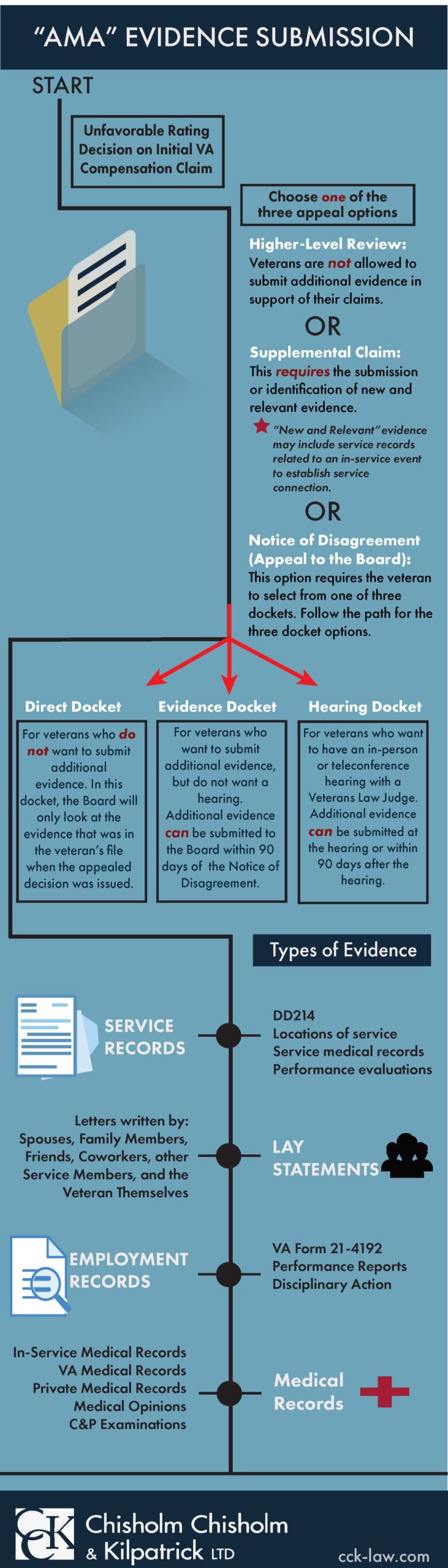
If your disability claim is denied due to a lack of evidence, you still have appeal options available to potentially change VA’s mind. Under the Appeals Modernization Act, a denied VA claim typically has three options for appeal:
- Higher-Level Review
- Supplemental Claim
- Request a hearing with the Board of Veterans Appeals
Consult the infographic below for more information on each of these appeal options.
Share this Graphic