When Do VA Ratings Become Permanent?


The Department of Veterans Affairs (VA) offers protections for disability ratings that have been in effect for certain periods of time. Until these regulatory protections kick in or your ratings become permanent, VA may sever or reduce a veteran’s disability rating based on specific findings.
When Can VA Sever Service Connection?
Severance is when VA tries to revoke a finding of service connection. If VA tries to sever service connection, it will notify the veteran of the proposed action and give them 60 days to submit evidence to show that service connection should not be severed and 30 days to request a hearing.
If the veteran does not submit evidence within that 60-day window or request a hearing within 30 days, VA will issue a final decision.
In cases of severance, veterans are given added protection if they have been service-connected for the condition for 10 years or more. Under 38 CFR 3.957 in the VA code of regulations, a veteran’s service-connected disability that has been in effect for 10 years or more “will not be severed except upon a showing that the original grant was based on fraud or it is clearly shown from military records that the person concerned did not have the requisite service or character of discharge.”
“In other words, if a disability has been service connected for 10 years, that service connection cannot be severed,” says Maura Black, partner at CCK Law. “In this case, they cannot take away your service-connected status unless there is evidence of fraud.”
The 10-year period is calculated from the effective date of the award for service connection. For example, if a veteran was granted service connection for a low back injury effective October 20, 1980, and VA issued a decision dated August 29, 2018, attempting to sever service connection, VA would have to abide by the 10-year rule above.
Watch CCK Law Partner Maura Black and VA-Accredited Claims Agent Claire Babcock cover the rating protections available to veterans:
When Can VA Reduce My Disability Rating?
Veterans with disabilities that are not considered permanent may be sent for future VA C&P examinations in order for VA to evaluate the severity of those disabilities and rate them appropriately. If VA finds that a veteran’s condition has improved, it can reduce a veteran’s disability rating.
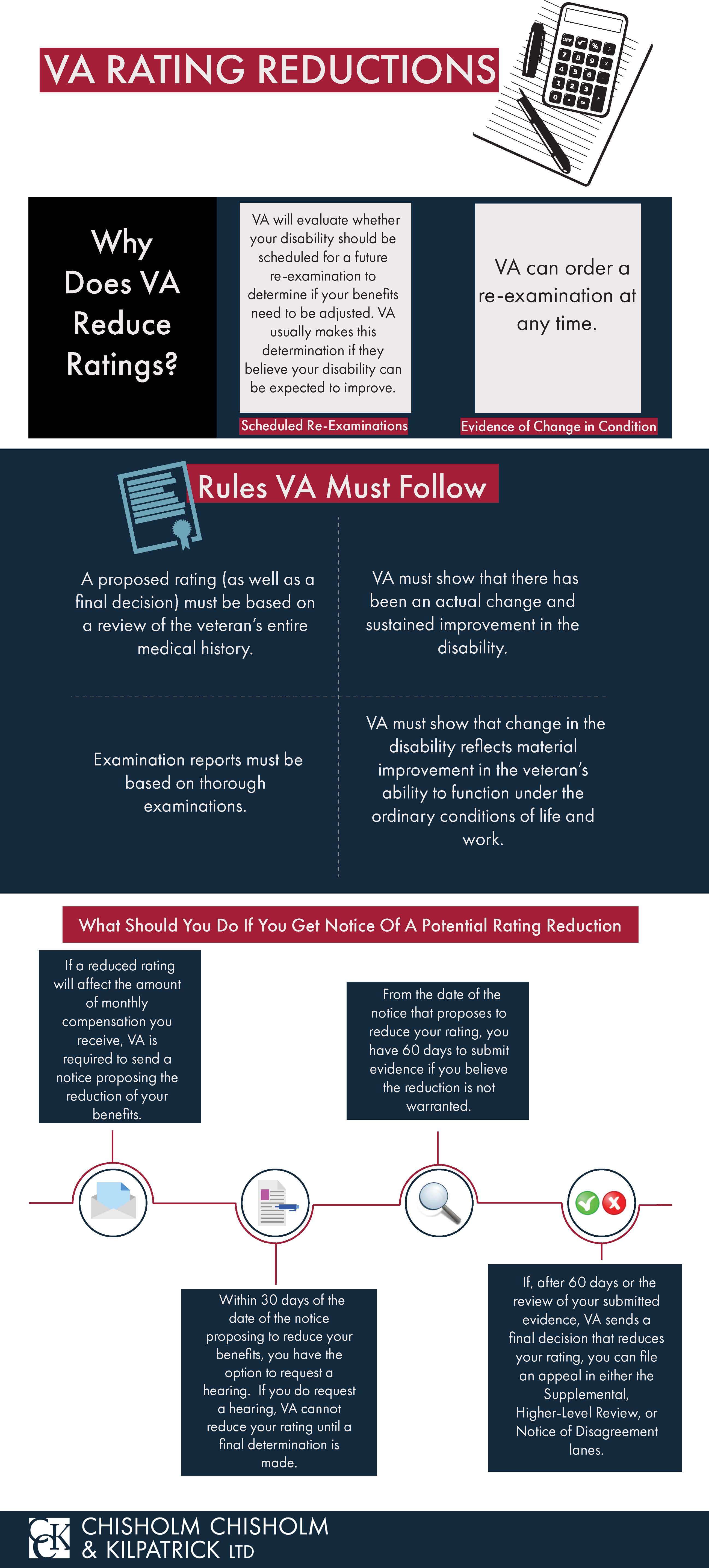
VA is required to follow the same process for reductions as they are for severances. This means that if VA wishes to reduce a disability rating, they must issue notice of the proposed reduction.
“Under 38 C.F.R. § 3.105(e), VA is required to send you a written notice before it can reduce your compensation,” says Bradley Hennings, partner at CCK Law. “That letter has to explain the reasons for the proposed reduction and identify the evidence that supports it.”
Upon receiving this proposed reduction letter, veterans have 60 days to submit evidence contesting the proposal and 30 days to request a hearing.
There is one major difference between the process of a reduction and severance. When the reduction would not change the actual amount of compensation that a veteran is receiving, VA does not have to issue notice of the reduction.
When Will VA Assign Staged Ratings?
Staged ratings are when VA changes a disability rating based on the severity of the condition over a period of time. Since claims can take multiple years to be resolved, VA looks at how the severity of a condition changed during that period of time, and rates the veteran accordingly.
Staged ratings can occur when the veteran’s condition has worsened or bettered from when they initially filed the claim, and when the claim was adjudicated.
For example, a veteran filed a claim for an increased rating above 10 percent for his back condition in 2009. He was then granted an increased rating in 2013, but his back condition progressively worsened throughout those four years. VA granted him an increase from 10 percent to 30 percent from 2009 to 2011 based on the severity during that period, and they then granted him 40 percent from 2011 forward.
When Does My VA Rating Become Permanent?
An easy way to tell if your VA disability ratings are permanent is if VA has deemed you to be totally and permanently disabled. This means VA does not see a reasonable chance of your conditions improving. However, if you are not “permanent and total,” VA has regulatory protections for reductions of service-connected disabilities.
Under 38 CFR 3.951(b), VA cannot reduce a rating that has been “continuously rated at or above any evaluation of disability for 20 or more years” unless it is shown that the rating was based on fraud.
“So if you qualify for the 20-year rule, VA cannot reduce your rating below its original level, which would be the lowest rating that you’ve had throughout those 20 years (unless the rating was based on fraud),” says Claire Babcock, VA-accredited claims agent at CCK Law.
So, for example, if you are rated at 20 percent for a right knee disability from January 1994 and VA proposes to reduce your right knee rating to 0 percent in March 2017, they can only do so if they find that your initial 20 percent rating was based on fraud.
If they cannot show that, they cannot reduce your 20 percent rating. This rule protects disabilities that have been increased over the span of 20 years or more as well. For example, the veteran who receives 20 percent for his right knee disability from January 1994 was increased to 30 percent in 2006.
In March 2017, VA proposes to reduce his 30 percent to 0 percent. Although the rating for the right knee condition changed between the initial grant and the proposed reduction, he is still protected under the 20-year rule.
Watch CCK Law Partner Bradley Hennings cover what veterans can do when VA proposes a rating reduction:
Stabilized Ratings
Stabilized ratings are for conditions that have been continuously rated for five years or more at the same disability level. In order for VA to reduce stabilized ratings, they must show that your condition has exhibited sustained improvement.
The threshold of evidence is higher in this circumstance, as VA cannot rely on only one C&P examination to implement the reduction of a stabilized rating.
When Does My VA Rating Become Total?
Veterans’ disabilities are rated based on VA’s Schedule of Rating Disabilities. The ratings levels for each type of disability are based on the severity of your symptomatology and the level of social and occupation impairment that you experience as a result.
A 100 percent rating indicates that your disability is completely, or “totally,” disabling. One hundred percent total ratings may be reduced if VA can show that your condition has shown material improvement.
Material improvement means that there has been a significant change in the veteran’s ability to function in daily life.
Temporary Total Ratings
VA allows veterans to be compensated at the 100 percent rate during a hospitalization in excess of 21 days due to a service-connected condition, and for the period following the hospitalization.
VA calls these convalescent ratings. Convalescent ratings can span up to three months following hospital discharge or release from outpatient treatment. Veterans can apply for convalescent ratings longer than those three months, but VA decides those claims on a case-by-case basis.
Following a temporary total evaluation, VA will rate the veteran’s condition based on the new level of severity. VA will assess the new level of severity based on medical records from the period of convalescence.
However, if VA is unable to adequately assess severity from the records, the veteran will be scheduled for an exam to assign the appropriate rating.
What if I Have TDIU? Is TDIU Permanent?
For veterans who have been granted entitlement to Total Disability Based on Individual Unemployability (TDIU), VA can only reduce that rating if “actual employability is established by clear and convincing evidence” (38 CFR 3.3.43(c)). That means VA can only sever your TDIU if you have been found to be employable.
For veterans with TDIU, VA will send out a yearly employment questionnaire to see if a veteran participated in substantially gainful employment during that year. For the employment to be substantially gainful, a veteran would have had to be employed for 12 months or more and would have had to earn over the federal poverty threshold.
Learn more about permanent and total disability.
Were Your VA Benefits Reduced or Severed?
If you think your VA disability rating was reduced or severed improperly by VA, we may be able to help. Contact our office for a free consultation at (800) 544-9144.
Share this Graphic