7 Things Every Veteran Should Know About Agent Orange

Agent Orange exposure gives many Vietnam-era veterans a presumptive pathway to disability compensation from the Department of Veterans Affairs (VA) for numerous cancers, heart disease, and other recognized conditions, without needing to prove a direct medical link to their service.
This guide will answer common questions veterans ask about Agent Orange-related presumption of exposure, the current list of presumptive conditions, benefits for affected dependents, and more.
Key points of this article include:
- The 2022 PACT Act expanded both the presumptive locations and the list of presumptive conditions for Agent Orange exposure.
- With the court ruling in Procopio v. Wilkie, Blue Water Navy veterans can now be included under the presumption of exposure for Agent Orange.
- The Nehmer v. U.S. Department of Veterans Affairs ruling may allow certain qualifying veterans to earn back pay for their Agent Orange-related conditions.
Who We Are: Chisholm Chisholm & Kilpatrick (CCK Law) has argued many of the cases that have defined and clarified veterans disability law. CCK Law attorneys serve in leadership positions throughout the legal community and have posted more than 2,500 blogs and 1,100 videos about veterans benefits.
1. What Is Agent Orange and How Was It Used?
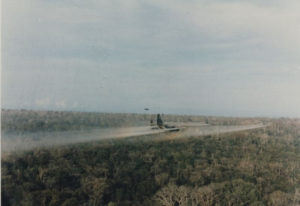
Agent Orange is an herbicide that was used by the U.S. during the Vietnam War. It is a 50/50 mixture of two kinds of herbicide agents: 2,4-D and 2,4,5-T. As a byproduct of its production, Agent Orange also contained the dioxin contaminant 2,3,7,8-TCDD, which is the most toxic of all the numerous dioxins.
Agent Orange is just one of the “rainbow herbicides” the U.S. used during the Vietnam War, including Agent Blue and Agent White, among others.
Agent Orange and other herbicides were used in the Vietnam War for two main purposes: (1) to destroy the enemy’s crops to interrupt their food supply; and (2) to destroy foliage in the jungle and increase visibility to prevent ambush attacks.
During the Vietnam War, herbicides, including Agent Orange, were sprayed mainly in four ways:
- C-123 aircraft were used to spray herbicides over the jungles of Vietnam during Operation Ranch Hand. These C-123 aircraft were modified with tanks to carry the herbicides.
- Helicopters were used to spray smaller areas.
- Buffalo turbines (i.e., truck-mounted decontamination sprayers) were used to spray roadsides and perimeters.
- Hand-held sprayers were also used as a method of spraying herbicides.
Watch CCK Law Partners Maura Black and Jenna Zellmer discuss the most important things veterans need to know about Agent Orange:
2. Does VA Have Presumptions for Agent Orange? If So, Who Qualifies?
Yes, the Agent Orange Act of 1991 created the framework that VA has since expanded by regulation and statute to create a presumption of exposure for veterans who served in specific locations during defined timeframes were exposed to Agent Orange.
A presumption of exposure replaces the element of service connection that requires veterans to provide proof of an in-service event or illness that caused their current disability. In these instances, VA presumes veterans were exposed to herbicides during service, and this counts as the in-service event.
VA presumes that veterans who served in the following locations during the specified timeframes were exposed to Agent Orange:
- Boots-on-the-ground in Vietnam, veterans with service aboard a ship that operated in the inland waterways of Vietnam (i.e., Brown Water veterans), or veterans with service aboard a ship in Vietnam’s territorial seas (i.e., Blue Water Navy veterans) between January 9, 1962, and May 7, 1975.
- On or near the Korean demilitarized zone (DMZ) between September 1, 1967, and August 31, 1971.
- Active duty and reservist personnel who had regular contact with C-123 aircraft between 1969 and 1986.
The 2022 PACT Act also added five more locations to this presumption of exposure list:
- Any U.S. or Royal Thai military base in Thailand between January 9, 1962, and June 30, 1976.
- Laos between December 1, 1965, and September 30, 1969.
- Cambodia, at Mimot or Krek in Kampong Cham Province, between April 16, 1969, and April 30, 1969.
- Guam or American Samoa, or their territorial waters, between January 9, 1962, and July 31, 1980.
- Johnston Atoll, or aboard a ship that called at Johnston Atoll, between January 1, 1972, and September 30, 1977.
3. What Presumptive Conditions Does VA Associate With Agent Orange Exposure?
VA will presume service connection for Agent Orange exposure as long as a veteran served in a qualifying time period and location and developed one of the following conditions as a result:
- AL amyloidosis
- Bladder cancer
- Chronic B-cell leukemia
- Chloracne (if it presents within one year of exposure to a degree of 10 percent disabling)
- Diabetes mellitus type 2
- Hodgkin’s disease
- Hypertension (high blood pressure)
- Hypothyroidism
- Ischemic heart disease (including coronary artery disease, stable and unstable angina, myocardial infarction, and sudden cardiac death)
- Monoclonal gammopathy of undetermined significance (MGUS)
- Multiple myeloma
- Non-Hodgkin’s lymphoma
- Parkinsonism
- Parkinson’s disease
- Peripheral neuropathy, early onset (if it presents within one year of exposure to a degree of 10 percent disabling)
- Porphyria cutanea tarda (if it presents within one year of exposure to a degree of 10 percent disabling)
- Prostate cancer
- Respiratory cancers, including lung cancer
- Soft tissue sarcomas (other than osteosarcoma, chondrosarcoma, Kaposi’s sarcoma, and mesothelioma)
“The presumption of service connection essentially eliminates the need to get a medical nexus opinion between your current disability and your Agent Orange exposure,” says Jenna Zellmer, a partner at CCK Law. “If you have any of the disabilities listed on VA’s presumptive list for Agent Orange exposure and you were in Vietnam, you automatically get service connected for that disability.”
It is also important to note that if additional disabilities develop as a result of one of the above-mentioned presumptive conditions, veterans can file a service connection claim for the additional disability, as secondary to the herbicide-related disability.
4. Are There Dependents’ Benefits for Effects of Agent Orange Exposure?
Yes, the dependents of veterans exposed to Agent Orange may be eligible for compensation, health care benefits, and vocational training.
“One of these benefits is called Dependency and Indemnity Compensation, or DIC,” says Kayla Rogers, VA-accredited claims advocate with CCK Law. “The surviving spouse, dependent children, or parents of a veteran who was exposed to Agent Orange and developed a disease that contributed to their death as a result may be eligible for this monthly compensation.”
Additionally, children with birth defects acknowledged by VA as associated with herbicide exposure may also qualify for benefits. The child must be a biological child of a veteran who served in Vietnam, Thailand, or the Korean DMZ during the presumptive time period, and was conceived after the dates during which the veteran served.
VA presumes that when veterans have children with spina bifida (except spina bifida occulta), the condition is due to the veteran’s exposure to herbicides during service.
On the other hand, VA presumes certain other birth defects (below) are connected to a veteran’s military service, but only if the veteran is the biological mother who served in Vietnam and the birth defect resulted in permanent physical or mental disability:
- Achondroplasia
- Cleft lip and cleft palate
- Congenital heart disease
- Congenital talipes equinovarus (i.e., clubfoot)
- Esophageal and intestinal atresia
- Hallerman-Streiff syndrome
- Hip dysplasia
- Hirschsprung’s disease
- Hydrocephalus due to aqueductal stenosis
- Hypospadias
- Imperforate anus
- Neural tube defects
- Poland syndrome
- Pyloric stenosis
- Syndactyly (i.e., fused digits)
- Tracheoesophageal fistula
- Undescended testicle
- Williams syndrome
Below, watch VA-Accredited Claims Advocate Nicholas Briggs and colleagues cover Agent Orange benefits for dependents of veterans:
5. Are There Agent Orange Presumptions for Veterans Who Served in Thailand?
Yes, veterans who served in Thailand during the Vietnam War era now qualify for a presumption of exposure to Agent Orange.
Under the 2022 PACT Act, VA presumes that veterans who served at any U.S. or Royal Thai military base in Thailand between January 9, 1962, and June 30, 1976, were exposed to herbicides. These bases include U-Tapao, Udorn, Ubon, NKP, Takhli, Korat, and Don Muang, among others.
This presumption applies regardless of a veteran’s military occupational specialty (MOS) or where on the base the veteran served. Veterans no longer need to show that their duties placed them near a base perimeter or provide other supporting evidence of exposure.
Before the PACT Act, VA only conceded exposure for certain veterans who served in Thailand, such as those whose military occupational specialty was security guard or patrol dog handler, or veterans who could show, through official records or lay evidence, that they served on or near a base perimeter.
Veterans whose claims were denied under these older, narrower rules may want to have their case reviewed, since the current presumption is broader.
Ultimately, to receive service-connected compensation, veterans must still show that they served in a qualifying location and time period, as described above, and have a current diagnosis of a presumptive condition associated with herbicide exposure.
6. What Is the Nehmer Lawsuit and How Does It Affect Agent Orange Claims?
Nehmer v. U.S. Department of Veterans Affairs is a 1986 class action lawsuit brought against VA by the National Veterans Legal Services Program. As a result of this case, VA must take certain actions when it recognizes a new condition as scientifically linked to Agent Orange exposure.
When VA adds a new condition to the presumptive list for Agent Orange, it must:
- Identify all claims for the recognized condition that were previously filed and/or denied; and
- Pay retroactive disability and death benefits to the veterans or their survivors back to the date of the veteran’s initial claim.
7. Do Blue Water Navy Veterans Qualify for Presumption of Exposure to Agent Orange?
Yes, on January 29, 2019, the Federal Circuit issued a decision in Procopio v. Wilkie, overruling a previous court decision in Haas v. Peake and allowing Blue Water Navy veterans to be included under the presumption of exposure for Agent Orange.
In the new ruling, the Federal Circuit specifically found that the “Republic of Vietnam” includes both the country’s landmass and its territorial seas in which Blue Water Navy veterans served.
Blue Water Navy veterans are those who served aboard ships in the open waters off the coast of Vietnam during the Vietnam War, including those who did not set foot on the landmass of Vietnam or who never went into the inland waterways of Vietnam (the latter of which are referred to as “Brown Water” veterans).
Historically, VA has excluded Blue Water Navy veterans from its presumption of herbicide agent exposure based on a decision issued in the case Haas v. Peake.
Under the Procopio decision and the Blue Water Navy Vietnam Veterans Act of 2019 (38 USC § 1116A), however, thousands of Blue Water Navy veterans are now afforded the same presumption of exposure to herbicides as veterans who served boots-on-the-ground in Vietnam.
We hope this blog helped answer your questions.
Need personalized assistance? If VA has made any kind of decision related to your claim, then CCK Law may be able to help. Contact us online or at 800-544-9144 for a free case evaluation.
(As of 2026, federal law prohibits agents and attorneys from charging veterans a fee to file an initial VA claim. In these cases, you will need to find a VA-accredited representative or VSO to assist you.)
Looking for more information? CCK Law hosts over 2,500 pages and 1,100 videos of free veterans law content. Search our blog or browse our YouTube channel for guides, explainers, and updates on VA benefits topics.
Stay current. Veterans disability law and VA policy change frequently. Follow CCK Law on social media using the links at the bottom of this page, or subscribe to one of our newsletters for updates tailored to your situation.
Frequently Asked Questions
What is the average compensation for Agent Orange claims?
Agent Orange claims do not have a single average payment, since VA bases compensation on a veteran’s combined disability rating and number of dependents, not the diagnosis alone.
In 2026, monthly payments for a veteran with no dependents range from $180.42 at a 10 percent rating to $3,938.58 at 100 percent. These rates increase with dependents and adjust annually for cost-of-living changes.
What if a veteran does not qualify for Agent Orange presumptions?
Veterans who do not meet the presumptive service locations or diagnosed conditions can still file a direct service connection claim for an Agent Orange-related health problem.
Generally, this route requires medical or scientific evidence linking the condition to herbicide exposure, plus proof the condition began during, or worsened because of, military service. A private medical opinion, often called a nexus letter, can support this type of claim.
Can grandchildren of Vietnam veterans receive Agent Orange benefits?
VA benefits for the effects of Agent Orange currently extend only to eligible children of Vietnam-era veterans, not grandchildren. Some families and researchers report health problems in later generations, but no VA-recognized condition currently covers grandchildren of exposed veterans.
What evidence supports a claim for a condition not on the Agent Orange presumptive list?
A veteran with an Agent Orange-related condition VA does not presume can still pursue benefits through direct service connection. This type of claim generally needs:
- A current diagnosis of a condition;
- Evidence of herbicide exposure during service; and
- A medical nexus opinion linking the condition to that exposure.
Supporting evidence can include service records, buddy statements, and scientific or medical literature on the condition.
Can a veteran reopen an Agent Orange claim VA denied years ago?
Yes, a veteran previously denied for a condition now on VA’s presumptive list can file a Supplemental Claim with updated evidence, or ask VA to review the denial under the Nehmer consent decree if the condition qualifies.
New presumptive locations and conditions added since an earlier denial, including those from the PACT Act, may also change the outcome of a reopened claim.
What is the Agent Orange Registry health exam?
The Agent Orange Registry health exam is a free evaluation for veterans who may have had contact with herbicides during qualifying service. The exam is not a Compensation and Pension (C&P) exam and does not itself establish a disability rating, but it can identify health problems related to herbicide exposure. A veteran does not need this exam to file a disability compensation claim.