7 of the Most Damaging Myths About VA Benefits

CCK Law: Our Vital Role in Veterans Law
Too many veterans miss out on life-changing disability benefits from the Department of Veterans Affairs (VA) because of misinformation, outdated assumptions, or a simple reluctance to ask for help. At Chisholm Chisholm & Kilpatrick, one of the nation’s largest and most-experienced VA-accredited law firms, advocates and attorneys hear the same myths repeated again and again, often from veterans who have earned benefits but never applied.
To help clear the air, this article walks through seven of the most common and damaging myths about VA benefits, along with what VA law and policy actually provide. The goal is not to encourage unnecessary claims, but to ensure veterans are not quietly excluding themselves from benefits Congress has already authorized.
Myth 1: “I don’t want to complain—it’s really not that bad.”
Military culture rewards toughness, endurance, and self-reliance. For many veterans, those values persist long after service ends. As a result, symptoms—especially chronic pain, anxiety, depression, or post-traumatic stress—are often minimized or ignored.
However, applying for VA benefits is not complaining. It is the lawful use of benefits earned through service. Since the American Revolution, VA benefits have existed precisely because lawmakers recognized that military service frequently causes long-term physical and mental health effects, many of which worsen over time.
Downplaying symptoms can delay treatment, strain families, and create avoidable long-term harm. Seeking help through VA is not weakness. It is responsible self-advocacy.
Myth 2: “If I can work at all, TDIU isn’t possible.”
Total Disability based on Individual Unemployability, commonly called TDIU or unemployability, is one of the least-understood VA benefits. Created by 38 C.F.R. § 4.16 as a catch-all benefit to protect veterans who cannot work due to service-connected disabilities, many veterans believe that any form of employment automatically disqualifies them.
That is incorrect.
VA regulations allow marginal employment, which includes work that is not substantially gainful. Examples include income below the federal poverty threshold or employment in a sheltered environment where an employer makes unique accommodations for the veteran.
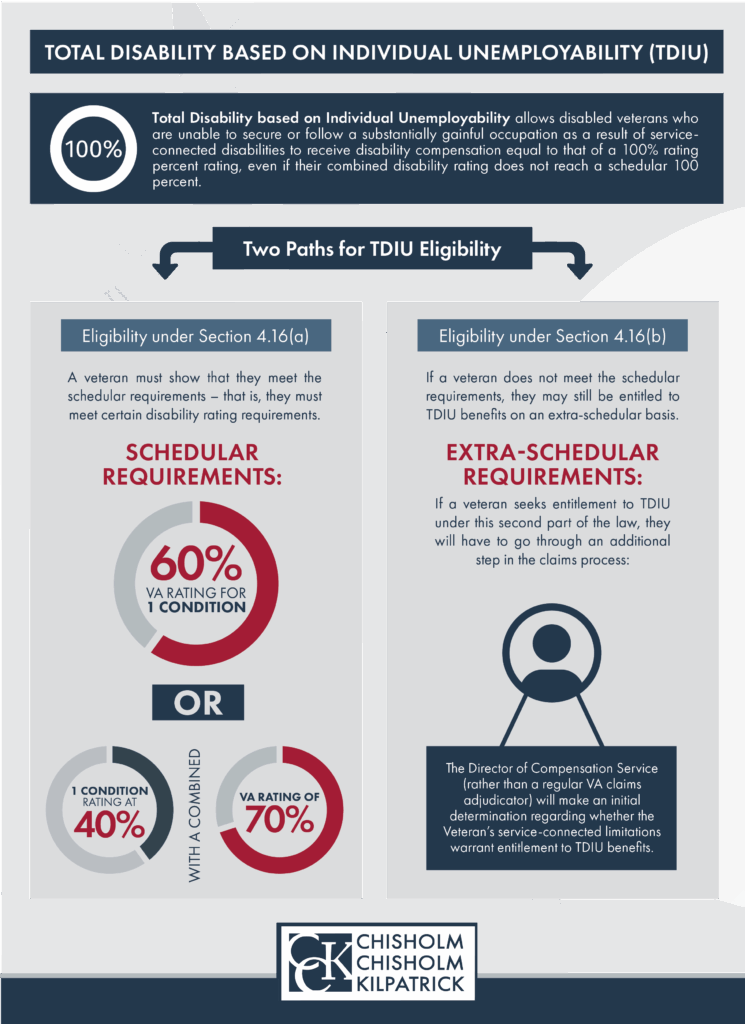
Many veterans qualify for TDIU without realizing it, when disabilities prevent consistent, competitive employment. Accredited representatives can help assess whether employment meets VA’s definition of substantially gainful work.
Myth 3: “A veteran must be completely incapacitated to receive a 100 percent rating.”
A 100 percent VA disability rating does not require a veteran to be bedridden or unable to function in daily life. Instead, it reflects the degree to which service-connected conditions impair earning capacity, based on criteria set forth in VA’s Schedule for Rating Disabilities.
Some 100 percent ratings are assigned based on specific medical benchmarks, such as severe respiratory impairment, active cancer diagnoses, or the combined effect of multiple disabilities. Others result from the cumulative impact of orthopedic, neurological, or mental health conditions.
If the medical evidence meets the rating criteria, VA must award the rating—regardless of how the veteran personally labels the disability.
Myth 4: “VA benefits are only for combat or wartime injuries.”
Combat service is not required to qualify for VA disability benefits. VA recognizes service-connected conditions arising from both wartime and peacetime service.
Many claims stem from training accidents, repetitive physical stress, toxic or environmental exposures, or mental health conditions related to military duties. Injuries sustained during stateside service, non-combat deployments, and even certain reserve training are evaluated under the same legal standards.
If a condition began during service or was caused or aggravated by service, it may qualify, regardless of whether the veteran served in combat.
Myth 5: “Benefits should be saved for veterans who need them more.”
This belief is rooted in generosity, but it misunderstands how VA benefits work. Disability compensation is not a limited pool where one veteran’s award reduces another’s.
Congress has authorized VA benefits so that every qualified veteran may receive them. These benefits are not charity. They are part of a statutory system designed to compensate for service-related harm.
Using earned benefits does not take away from others. In fact, participation helps reinforce the importance of maintaining a strong and well-funded veteran support system.
Myth 6: “An other-than-honorable discharge means no benefits are available.”
Discharge status matters, but it is not always determinative. Some VA benefits, including certain health care services, may still be available depending on the circumstances of service.
Additionally, veterans may pursue discharge upgrades or request a VA character-of-service determination. In recent years, VA and review boards have been instructed to give special consideration to cases involving post-traumatic stress disorder, traumatic brain injury, or military sexual trauma.
An unfavorable discharge should never be assumed to be the end of the inquiry. A qualified legal opinion can clarify available options.
Myth 7: “A disability must be directly caused by service to be eligible for compensation.”
Direct service connection—where an in-service event causes a disability—is only one pathway to VA compensation. VA law also recognizes secondary service connection, which applies when a service-connected disability causes or worsens another condition.

Common examples include altered gait from a knee injury leading to back problems, post-traumatic stress contributing to sleep apnea or gastrointestinal conditions, or medication side effects causing additional impairments.
Secondary service connection is often overlooked, yet it plays a critical role in ensuring veterans receive compensation for the full scope of service-related health consequences.
A Final Word
VA benefits are not handouts. They are the result of legislative promises made to those who served, dating back to the earliest days of the country. Yet misinformation continues to discourage veterans from applying for benefits they have earned.
Veterans should not self-deny based on myths or assumptions. When questions arise, VA-accredited advocates, VA regulations, and publicly available guidance from VA and Congress provide clarity.
Understanding the law can make the difference between going without and receiving meaningful support for both veterans and their families.
Prepare for VA claims and appeals using the free tools and resources on CCK Law’s blog and YouTube channel. CCK Law is a nationally recognized, VA-accredited law firm focusing on VA disability appeals.