40 Percent VA Disability Ratings, Benefits, and Pay

CCK Law: Our Vital Role in Veterans Law
Earning a 40 percent VA disability rating from the Department of Veterans Affairs (VA) can open the door to several valuable benefits, including monthly financial compensation, access to VA medical services, job-related assistance, and other supportive programs.
In this article, you will learn about the specific benefits available with a 40 percent VA disability rating and explore practical tips to potentially increase your rating and maximize your compensation.
Highlights of this article include:
- Descriptions of the financial compensation that accompanies a 40 percent disability rating
- Explanations of additional benefits you can earn with a 40 percent rating
- Strategies to help you increase your rating and receive all VA compensation that you are eligible for
- And more
What Is a 40 Percent VA Disability Rating?
Disability ratings are percentages that VA assigns to disabled veterans to reflect the impact that a veteran’s service-connected condition has on their economic well-being. These ratings, which span from 0 percent to 100 percent, are determined by evaluating how often a veteran’s symptoms occur, how long they last, and how severe they are. Generally, a higher rating indicates a more serious disability.
A 40 percent VA disability rating, then, indicates that a veteran has lost about 40 percent of the average economic potential compared to a typical person.
Combined Ratings and “VA Math”
When a veteran has more than one service-connected condition, VA applies “VA math” to calculate their combined disability rating. This final combined percentage is what determines the amount of monthly compensation a veteran receives.

To be eligible for monthly VA disability payments, a veteran must have a combined rating of at least 10 percent.
For more information on VA math and how VA calculates total disability ratings, check out the 2025 VA Disability Calculator from CCK Law. This page provides both explanations for VA math as well as a calculator to help you estimate your combined disability rating.
40 Percent VA Disability Rating Pay
In 2025, veterans rated as 40 percent disabled received $774.16 per month from VA in tax-free compensation. This is a 2.5 percent increase from last year (2024), as per the 2025 cost-of-living adjustment from VA.
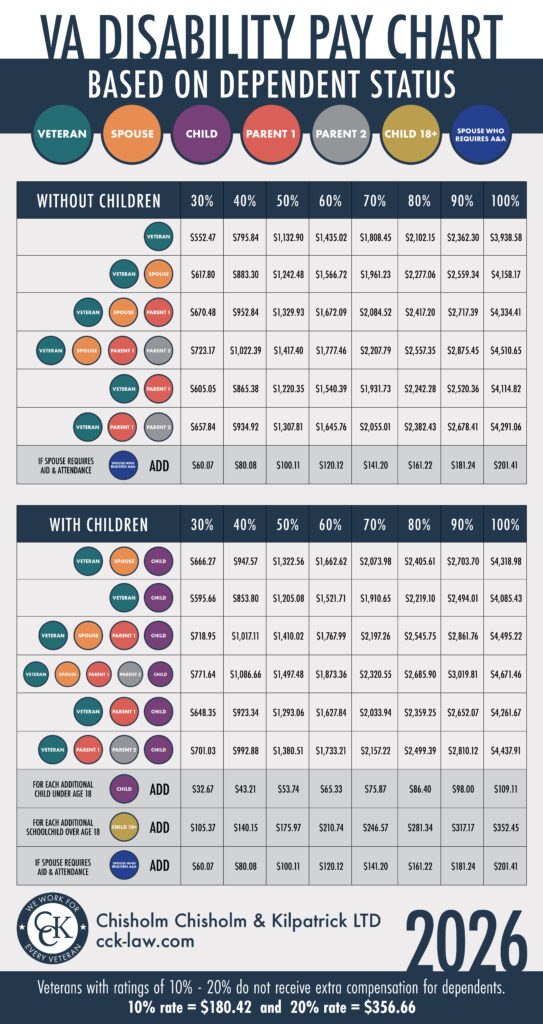
As of 2026, the VA disability rate benefit amounts are as follows:
- 0 percent disability rating: $0.00 per month
- 10 percent disability rating: $180.42 per month
- 20 percent disability rating: $356.66 per month
- 30 percent disability rating: $552.47 per month
- 40 percent disability rating: $795.84 per month
- 50 percent disability rating: $1,132.90 per month
- 60 percent disability rating: $1,435.02 per month
- 70 percent disability rating: $1,808.45 per month
- 80 percent disability rating: $2,102.15 per month
- 90 percent disability rating: $2,362.30 per month
- 100 percent disability rating: $3,938.58 per month
The 2026 Cost-of-Living Adjustment has been announced. Learn more about 2026 VA compensation.
Additional Compensation for Dependents
Veterans with VA ratings above 30 percent are eligible to receive additional monthly compensation for each qualifying dependent that they can claim. Eligible dependents can include:
- A spouse
- Dependent parents
- Children under 18
- Unmarried children between 18 and 23 who are enrolled in school
- Children with severe disabilities that began before age 18
The exact amount of additional compensation is based on both the veteran’s overall disability rating and the number and type of dependents included in their claim. For 2026, the rates will be as listed in the graphic below.
40 Percent VA Disability Benefits
In addition to monthly payments from VA, veterans rated as 40 percent disabled may also qualify for some of the following benefits.
VA Healthcare Benefits for 40 Percent Disabled Veterans
VA organizes veterans into eight different priority groups depending on the severity of their service-connected disabilities. Each group has a distinct number of perks and levels of copay.
Veterans who receive a 40 percent VA disability rating are placed in Priority Group Two, the second highest priority group. While those in this priority group still must pay copays for certain medications, they also receive many medical services free through VA, possibly including:
- Preventive care
- Inpatient (hospitalization) services
- Ancillary services
- Mental health care
- Geriatrics and extended care
- Medication/supplies
- Automotive adaptive equipment (under certain conditions)
- Home improvement and structural alteration grants (under certain conditions)
- Clothing allowance benefits (under certain conditions)
- Emergency care at a non-VA facility (under certain conditions)
- Foreign medical care (for service-connected and secondary conditions)
Note that access to some of these medical benefits may vary depending on the specific condition that grants you your 40 percent disability rating.
Vocational Readiness and Employment (VR&E)
Veterans with a 40 percent VA disability rating may qualify for the Vocational Readiness and Employment (VR&E) program. This benefit offers a wide range of career-related services, such as individualized employment counseling, vocational planning, and training programs.
It also includes job readiness support like résumé building, job search assistance, apprenticeships, on-the-job training, and unpaid work experiences to help veterans prepare for and secure meaningful employment.
Federal Hiring Preference
Qualified disabled veterans may be entitled to preference when applying for certain federal jobs. This hiring advantage typically adds extra points to a veteran’s application or civil service exam score, which can improve their ranking and boost their chances of being selected over non-veteran applicants.
Life Insurance for Disabled Veterans
Veterans’ Group Life Insurance (VGLI) is a low-cost life insurance option available to eligible former service members. Coverage amounts range from $10,000 to $500,000 and are typically based on the level of Servicemembers’ Group Life Insurance (SGLI) the veteran had in place at the time of separation from active duty.
Free Tax Preparation Services
Every year, thousands of veterans receive no-cost tax filing help through the IRS’s Volunteer Income Tax Assistance (VITA) and Tax Counseling for the Elderly (TCE) programs. These services are supported by local community organizations that train and certify volunteers. Once trained, these volunteers assist qualifying disabled veterans with preparing and e-filing their tax returns—all at no charge.
Training Programs Under the Post 9/11 GI Bill
Veterans who meet eligibility criteria for the Post-9/11 GI Bill can access a wide variety of educational and career training opportunities. These may include:
- Entrepreneurship programs
- Flight school training
- Undergraduate and graduate degree programs
- Reimbursement for licensing and certification exams
- On-the-job training
- Academic tutoring support
- Technical or vocational training
Travel Allowance for VA Healthcare
If you are traveling to a VA hospital or an authorized non-VA medical facility for care, VA may reimburse you for certain transportation expenses. Covered costs can include travel by car, train, plane, or taxi—as well as specific lodging and meal expenses incurred during the trip.
VA Home Loan Guarantee
To help veterans buy, refinance, or retain a home, VA provides a home loan guarantee benefit. This program works by backing loans from private lenders—such as banks or mortgage companies—allowing veterans to access more favorable mortgages. With VA backing, eligible veterans may benefit from lower interest rates, reduced down payments, and more accessible financing options.
State Benefits for 40 Percent Disabled Veterans
On top of federal benefits, veterans with a 40 percent VA disability rating may also qualify for extra perks provided by their state of residence. Depending on state-specific programs, these can include free or discounted access to public parks, hunting and fishing licenses, and property tax exemptions.
40 Percent VA Disability and Social Security
Veterans rated as 40 percent disabled by VA may also be eligible to receive Social Security benefits. There are two primary types: Social Security Disability Insurance (SSDI) and Supplemental Security Income (SSI).
SSDI is based solely on a person’s work history and earned income, which means VA disability compensation does not affect eligibility. However, to qualify for SSDI, a veteran must have a condition that is considered fully disabling.
In contrast, SSI is a need-based program, and VA disability payments are factored into the applicant’s total income. For 2025, the SSI income cap is set at $967 per month. Since the monthly VA compensation for a 40 percent disability rating is $774.16, some veterans may still qualify for SSI depending on their complete financial situation.
How to Increase a 40 Percent VA Disability Rating
If you believe your current 40 percent VA disability rating does not accurately reflect the severity of your condition, there are several options you have to pursue a higher rating:
- Appeal VA’s Decision: Veterans have up to one year from the date of VA’s initial decision to contest the rating they were assigned. This process includes three appeal options, or “lanes”: (1) Request a Higher-Level Review, (2) Submit a Supplemental Claim, or (3) File a Notice of Disagreement with the Board of Veterans’ Appeals.
- File for an Increased Rating: If your service-connected condition has significantly worsened since you first received your rating, you can submit a claim requesting a higher disability rating to reflect the increased severity.
- Seek Secondary Service Connection: If you have developed a new medical issue that was caused or aggravated by an existing service-connected condition, you can apply for secondary service connection. This has the bonus effect of potentially helping you raise your overall combined disability rating.
In addition to these options, a veteran might also decide to pursue total disability based on individual unemployability, or TDIU. Learn more below.
40 Percent Disability and Extraschedular TDIU
Total Disability based on Individual Unemployability (TDIU) allows veterans who are unable to work due to their service-connected conditions to receive compensation at the 100 percent disability rate—even if their actual disability rating is lower than 100 percent. To qualify, veterans must demonstrate that they are unable to secure or maintain substantially gainful employment as a result of their service-connected impairments.
While veterans with a combined rating of 40 percent typically do not meet the standard percentage requirements for TDIU under the schedular criteria, they may still be considered under extraschedular review.
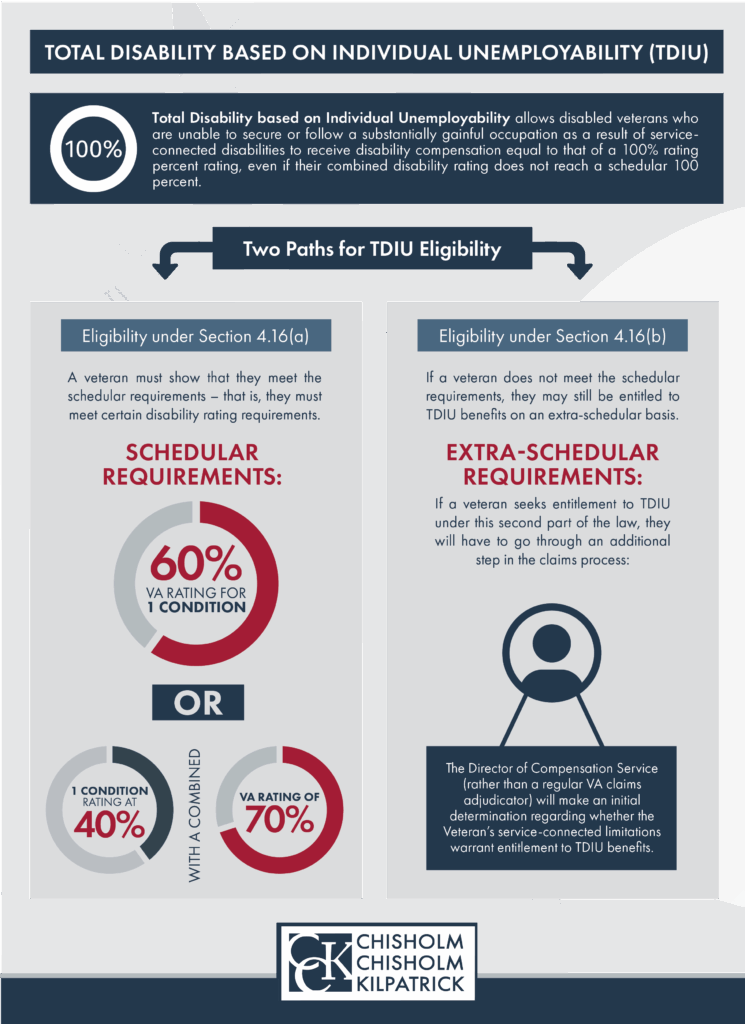
According to VA regulation 38 CFR § 4.16(b), VA must forward extraschedular TDIU claims to the Director of Compensation Service for further evaluation. The Director will assess various factors, including the veteran’s disabilities, work history, education, and vocational background, to determine whether TDIU is appropriate.
Note: With how complex TDIU can be to navigate, it is recommended that veterans seek out a VA-accredited attorney to help them during the appeals process. Contact the team at CCK Law for a free evaluation of your TDIU case.
Looking to Increase Your VA Rating?
If your VA disability claim has been denied or you believe you are entitled to a higher rating, the team at Chisholm Chisholm & Kilpatrick LTD may be able to help. With decades of experience representing veterans, CCK Law’s skilled attorneys and accredited claims agents are dedicated to securing the benefits veterans have earned.
To get started, call (800) 544-9144 or contact us online to schedule a free case evaluation.