







Receiving Both SSDI and VA Benefits
If you are a veteran receiving Social Security Disability Insurance (SSDI) compensation, you may also be eligible for additional income from the Department of Veterans Affairs (VA). Pursuing both types of compensation can provide you and your family with greater financial security.
SSDI and VA Benefits: Can I Get Both?
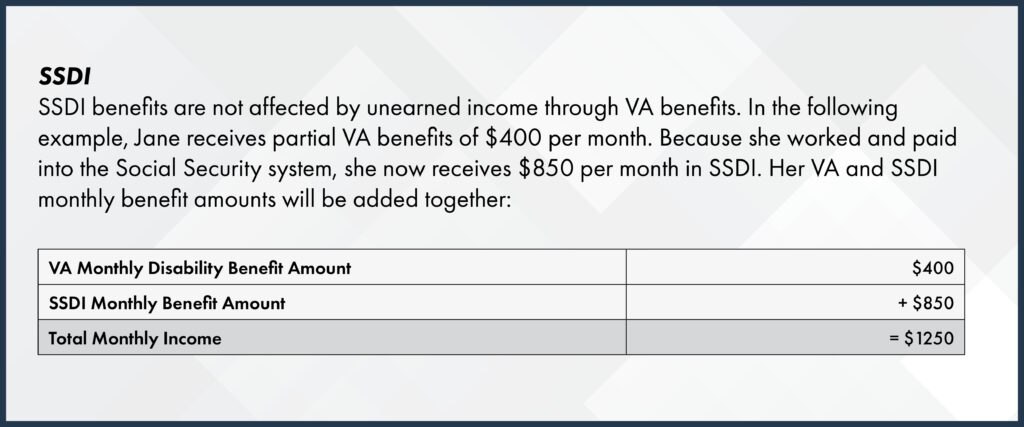
Many people believe that SSDI and VA benefits reduce (offset) each other, but luckily this is not the case. These programs are designed to complement each other, allowing you to receive the full amount from both with no offsets.
Key Differences Between SSDI and VA Disability Compensation
While it is possible to receive both SSDI and VA disability compensation with no offsets, they differ in important ways:
- SSDI is administered by the Social Security Administration (SSA) and VA disability compensation is administered through the Department of Veterans Affairs (VA).
- SSDI eligibility is based on work history and disability, while VA eligibility is based on service-connected disability.
- Benefit Calculation. SSDI benefits are based on past work earnings. VA benefits are calculated based on a disability rating from 0 to 100%.
- Disability Requirements. SSDI requires that a person must be completely disabled and unable to work. VA benefits are available to a person only be partially

Getting the Most Out of VA and SSDI Benefits: TDIU Benefits for Those Totally Disabled
While VA does not require total disability and the inability to work, if the veteran is not able to work greater income is available.
There is a VA benefit known as Total Disability based on Individual Unemployability, or TDIU. This program compensates veterans at the maximum benefit rate of $3,737.85 for service-connected disabilities that impair the ability to work.
If you’re a veteran receiving SSDI for service-connected conditions, you may also be eligible for TDIU.
Nyman Turkish, a national firm known for its experience and ability in handling Social Security Disability and Workers’ Compensation claims, is partnering with Chisholm Chisholm & Kilpatrick (CCK), a national leader in veterans disability law, to help veterans maximize the benefits to which they are entitled.
CCK has helped thousands of veterans receive their wrongly denied VA disability benefits. It can be a complicated process. There are strict eligibility criteria, extensive evidence requirements, and a lengthy appeals process if denied. CCK knows how to navigate these complexities.

What About SSI?
Supplemental Security Income (SSI), a needs-based program, does offset VA benefits—and vice versa. Likewise, if a person’s VA benefits are higher than their SSI benefits, then they may become disqualified from receiving the SSI benefits altogether.
While it is still possible to receive both SSI and VA disability compensation, reaching out to a Veterans Service Organization (VSO) can help you understand all your options for free.

Are You Receiving Both SSDI and VA?
Since 1999, CCK has been helping veterans receive the benefits they deserve for serving our country. If you are a veteran receiving SSDI and need help obtaining VA benefits too, then CCK may be able to help. Fill out an easy-to-complete online form for a free case evaluation at any time.