VA Disability for Crohn’s Disease

CCK Law: Our Vital Role in Veterans Law
Crohn’s disease is an inflammatory bowel disease (IBD) where the digestive tract becomes irritated or inflamed, causing intense discomfort, pain, and often severe medical issues. If you are a veteran suffering from Crohn’s disease because of service, then you may be eligible for a Crohn’s disease VA rating and the accompanying benefits it provides.
Highlights of this article include:
- The best steps to gaining VA disability for Crohn’s disease
- How the new VA diagnostic code for Crohn’s disease rates symptoms
- Methods to prove service connection for Crohn’s disease
- And more
What Is Crohn’s Disease?
Crohn’s disease is an inflammatory bowel disease (IBD) that predominantly impacts the large and small intestines. Crohn’s is characterized by the immune system attacking the lining of the GI tract, often leading to irritation in the bowels and the development of painful ulcers.
Symptoms of Crohn’s disease can include:
- Abdominal pain and cramping
- Diarrhea
- Rectal bleeding or blood in the stool
- Nausea and vomiting
- Constipation
- Fatigue
- Fever
- Weight loss or loss of appetite
- Ulcers in the gut
- Infections around the anus
Veterans with Crohn’s Disease
Although the exact cause of Crohn’s disease remains uncertain, research suggests a genetic predisposition may be involved—one that remains dormant until certain environmental factors activate the condition by straining the immune system.
Some possible triggers that could contribute to the onset of Crohn’s in veterans include:
- Prolonged psychological stress – Chronic stress can be deeply disruptive to the body’s immune and digestive systems. Due to the prolonged stress military service can induce, it’s possible that this could contribute to Crohn’s disease in veterans.
- Exposure to toxins, chemicals, or infections – Exposure to dangerous chemicals (like those encountered in burn pits) or pathogens during military service can leave lasting damage on the body. This can cause dysfunctions in gut or immune health, potentially leading to the onset of Crohn’s.
- Alcoholism – Studies show that alcoholism rates are substantially higher among veterans than in the civilian population, due to multiple factors. Over time, the damage from alcohol use disorder (AUD) can worsen the symptoms of diseases like Crohn’s.
Service Connection for Crohn’s Disease
To gain a VA rating for Crohn’s disease, you must establish that your Crohn’s is related to your military service. This is called service connection, and it comes in two forms: direct service connection and secondary service connection.
Direct Service Connection for Crohn’s Disease
A direct service connection means that your Crohn’s disease can be clearly linked to your time in the military—either as a condition that developed because of service or one that was worsened because of it.
To establish this type of connection, VA generally looks for three key elements:
- A formal diagnosis of Crohn’s disease—given by a qualified healthcare provider and confirmed with an endoscopy or radiologic study
- Evidence of an event or injury during service—this could be an illness, incident, or exposure that may have led to the onset of Crohn’s, ideally supported by military medical records
- A medical nexus—a professional medical opinion stating that your Crohn’s is “at least as likely as not” related to the service event in question
Meeting these criteria is crucial for VA to recognize your Crohn’s as deserving of monthly compensation from the government.
Secondary Service Connection for Crohn’s Disease
A secondary service connection applies when a veteran can show that their Crohn’s disease developed as a result of another condition that the VA has already acknowledged is service connected.
For instance, say that a veteran has developed an anxiety disorder because of a helicopter crash they experienced during their time in the military. This anxiety disorder has severely disrupted their daily life, and VA recognizes this, assigning them a VA rating for anxiety and providing monthly compensation.
Years later, a doctor determines that the veteran’s chronic worry and stress have caused dysfunction in their digestive system, culminating in the development of Crohn’s disease.
In this circumstance, the veteran could file a claim for Crohn’s disease on a secondary basis and be awarded disability for it. This is because the Crohn’s disease was caused by an anxiety disorder that VA has already determined is related to their military service.
Conditions Linked to Crohn’s Disease
Whether you are seeking to establish a secondary service connection for Crohn’s or believe your Crohn’s may have caused further conditions for which you can claim VA disability, it’s important to be aware of the many conditions found to be medically connected to Crohn’s.
If you have any of the following conditions and believe that Crohn’s could be either the cause or result of these other disorders, then seek out the advice of a medical professional to determine a possible link:
- Colorectal cancer
- Anemia
- Anxiety
- Depression
- Psoriasis or other skin conditions
- Arthritis or other joint pain
- Osteoporosis
- Heart disease
- Asthma or other respiratory conditions
- Inflammation in the eyes
VA Presumptions for Crohn’s Disease
Some conditions fall under VA’s presumptions of service connection, meaning veterans do not need to prove a direct link between their illness and military service.
If a veteran served in a designated location during a specific period and later develops a condition associated with that service, VA will presume the illness is service related and grant benefits accordingly.
As of 2025, Crohn’s disease is not currently a presumptive VA condition. This means that veterans will have to go through the usual steps of proving service connection for their disorder.
What Is the VA Disability Rating for Crohn’s Disease?
Starting in May 2024, the VA diagnostic code for Crohn’s disease is 7326 under 38 CFR § 4.114 – Ratings of the Digestive System. Veterans with Crohn’s disease will have their symptoms rated at 10 percent, 30 percent, 60 percent, or 100 percent, depending on severity.
The criteria for how VA rates Crohn’s disease are as follows:
- 100 percent – Severe inflammatory bowel disease that is unresponsive to treatment; and requires hospitalization at least once per year; and results in either an inability to work or is characterized by recurrent abdominal pain associated with at least two of the following: (1) six or more episodes per day of diarrhea, (2) six or more episodes per day of rectal bleeding, (3) recurrent episodes of rectal incontinence, or (4) recurrent abdominal distension
- 60 percent – Moderate inflammatory bowel disease that is managed on an outpatient basis with immunosuppressants or other biologic agents; and is characterized by recurrent abdominal pain, four to five daily episodes of diarrhea; and intermittent signs of toxicity such as fever, tachycardia, or anemia
- 30 percent – Mild to moderate inflammatory bowel disease that is managed with oral and topical agents (other than immunosuppressants or other biologic agents); and is characterized by recurrent abdominal pain with three or less daily episodes of diarrhea and minimal signs of toxicity such as fever, tachycardia, or anemia
- 10 percent – Minimal to mild symptomatic inflammatory bowel disease that is managed with oral or topical agents (other than immunosuppressants or other biologic agents); and is characterized by recurrent abdominal pain with three or less daily episodes of diarrhea and no signs of systemic toxicity
Notably, to receive VA disability for Crohn’s disease, your diagnosis must be confirmed by endoscopy or radiologic study.
What If I Have an Older Crohn’s Disease VA Rating?
Prior to May 2024, there was no specific VA diagnostic code for Crohn’s disease in the disability rating schedule. Instead, veterans with Crohn’s-related symptoms could be rated under analogous conditions, such as ulcerative colitis (DC 7323).
If you received a Crohn’s disease VA rating using this older system and now want a rating increase, be aware that VA won’t automatically reassess your case under the new standards. Instead, you must actively file for an increase to potentially receive the 30, 60, or 100 percent ratings.
However, if your Crohn’s-related disability claim was still pending as of May 19, 2024, when VA began implementing the updated criteria, then your case will be evaluated under both the previous and the revised standards. VA will then apply whichever version is more beneficial to your claim.
How Much Is VA Compensation for Crohn’s Disease?
The primary benefit for compensable (i.e., greater than zero percent) VA ratings is monthly, tax-free compensation. The amount of compensation depends on your VA rating for Crohn’s disease.
As of 2025, the VA disability rate benefit amounts are as follows:
- 0 percent disability rating: $0.00 per month
- 10 percent disability rating: $175.51 per month
- 20 percent disability rating: $346.95 per month
- 30 percent disability rating: $537.42 per month
- 40 percent disability rating: $774.16 per month
- 50 percent disability rating: $1,102.04 per month
- 60 percent disability rating: $1,395.93 per month
- 70 percent disability rating: $1,759.19 per month
- 80 percent disability rating: $2,044.89 per month
- 90 percent disability rating: $2,297.96 per month
- 100 percent disability rating: $3,831.30 per month
Total Disability Based on Individual Unemployability (TDIU) for Crohn’s Disease
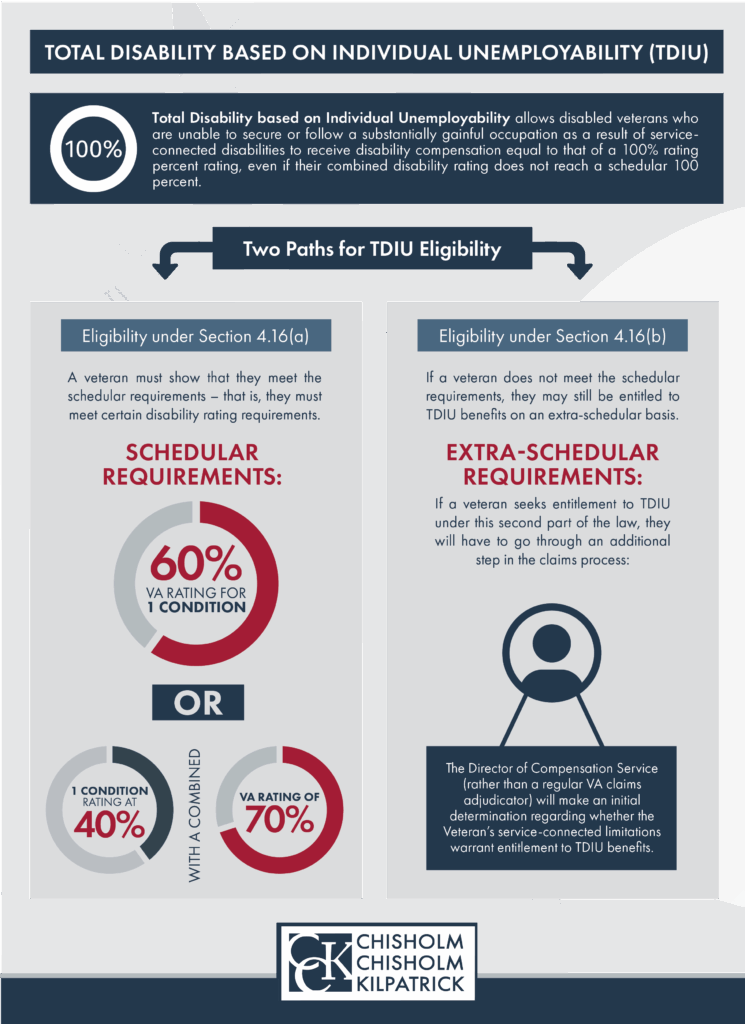
If your service-connected Crohn’s disease makes it difficult or impossible to maintain steady employment, you may qualify for Total Disability based on Individual Unemployability (TDIU). This VA benefit allows eligible veterans to receive compensation at the 100 percent disability rate—even if their current VA rating for Crohn’s is lower than 100 percent.
There are two main paths to qualifying for TDIU:
- Schedular TDIU: Veterans can be eligible under schedular guidelines if they meet one of these criteria:
- They have a single service-connected disability rated at 60 percent or more, or;
- They hold a combined disability rating of 70 percent or higher, with at least one condition rated at 40 percent or more.
- Extraschedular TDIU: Veterans who don’t meet the above rating thresholds might still receive TDIU through an “extraschedular” determination. In such cases, VA’s Director of Compensation Service may grant the benefit if the veteran’s Crohn’s disease significantly limits their ability to work, regardless of their assigned rating.
When considering TDIU for Crohn’s, VA evaluates how the condition affects a veteran’s employability. Veterans can also submit a separate TDIU application if they believe their symptoms prevent them from sustaining meaningful employment.
Disagree with a VA Decision About Your Crohn’s Disease? Call CCK Law
Filing an increased rating or appeal of your Crohn’s disease VA rating can be time-consuming and complex. However, with the help of a VA-accredited attorney, you gain access to a wealth of knowledge and experience to help you navigate this journey, identify related benefits, and receive the benefits you deserve as efficiently as possible.
Call CCK Law at (800) 544-9144 or contact us online for a free case evaluation.